Why Fire Alarm Commissioning Matters Before Your Building Opens
Fire alarm commissioning is the formal verification process used to confirm a newly installed or modified fire alarm system has been installed correctly and functions as intended before a building is occupied or handed over.
Here’s what you need to know at a glance:
- What it is: A structured, documented process that tests fire alarm components against the approved design intent
- When it happens: Typically after installation is complete and before final inspection or occupancy approval
- Who does it: Often a qualified engineer, commissioning authority, fire alarm professional, or approved contractor, depending on the project and AHJ
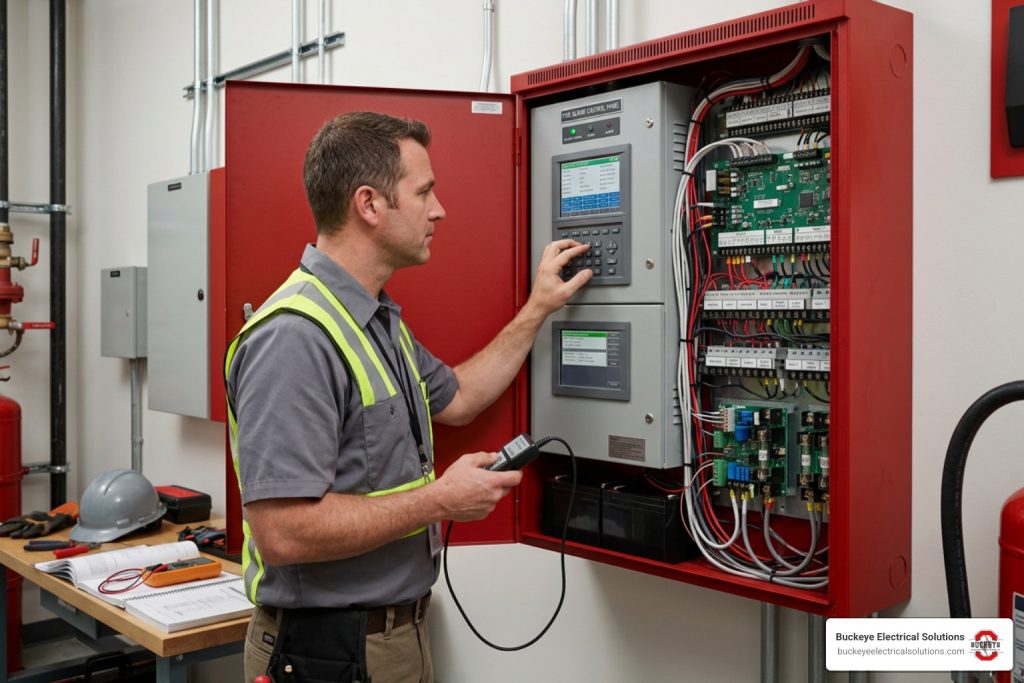
- What it covers: Control panels, initiating devices, notification appliances, and integrated systems such as elevators, HVAC, and access control where applicable
- What you get: Closeout documentation showing the system was inspected, tested, and approved for handover
- Why it matters: Commissioning helps catch installation, wiring, programming, and coordination issues before they delay approval or affect life safety performance
This is not the same as routine testing. Commissioning is typically a one-time quality assurance process for a new or modified system. Ongoing testing happens after handover on a schedule required by the applicable code, owner policy, and local AHJ.
I’m Aaron, owner of Buckeye Electrical Solutions — a licensed electrical contractor serving Northeast Ohio with experience across dozens of permitted commercial and residential projects, including fire alarm commissioning work on buildings ranging from small offices to large commercial spaces. Whether you’re starting from scratch or verifying an existing system, this guide walks you through what the process usually involves.
Relevant articles related to fire alarm commissioning:
What is Fire Alarm Commissioning and Why is it Essential?
At its core, fire alarm commissioning is a systematic quality assurance process. It bridges the gap between the physical installation of conduit, wires, and devices, and the life safety performance expected from the finished system.
When an electrical contractor finishes pulling wire and mounting devices, the system may be physically complete. However, without commissioning or acceptance testing, there may not be documented proof that the system operates as intended under the approved design.
Commissioning helps identify issues such as incorrect device addressing, wiring faults, programming errors, missed control sequences, and coordination problems with other building systems. It also gives building owners, insurers, and local authorities a clearer record of what was tested, what was corrected, and what was approved. For an in-depth look at how commissioning integrates with broader engineering standards, you can read more about Integrating commissioning, testing for fire alarm systems.
If you are a business owner or property manager in Northeast Ohio, professional commissioning is an important step toward protecting occupants, reducing liability, and avoiding preventable inspection delays. You can explore our professional fire alarm solutions to see how we help local properties stay safe and compliant.
The Difference Between Fire Alarm Testing and Commissioning
It is common for building owners to confuse fire alarm testing with commissioning, but they occur at different points in the system life cycle:
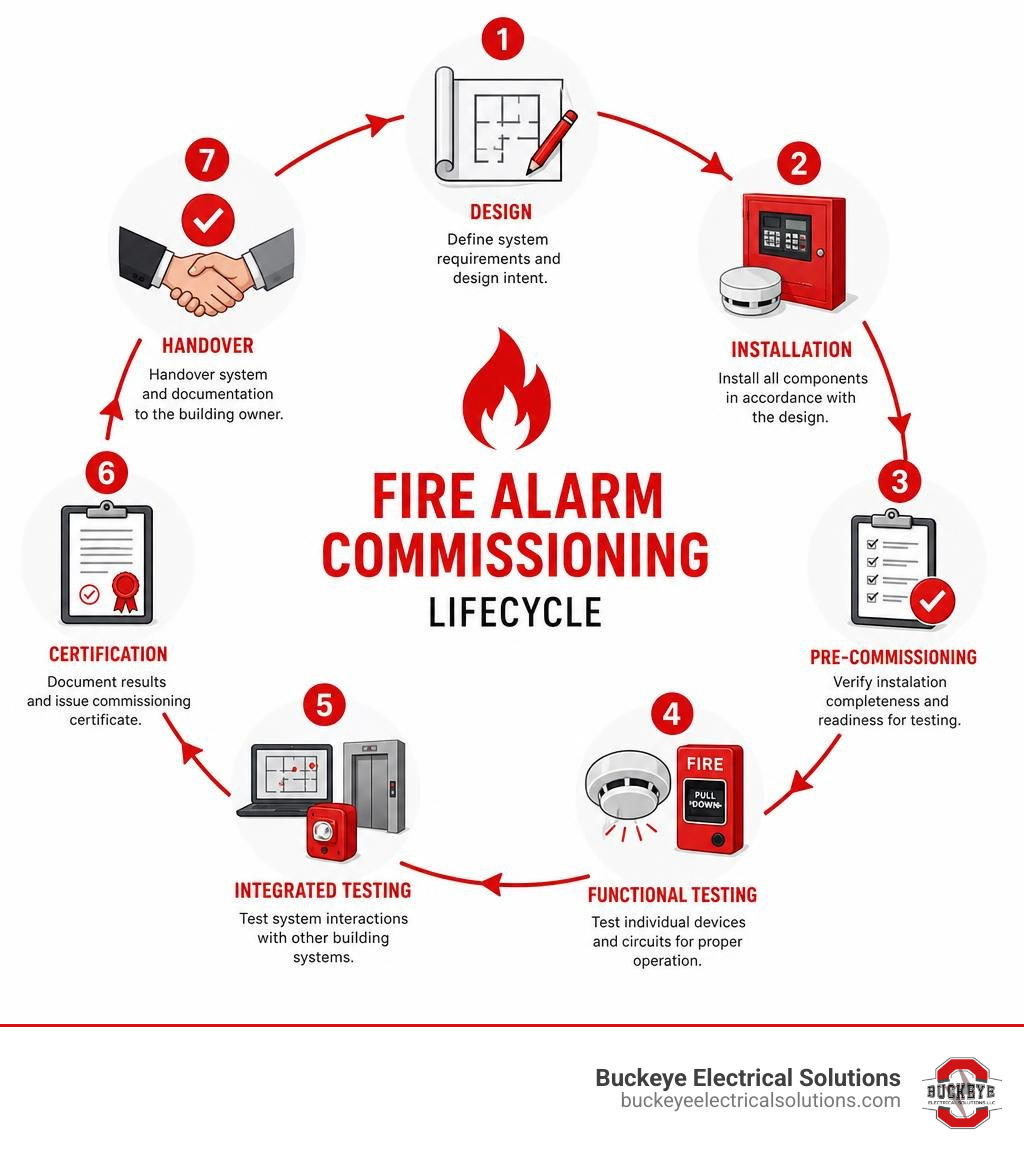
- Commissioning is usually a comprehensive verification and quality-assurance process for a new installation, major renovation, or system modification. It may include design review, installation checks, functional testing, integrated testing, documentation, and handover.
- Testing is the ongoing inspection, testing, and maintenance performed after the system has been placed in service. The frequency and scope depend on the applicable code edition, system type, owner requirements, and local AHJ.
While commissioning establishes the baseline functionality and compliance record, routine checks help keep the system operating properly. Property managers can learn more about scheduling regular inspections in our guide to quarterly fire alarm testing.
Is Fire Alarm Commissioning a Legal Requirement in Ohio?
In Ohio, fire alarm commissioning is best understood as part of the broader code compliance, acceptance testing, and AHJ approval process for new construction, renovations, and system modifications.
Ohio projects are reviewed under the applicable building and fire codes, which commonly reference NFPA 72 for fire alarm installation, inspection, testing, and documentation. Before a system is accepted for service or a building receives final approval, the AHJ may require acceptance testing, documentation, corrections to deficiencies, and in some cases witnessed functional testing. Electrical supply, grounding, and pathway requirements may also depend on the adopted electrical code edition and the project scope.
Because each Ohio jurisdiction has its own Authority Having Jurisdiction, expectations can vary between Cleveland, Akron, Canton, and surrounding Northeast Ohio communities. The local fire marshal, building official, or inspector determines what documentation and testing are required for approval. Failing to complete the required acceptance testing and documentation can delay final inspection, occupancy approval, or project closeout. You can read more about navigating these complex regulations in our article on demystifying fire alarm code compliance.
Roles and Responsibilities in the Commissioning Process
Successful fire alarm commissioning is a collaborative effort. It typically requires coordination among several stakeholders, each with distinct responsibilities throughout design, construction, testing, and handover. A breakdown of these roles is often detailed in the project’s sample fire alarm commissioning specifications.
- The Commissioning Agent (CxA / FCxA): Often an independent professional who leads the commissioning team, prepares or follows the commissioning plan, reviews design documents, and oversees functional or integrated testing.
- The Building Owner: Establishes project requirements, funds the commissioning process, and designates the personnel who will receive system training.
- The Design Team: Develops the design documents, fire alarm layouts, control sequences, and submittal requirements needed for code compliance.
- The Electrical / Fire Alarm Contractor: Installs the system according to the approved documents, performs pre-testing, corrects deficiencies, provides documentation, and assists during final testing.
Who Can Perform Fire Alarm Commissioning?
Because fire alarm systems are regulated life safety systems, commissioning should be performed or supervised by qualified professionals familiar with fire alarm codes, equipment, documentation, and local AHJ expectations.
Depending on the project, this may include a qualified commissioning agent, fire protection engineer, NICET-certified fire alarm professional, factory-authorized representative, or approved installing contractor. The exact qualifications expected can vary by owner requirements, project specifications, system complexity, and AHJ direction.
Working with experienced professionals helps keep the project aligned with technical requirements and local inspection expectations. If you are planning a commercial build or renovation, you can learn about our qualifications and process in our guide to commercial fire alarm installation.
Step-by-Step Fire Alarm Commissioning Procedure
Commissioning is not always a single event at the end of construction. On many projects, it begins during design and continues through installation, testing, documentation, and handover.
To help prevent missed items, the process typically follows a structured plan based on the approved design documents, manufacturer requirements, applicable codes, and AHJ expectations. For a technical overview, you can refer to this fire alarm commissioning procedure guide. Our guide on how to conduct fire alarm checks also provides helpful context for understanding device behavior.
Phase 1: Pre-Commissioning and Visual Inspection
Before final functional testing, the team usually performs a visual inspection to confirm the installation matches the approved drawings and applicable requirements.
Common activities during this phase include:
- Device Placement and Spacing Check: Verifying that smoke detectors, heat detectors, manual stations, and notification appliances are installed in the expected locations and at code-compliant heights, subject to AHJ approval.
- Clearance Verification: Checking that detectors are not blocked by architectural features, storage, construction materials, or mechanical equipment that could affect operation.
- Wiring and Conduit Inspection: Reviewing cable pathways, junction boxes, terminal connections, circuit separation, labeling, and any fire-rated or survivability requirements that apply to the project. For residential smoke alarms, proper physical installation is also critical; see our guide on smoke alarm installation and maintenance for residential best practices.
Phase 2: Functional Device and System Verification
Once the visual inspection is complete and the system is ready for testing, the commissioning team performs functional verification of devices and system responses. The required scope depends on the project documents, system type, applicable code, and AHJ.
- Smoke Detectors: Typically tested with an approved method that verifies smoke entry or sensor operation according to the manufacturer’s instructions.
- Heat Detectors: Tested using approved equipment and methods so the device can be verified without damage.
- Manual Pull Stations: Activated and reset to confirm the panel receives the correct signal.
- Notification Appliances: Horns, strobes, speakers, and other appliances are checked for proper activation, synchronization, audibility, and visibility where required.
- Battery and Power Supply Testing: Primary and secondary power are verified to confirm the system can operate as required by the applicable standards and project design.
If an older system is being decommissioned or upgraded, you can read our insights on navigating a fire alarm system replacement.
Phase 3: Integrated Testing and Cause-and-Effect Programming
A fire alarm system often interacts with other building systems. Integrated testing verifies that the fire alarm system communicates properly with connected equipment and that the intended cause-and-effect sequences occur.
For more on integrated life safety systems, refer to fire and life safety building commissioning.
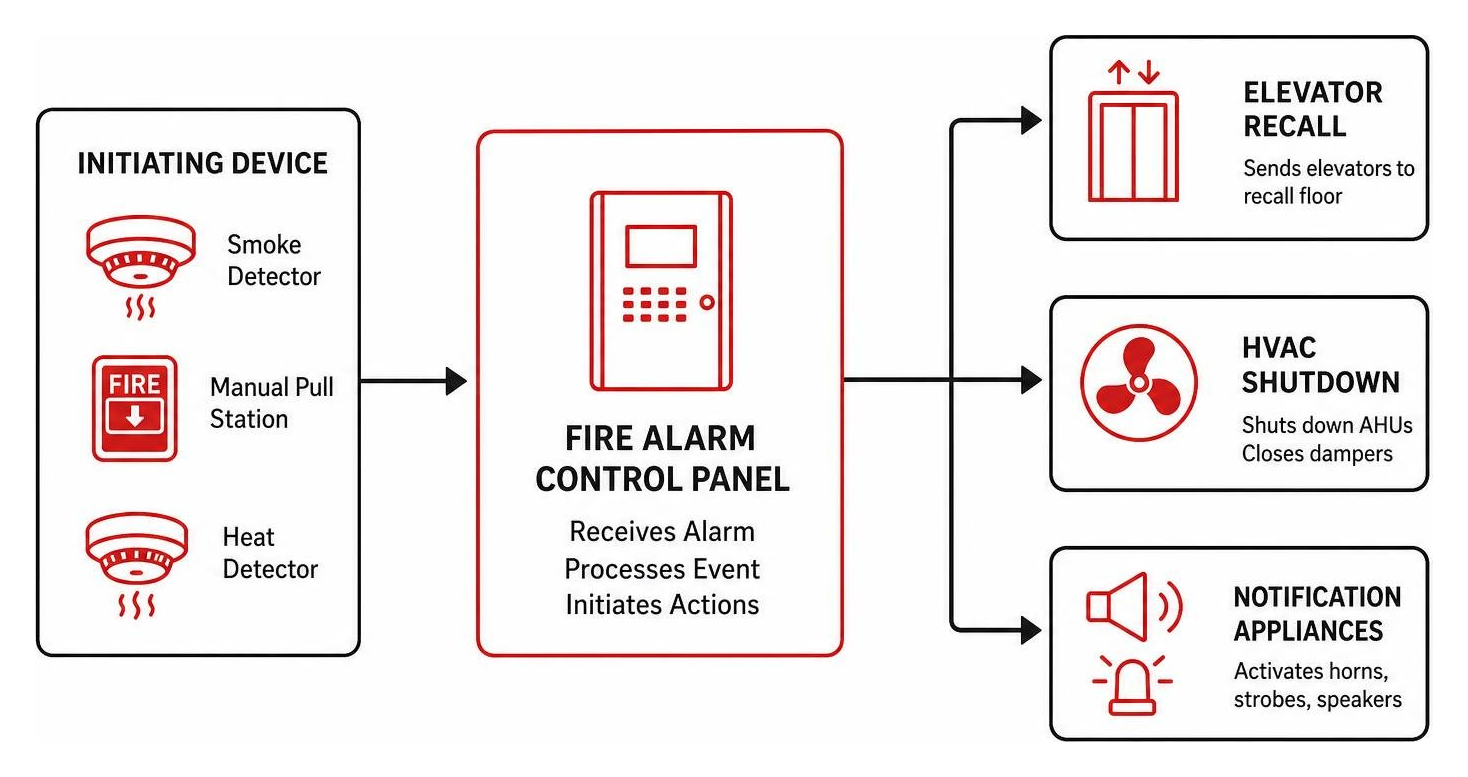
During this phase, the team may verify operations such as:
- Elevator Recall: Confirming that applicable elevator lobby, machine room, or hoistway devices trigger the required elevator response according to the approved sequence.
- HVAC and Duct Dampers: Confirming duct detectors, relays, fans, and dampers respond as designed to limit smoke movement where required.
- Access Control and Magnetic Doors: Confirming fire alarm activation releases door holders or fail-safe locks where required for egress.
- Sprinkler Monitoring: Confirming waterflow switches, tamper valves, and supervisory signals report correctly at the fire alarm control panel and monitoring service where applicable.
Documentation, Closeout Records, and Handling Deficiencies
A successful commissioning project is defined by its documentation. If a test is not documented, inspectors, owners, and insurance representatives may have no reliable way to confirm what was verified.
The closeout package often includes:
- NFPA 72 records or other required acceptance testing forms
- An approved input/output cause-and-effect matrix
- As-built or record drawings showing device locations and circuit routing
- Voltage drop and battery calculations where required
- Manufacturer operation and maintenance manuals
- Deficiency logs and correction records
During testing, deficiencies are common. Rather than halting the project completely, they are usually tracked, corrected, and re-tested. If you encounter issues with your system, you can refer to our guide on how to repair fire alarm systems for troubleshooting tips.
The following table outlines common commissioning deficiencies, likely causes, and typical priority levels:
| Deficiency | Likely Causes | Typical Priority Level |
|---|---|---|
| Detector fails to activate during approved testing | Device improperly addressed, dirty sensing chamber, or faulty terminal contact | High |
| Notification appliances out of synchronization | Incorrect sync module programming, mixed manufacturer devices, or wiring fault | High |
| Elevator does not respond as designed | Faulty relay module, incorrect cause-and-effect programming, or elevator controller wiring issue | High |
| Duct detector does not trigger the intended HVAC response | Auxiliary control relay wired incorrectly or fan control circuit bypassed | High |
| Trouble signal on initiating loop | Open circuit, ground fault, or loose terminal screw | Medium |
| Construction dust or paint contamination | Device covers missing or removed too early during construction | Medium |
| Auxiliary power supply issue | Breaker, GFCI, switched outlet, wiring, or power supply problem | Medium |
| Incorrect labeling on control panel circuits | Administrative oversight or late-stage circuit changes | Low |
What Documentation Is Provided After Fire Alarm Commissioning?
The final documentation package is the set of records provided at the end of commissioning or acceptance testing. The exact document name can vary by project, contractor, code edition, and AHJ. It may include a record of completion, acceptance testing form, commissioning report, deficiency resolution log, or other closeout records.
These records typically show what was tested, who performed the testing, what deficiencies were found, what corrections were made, and whether the system was accepted for handover. The package is commonly submitted to the local building department, fire marshal, owner, or general contractor as part of final approval and project closeout. For a broader look at getting your system ready for handover, check out our new fire alarm system guide.
What Happens If a Fault is Found During Commissioning?
Finding a fault or deficiency during commissioning is a normal part of the construction process. When a fault is identified, it should be documented on a deficiency log or resolution tracking form.
The responsible contractor then corrects the issue, whether that means replacing a faulty module, correcting wiring, adjusting programming, updating labels, or coordinating with another trade. Once the repair is made, the affected device or sequence should be re-tested.
Final approval is typically not granted until required deficiencies have been resolved or otherwise accepted by the AHJ. Ignoring these faults can lead to inspection delays, nuisance alarms, or unreliable system performance. To understand the impact of unresolved system issues, read our detailed article on fire alarm false alarms in Ohio.
Frequently Asked Questions About Fire Alarm Commissioning
How long does the fire alarm commissioning process typically take?
The duration depends on the size and complexity of the building, the number of devices, integrated systems, documentation requirements, and AHJ involvement.
- A small commercial office space may be completed in one day if the system is simple and pre-tested.
- A mid-sized facility such as a school or multi-story office building may require several days.
- Large industrial facilities, high-rise buildings, hospitals, or buildings with smoke control systems may require multiple coordinated testing sessions.
What spare parts should be kept on hand during commissioning day?
To prevent delays, the installation contractor should usually have a commissioning kit on hand. Recommended spares may include:
- Smoke detectors or detector bases used on the project
- Monitor modules and control modules
- Backup batteries where applicable
- Horn/strobes or other notification appliances in common candela ratings
- Manual pull stations or replacement parts
Does the local fire department need to be notified before commissioning?
Often, yes. Before functional testing that involves sounding alarms or activating monitoring signals, the contractor or building representative should coordinate with the monitoring company, building occupants, and any required local emergency contacts.
During commissioning, the system may transmit alarm, supervisory, or trouble signals to the monitoring center. If the system is not placed into the correct test status or dispatch procedures are not followed, emergency responders may be sent unnecessarily and the owner may face false alarm consequences depending on the local jurisdiction.
Conclusion
Fire alarm commissioning is a critical quality control step for a building’s life safety system. It helps confirm that devices are installed correctly, programmed properly, documented clearly, and coordinated with other building systems before final approval.
At Buckeye Electrical Solutions, we bring over 20 years of trusted electrical contracting experience to commercial and residential properties across Northeast Ohio. Our team is fully licensed, bonded, and insured, and we understand the importance of local code requirements and AHJ coordination.
Whether you need a new commercial fire alarm system installed and commissioned, or you need help resolving deficiencies on an existing system, we can help you move toward a smoother inspection and safer handover. Service pricing and estimates are subject to site conditions, project scope, and local AHJ requirements.
Ready to secure your building’s compliance and safety? Contact us today to discuss our comprehensive fire alarm services and schedule your consultation!