
Why Fire Alarm Code Compliance Matters for Every Ohio Building Owner
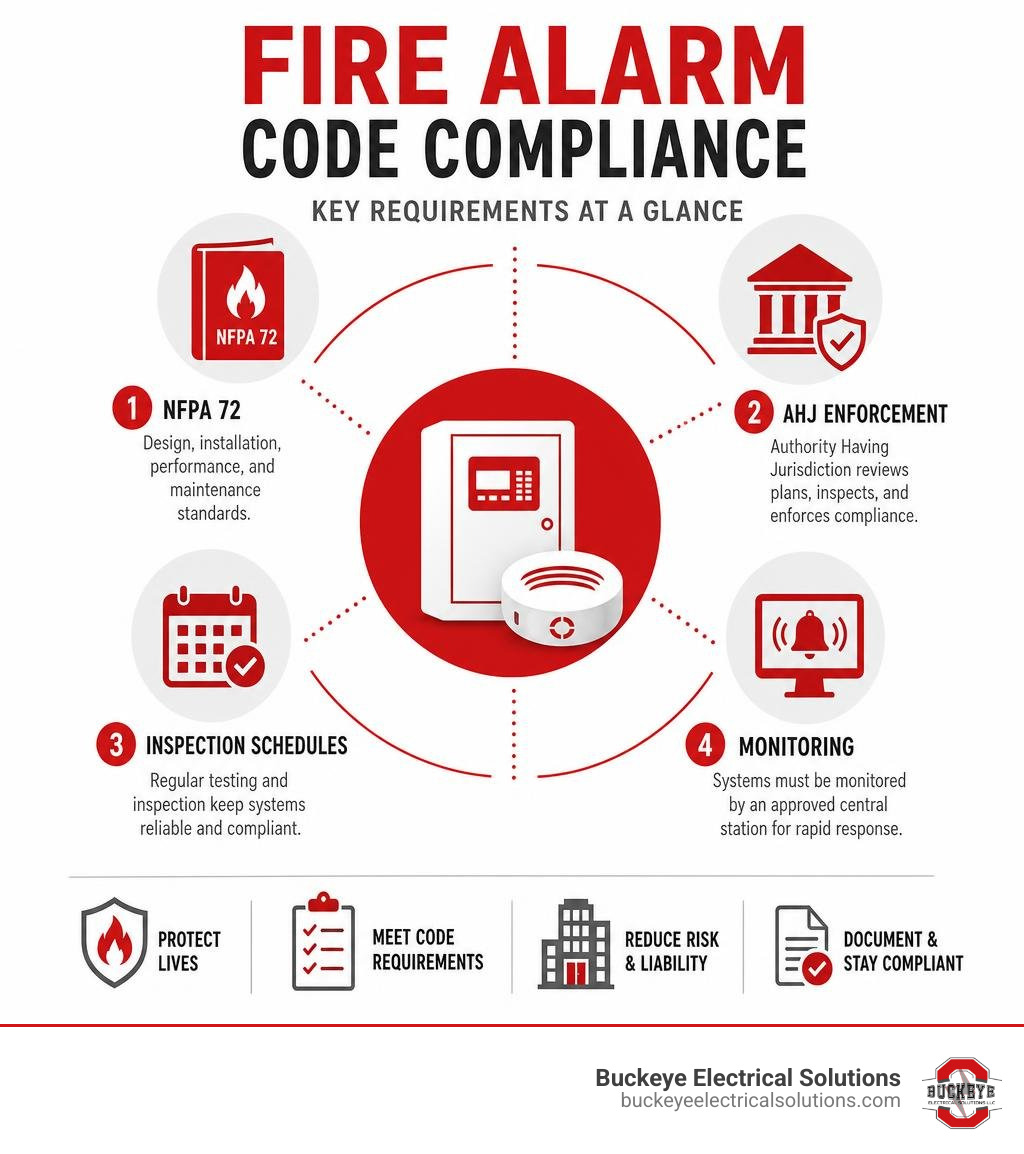
Fire alarm code compliance means meeting the applicable legal and technical requirements for your building, system type, and local Authority Having Jurisdiction (AHJ). National standards such as NFPA 72 often shape the technical requirements, but enforcement depends on Ohio rules, adopted codes, and local review.
In many cases, fire alarm code compliance may involve:
- Designing and installing the system according to applicable fire alarm codes and approved plans
- Using qualified designers, installers, and service providers when required by the project or AHJ
- Passing plan review and acceptance testing before occupancy or system approval
- Scheduling inspections and tests based on the system type and required components
- Keeping documentation for testing, maintenance, repairs, and AHJ review
- Providing approved monitoring when required for the occupancy or system design
These requirements are not universal checkboxes. They depend on the building use, local enforcement, adopted code edition, and the specific fire alarm equipment installed.
Fire codes can feel overwhelming. Between NFPA 72, the International Fire Code, NFPA 101, Ohio amendments, and local AHJ expectations, it can be hard to know exactly what applies to your building and your situation. Missed inspections, undocumented repairs, or unapproved system changes can create safety, permitting, insurance, and liability concerns.
I’m Aaron, owner of Buckeye Electrical Solutions LLC, and I’ve overseen dozens of permitted commercial and residential electrical projects across Northeast Ohio — including work that intersects with fire alarm code compliance, from dedicated circuits and panel upgrades that support alarm equipment to commercial installations that require local inspection. In the sections ahead, I’ll walk you through the major codes, Ohio-specific enforcement, and practical steps that help keep your building compliant.
Discover more about fire alarm code compliance:
The Core Standards of Fire Alarm Code Compliance
Achieving fire alarm code compliance requires understanding the national standards and local enforcement rules that apply to your building. For Ohio building owners, this usually means a combination of model codes, state rules, and AHJ interpretation.
The regulatory framework often includes:
- NFPA 72 (National Fire Alarm and Signaling Code): Addresses how fire alarm and signaling systems are designed, installed, tested, inspected, and maintained.
- The International Fire Code (IFC): Helps establish when fire alarm systems are required based on occupancy, use, size, height, and other conditions.
- NFPA 101 (Life Safety Code): Focuses on occupant protection, egress, notification, and life-safety performance.
In Ohio, these standards may be incorporated through the Ohio Fire Code, local enforcement practices, and project-specific plan review. Understanding how these requirements overlap is the first step toward securing Professional Fire Alarm Solutions for Your Business.
Understanding NFPA 72 and the National Fire Alarm and Signaling Code
The cornerstone of fire alarm code compliance is NFPA 72. Rather than deciding whether every building needs an alarm system, NFPA 72 focuses on how applicable fire alarm and signaling systems should function.
One important area is its classification of circuits and pathways. These classifications affect how signals travel between control panels, initiating devices, notification appliances, and communication equipment.
- Class A and Class B Pathways: Class B wiring can leave downstream devices affected by a single break, while Class A pathways provide a return path that can help maintain operation after certain faults.
- Class N Pathways: Class N pathways address Ethernet and IP-based infrastructure when listed equipment, monitoring, and redundancy requirements are met.
These pathway requirements help reduce the chance that one wiring or network fault compromises the system.
Comparing the International Fire Code (IFC) and NFPA 101
While NFPA 72 handles technical installation and performance details, the 2024 International Fire Code, NFPA 101, and local rules help determine when a fire alarm system is required.
The IFC categorizes buildings by occupancy groups and may require alarms based on factors such as:
- Occupant Load: Assembly spaces and similar uses may require more robust notification or voice communication.
- Fire Area: Building size or fire-rated areas can affect alarm and sprinkler requirements.
- Building Height: Multi-story and high-rise buildings often face additional alarm and emergency communication requirements.
NFPA 101 focuses on occupant life safety, including notification and egress during an emergency.
Ohio-Specific Regulations and Local AHJ Enforcement
While national codes provide the foundation, fire safety is enforced at the state and local levels. In Ohio, the State Fire Marshal establishes baseline rules, but the local Authority Having Jurisdiction (AHJ) interprets and enforces requirements for specific projects.
Whether you are seeking Code Compliance – City of Columbus, Ohio or operating in a smaller municipality, you need to satisfy local review and inspection requirements. Because local expectations can vary, reviewing Detailed Reviews of the Top 10 Fire Alarm Services in Northeast Ohio can help you find partners familiar with county or city requirements.
The Role of Local AHJs in Boardman Township and Beyond
The AHJ may review plans, issue permits, witness acceptance testing, conduct inspections, and approve occupancy or system operation. For example, the Fire Alarm Requirements – Boardman Township show how one local department handles submittals, acceptance testing, and annual inspection reporting.
Before installation begins, shop drawings may need to be submitted to the local building department or fire prevention bureau. Depending on the system and jurisdiction, these drawings can include:
- Device placement and spacing calculations
- Voltage drop and battery standby calculations
- Riser diagrams and input/output matrices
Without AHJ approval when required, a building may face permitting delays, failed inspections, or occupancy issues. Early coordination with a qualified contractor helps prevent those problems.
Requirements for System Design, Installation, and Maintenance
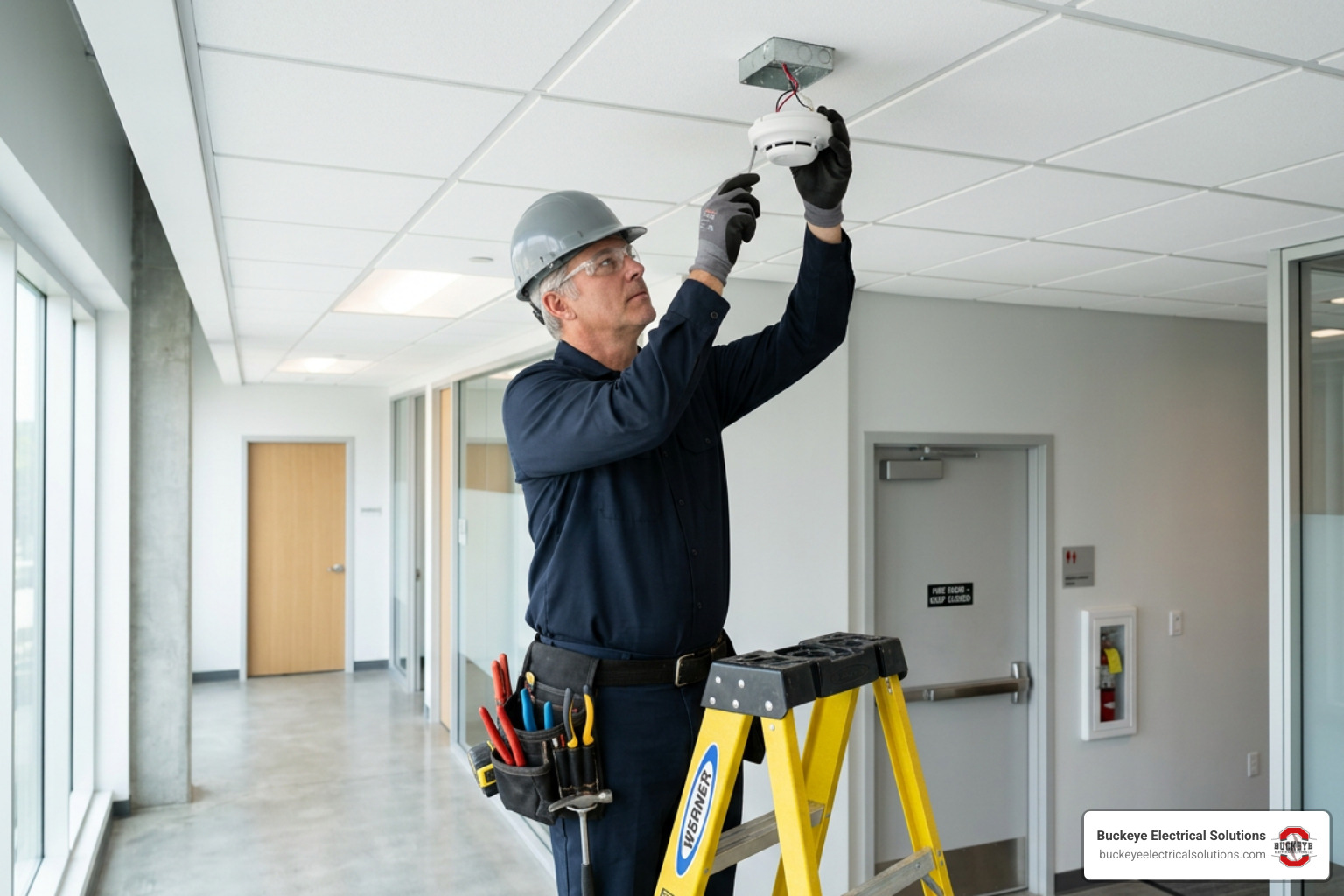
For fire alarm code compliance, your system should be designed and installed by qualified professionals familiar with the applicable codes, equipment listings, and local AHJ requirements. NICET certification is commonly recognized in the fire alarm field, and some projects may require a registered design professional or specific credential level.
Engineering specifications like SECTION 28 3100 FIRE DETECTION AND ALARM often require submittals prepared by a qualified fire alarm designer, NICET-certified technician, or Professional Engineer, depending on the project.
Once designed, installation must follow approved plans, manufacturer instructions, equipment listings, and applicable code requirements. Our guide on From Blueprint to Blaze Protection: Mastering Commercial Fire Alarm Installation explains the process in more detail. After installation, the contractor may need to provide NFPA 72 documentation, such as a Record of Completion, acceptance test records, and other AHJ-required paperwork. If you are starting from scratch, New Fire Alarm System? Here’s How to Get It Done Right can help you avoid delays.
Achieving Fire Alarm Code Compliance Through Regular Inspections
Installing the system is only part of compliance. Ongoing inspection, testing, and maintenance (ITM) depends on the system type, device types, occupancy, adopted code edition, and local AHJ requirements. Records should be kept in the format and location required by the applicable rules.
Common testing considerations include:
- Control equipment: Fire alarm control units and power supplies are typically checked for normal operation, trouble signals, supervisory signals, battery condition, and communication with monitoring equipment when present.
- Initiating devices: Smoke detectors, heat detectors, manual pull stations, sprinkler waterflow switches, and supervisory switches are tested according to the system design and applicable schedule.
- Notification appliances: Horns, strobes, speakers, and visible notification appliances are tested for operation, audibility, visibility, and synchronization where applicable.
- Emergency control functions: Elevator recall, HVAC shutdown, door release, and other interfaces should be tested when they are part of the approved system.
To keep your building safe and compliant, refer to our guides on How to Conduct Fire Alarm Checks: A Step-by-Step Safety Guide and Everything You Need to Know About Quarterly Fire Alarm Testing.
System Upgrades and Smoke Alarm Maintenance
As technology evolves and systems age, components can degrade. If your system is experiencing recurring ground faults, communication errors, or obsolete parts, it may be time to consult From Old to Bold: Navigating Fire Alarm System Replacement.
Smaller commercial spaces and residential units may use simpler smoke alarms or detection equipment, but they still require proper placement, power, testing, and replacement based on manufacturer instructions and applicable requirements. Learn more in From Chirps to Cheers: Mastering Smoke Alarm Installation and Maintenance.
System Interfaces and Emergency Functions
Modern fire alarm systems do not operate in a vacuum. To protect occupants, they must interface with several other building systems during an emergency. These connections are known as emergency control functions.
Key interfaces include:
- Sprinkler Monitoring: Water flow switches must trigger the fire alarm when water starts moving through the sprinkler pipes.
- Elevator Recall: Smoke detectors in elevator lobbies, shafts, or machine rooms must recall elevators to a primary exit floor to prevent occupants from trapping themselves.
- HVAC Shutdown: Duct smoke detectors must shut down air handling units to prevent smoke from circulating throughout the building.
- Door Release: Magnetic door holders must release fire barriers and smoke doors to contain the spread of fire.
The table below outlines these crucial interfaces, their likely causes of failure, and their priority level for maintenance.
| Emergency Interface Function | Likely Causes | Priority Level |
|---|---|---|
| Sprinkler Water Flow Monitoring | Faulty flow switch, corroded wiring, frozen pipes | High |
| Elevator Recall & Power Shutdown | Relay failure, programming errors, faulty shaft detectors | High |
| HVAC Damper & Fan Shutdown | Dirty duct detectors, failed control relays, actuator mechanical failure | Medium |
| Access Control & Door Release | Auxiliary power supply failure, incorrect fail-safe programming | High |
Monitoring Services and the Consequences of Non-Compliance
A fire alarm system may need to communicate with emergency responders or an approved supervising station, depending on the occupancy, system design, and local AHJ requirements.
Historically, many systems used a Digital Alarm Communicator Transmitter (DACT) connected to traditional telephone lines (POTS). As analog lines become less common, many systems now use cellular, IP-based, or dual-path communication equipment when approved for the application.
Failing to maintain an approved and properly documented system can lead to serious consequences. If you are curious about the financial investment required to keep your building secure, explore Budgeting for Beeps: How Much Does a Fire Alarm System Really Cost?. Pricing and estimates depend on local site conditions, equipment, monitoring needs, and AHJ requirements.
Avoiding Penalties and Ensuring Fire Alarm Code Compliance
The legal and financial risks of non-compliance can include:
- Insurance complications: Missing permits, poor documentation, or overdue inspections can complicate claims after a fire.
- Fines and citations: Local fire officials may issue correction notices, fines, or occupancy-related restrictions depending on the severity of the issue.
- False alarm costs: Poorly maintained systems can contribute to nuisance alarms, service calls, and municipal false alarm fees in some jurisdictions.
Frequently Asked Questions about Fire Alarm Compliance
What should I do if a fire alarm notification appliance or dedicated outlet has no voltage?
If a dedicated fire alarm outlet, control panel circuit, or notification appliance has no voltage, treat it as a priority service issue. Loss of normal power can affect system operation and may cause backup batteries to carry the load longer than intended.
A licensed electrician can evaluate the branch circuit, breaker, wiring, disconnecting means, grounding, and related equipment. Fire alarm control equipment is separate from general troubleshooting, so the repair should also account for the fire alarm manufacturer’s instructions, equipment listing, and any AHJ requirements.
How do NEC electrical requirements relate to fire alarm compliance?
The NEC governs electrical wiring methods, overcurrent protection, grounding, power circuits, and related installation details. Fire alarm compliance is a separate but connected issue: the alarm system must also satisfy applicable fire alarm codes, approved plans, manufacturer instructions, equipment listings, and local AHJ enforcement.
For example, the power circuit serving a fire alarm control unit must be installed correctly as electrical work, but whether the overall fire alarm system is accepted depends on the full system design, documentation, testing, monitoring, and local inspection process.
How often are commercial fire alarm systems required to be tested under NFPA 72?
Testing frequency depends on the system type, devices installed, adopted code edition, occupancy, and local AHJ requirements. A small system with basic initiating devices may have different obligations than a larger building with voice evacuation, sprinkler monitoring, elevator recall, HVAC shutdown, or multiple notification zones.
Rather than relying on a single generic schedule, building owners should maintain a system-specific inspection and testing plan based on the approved design, NFPA 72 tables where adopted, manufacturer instructions, and local enforcement expectations.
Conclusion
Achieving and maintaining fire alarm code compliance is not just about avoiding fines. It is about protecting employees, tenants, customers, and property while keeping your building aligned with applicable codes and local enforcement requirements.
Buckeye Electrical Solutions is a trusted electrical contractor in Northeast Ohio. With over 20 years of experience, we provide residential and commercial electrical repair, installation, and maintenance. Whether you need to troubleshoot a dedicated circuit for fire alarm equipment, upgrade electrical service to support life safety equipment, or coordinate wiring with applicable Ohio and local requirements, we can help.
If you are ready to secure your facility or need professional electrical support, explore our Fire Alarm Services and let our team help keep your building safe, compliant, and powered for success.