What Are Fire Alarm Checks — and Why Do They Matter?
Fire alarm checks are systematic inspections and tests performed on smoke alarms and fire alarm systems to confirm they will work when a real emergency happens.
Here is a quick overview of what fire alarm checks involve:
| Check Type | Who Performs It | How Often |
|---|---|---|
| Visual inspection (home smoke alarm) | Homeowner | Monthly |
| Functional test (press test button) | Homeowner | Monthly |
| Battery replacement | Homeowner | Annually (or per manufacturer) |
| Smoke alarm replacement | Homeowner | Every 10 years |
| Visual inspection (commercial system) | Trained facility staff | Monthly to semi-annually |
| Functional testing (commercial system) | Licensed professional | Quarterly to annually |
| Sensitivity testing (smoke detectors) | Licensed professional | Within 1 year of install, then every 2 years |
| Full system inspection | Licensed fire alarm contractor | Annually |
The stakes are high. Fire safety data consistently shows that many fire deaths occur in homes with no smoke alarms or alarms that are not working. That reality explains why routine fire alarm checks are not optional — they are one of the most important safety habits a homeowner or property manager can build.
Fires move fast. Smoke spreads even faster. A working, properly maintained alarm gives everyone inside the time they need to get out safely.
I’m Aaron Estep, owner of Buckeye Electrical Solutions LLC, a licensed residential and commercial electrical contractor serving Northeast Ohio. Through more than 60 permitted projects across the region — including smoke alarm installations, panel work, and commercial rewires — our team has seen how critical routine fire alarm checks are for protecting Ohio homes and businesses. Let’s walk through everything you need to know to keep your alarms working and your property code-conscious.
Why Regular Fire Alarm Checks Are Essential for Ohio Properties
When we talk about fire safety in Northeast Ohio, we are talking about protecting the people we love and the properties we have worked hard to build. Fire safety data consistently shows that many civilian fire deaths happen in home structure fires, and a significant share of fatal fires involve properties without working smoke alarms.
A home fire can go from a tiny spark to a fully engulfed room in less than three minutes. Because modern synthetic home furnishings can burn faster and hotter than many older natural materials, early warning is your best defense. Regular fire alarm checks help ensure that your early warning system remains active 24 hours a day, 365 days a year.
Beyond life safety, routine checks offer several practical benefits:
- Property Protection: Early detection allows local fire departments to respond and extinguish fires before they cause catastrophic structural damage.
- Nuisance Alarm Reduction: Dust, insects, and sensor drift can cause alarms to sound when there is no danger. Regular cleaning and testing prevent these annoying false alarms.
- Liability and Compliance: For business owners and landlords in Ohio, maintaining functional fire alarms is a legal requirement. Failure to do so can result in steep fines, voided insurance policies, and severe legal liability.
To keep your home safe, we recommend reviewing our comprehensive guide on smoke alarm installation and maintenance to understand the foundational steps of setting up a reliable home defense system.
NFPA 72 Standards and Ohio Inspection Considerations
In Ohio, commercial fire protection systems are governed by the Ohio Fire Code (OFC), which heavily adopts the standards set by the National Fire Protection Association (NFPA). Specifically, NFPA 72 (National Fire Alarm and Signaling Code) outlines the strict legal requirements for the inspection, testing, and maintenance of fire alarm systems.
Building owners often make the mistake of treating fire safety compliance as a single annual event. However, NFPA 72 establishes a tiered schedule of visual inspections and functional tests that must be performed throughout the year. The local Authority Having Jurisdiction (AHJ)—such as your local Ohio city or township fire inspector—has the final say on compliance and will require detailed documentation proving these intervals were met.
For a deeper dive into the specific schedules required for commercial buildings, you can read about quarterly fire alarm testing to see how these mid-year checks keep commercial systems operating reliably. You can also review the detailed breakdown of NFPA 72 requirements on this guide to NFPA 72 Fire Alarm Inspection Requirements | Up To Code .
Monthly and Quarterly Fire Alarm Checks
Monthly and quarterly checks are primarily visual and basic functional evaluations designed to catch obvious system failures before they compromise building safety.
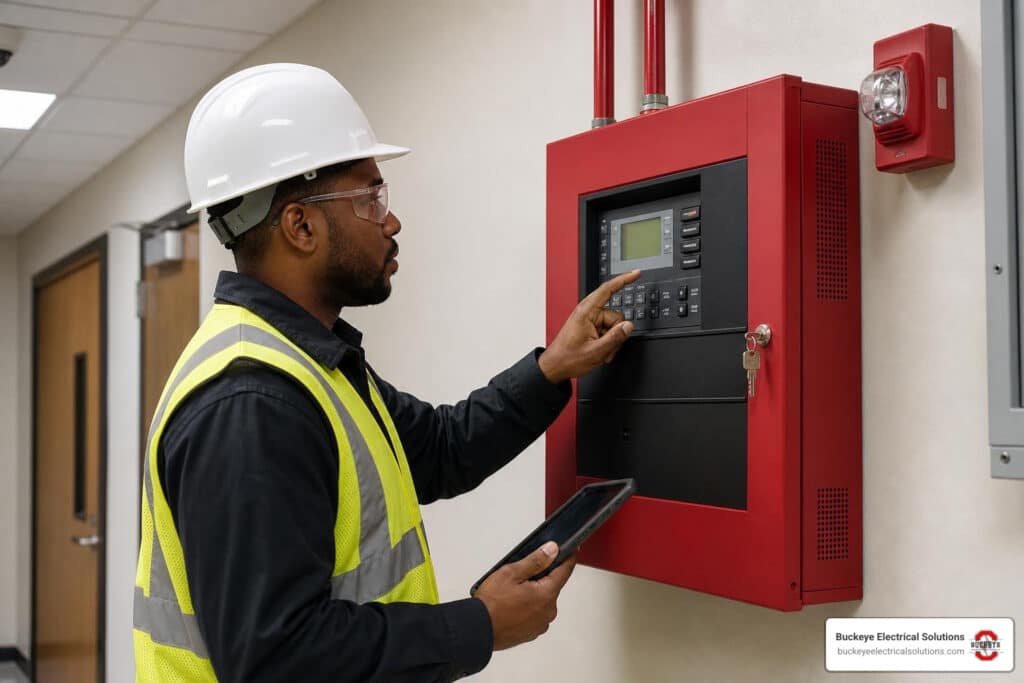
- Monthly Visual Inspections: Facility managers or trained maintenance staff can perform these checks. Walk through the building and verify that the Fire Alarm Control Panel (FACP) shows a “normal” status with no active trouble or supervisory lights. Ensure that all manual pull stations, smoke detectors, and notification appliances (strobes and horns) are clean, unobstructed, and physically undamaged.
- Quarterly Functional Tests: These are more technical and often require a qualified professional. They include testing waterflow alarm devices (on sprinklered properties) and supervisory signal-initiating devices (such as valve tamper switches). The technician must verify that opening a valve or simulating water flow triggers the appropriate signal at the main panel within 90 seconds.
- Documentation: Every visual check and quarterly test must be logged. If any trouble signals or physical damage are observed, a licensed fire alarm professional should be contacted immediately to repair the system.
To understand how these smaller intervals fit into the broader compliance picture, take a look at How Often Should Fire Alarms Be Inspected? 4 Key Intervals.
Semi-Annual and Annual Fire Alarm Checks
Semi-annual and annual inspections are comprehensive, highly technical processes that require specialized testing equipment and certified technicians.
- Semi-Annual Inspections: These focus on testing the system’s secondary power supplies. Technicians perform battery visual inspections and load tests to ensure the backup batteries can support the system for a minimum of 24 hours in standby mode, plus at least 5 minutes in full alarm.
- Annual Full-System Inspections: During an annual check, 100% of the system’s initiating devices—including smoke detectors, heat detectors, duct detectors, and manual pull stations—must be functionally tested. The technician must also verify that all audible and visual notification appliances activate correctly and that the central monitoring station receives the alarm signals instantly.
- Sensitivity Testing: Under NFPA 72, smoke detector sensitivity testing must occur within one year of installation and every alternate year thereafter. This test measures whether the sensing chamber responds within its listed range (typically 0.5% to 4.0% obscuration per foot). If a detector drifts out of its calibration range, it can cause false alarms or fail to detect a real fire.
To assist facility managers in preparing for these rigorous audits, we recommend downloading a Fire Alarm System Inspection Checklist | Free Download | Ecesis or utilizing the Fire Alarm System Annual Inspection and Te [FREE] | POPProbe to ensure no component is overlooked.
Step-by-Step Guide to Testing and Maintaining Smoke Alarms
For homeowners, conducting regular fire alarm checks is simple, fast, and does not require complex tools. By following this step-by-step monthly routine, you can ensure your family remains protected:
- Alert the Household: Before you begin, let everyone in the house know you are testing the alarms so no one is frightened by the loud siren.
- Station an Assistant: If possible, have someone stand in the furthest room or level of the house to verify that the alarm is clearly audible throughout the entire living space.
- Press and Hold the Test Button: Press and hold the test button on the face of the smoke alarm. It may take a few seconds to sound. You should hear a loud, piercing siren. If the sound is weak, muffled, or non-existent, the battery or the alarm itself must be replaced immediately.
- Clean the Unit: Use a soft brush attachment on your vacuum cleaner or a can of compressed air to gently remove dust, cobwebs, and debris from the vents around the alarm. Dust accumulation is a primary cause of sensor failure and nuisance tripping.
- Check the Expiration Date: Twist the alarm off its mounting bracket and look at the back of the unit. You will find a manufacture date or an expiration date. If the alarm is 10 years old or older, it must be replaced—even if it still makes a sound when you press the test button.
If your alarm is chirping or behaving erratically, you can discover how to repair fire alarms with 5 easy changes to resolve common residential issues quickly.
Proper Placement and Installation Guidelines
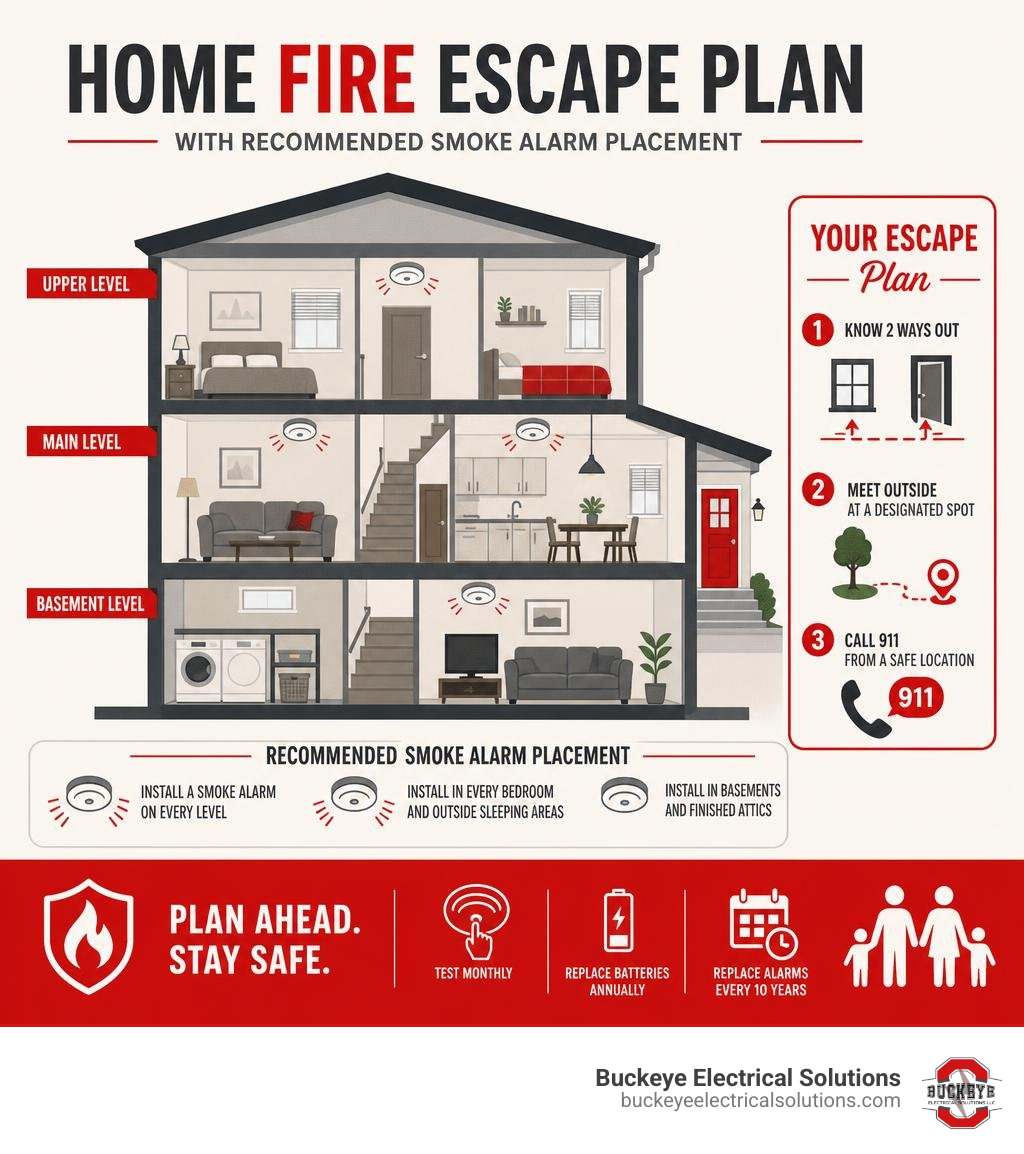
Where you place your smoke alarms is just as important as how often you test them. To ensure optimal protection, alarms should be installed:
- Inside every bedroom or sleeping area.
- Outside each separate sleeping area (such as in the hallway leading to the bedrooms).
- On every level of the home, including the basement.
When mounting alarms, place them high on walls or on the ceiling. Avoid mounting them in “dead-air” spaces—such as within 4 inches of a wall-to-ceiling corner—where smoke may not easily circulate.
+-------------------------------------------------------------+
| CEILING PLACEMENT |
| |
| [OK] Mount on ceiling (at least 4" from wall) |
| / |
| v |
|  +-------------------------------------------------------+  |
|  | |  |
|  |  X <-- [DEAD AIR SPACE] (Do not mount within 4") |  |
|  | |  |
|  | |  |
|  |  [OK] Mount on wall (4" to 12" down from ceiling) |  |
|  | |  |
+--+-------------------------------------------------------+--+
In Ohio, residential electrical installations must comply with the state's recent electrical codes. Ohio's 2023 NEC adoption includes expanded GFCI (Ground Fault Circuit Interrupter) requirements in several locations. However, specific rules—such as those governing kitchens—are situational rather than universal.
When planning a smoke alarm system, it is vital to coordinate power sources. Modern building codes require residential smoke alarms to be hardwired into the home’s electrical system with a battery backup, and they must be interconnected. This means that if one alarm detects smoke in the basement, every alarm throughout the house sounds simultaneously.
Because hardwired systems interface directly with your home's electrical wiring, they must be safely integrated into your electrical panel without overloading circuits or conflicting with specialized safety devices.
Managing Nuisance Alarms and Cooking Steam
We have all been there: you sear a steak or take a hot shower, and suddenly the smoke alarm is screaming. These are known as nuisance alarms.
The type of sensor inside your alarm plays a big role in how it reacts to everyday activities:
- Ionization Sensors: These are highly sensitive to small particles produced by fast-flaming fires (like grease fires or burning paper). However, they are also highly susceptible to cooking vapors and steam, making them poor choices for locations near kitchens or bathrooms.
- Photoelectric Sensors: These use a light beam to detect larger smoke particles produced by slow, smoldering fires (like a burning mattress or overheated wiring). They are much less likely to trigger from normal cooking steam or high humidity.
To manage nuisance alarms:
- Install photoelectric alarms near kitchens and bathrooms, keeping them at least 10 feet away from cooking appliances to prevent false triggers.
- Never remove the battery to silence a nuisance alarm. Instead, use the unit's "hush" button, open a window, or wave a towel near the unit to clear the air.
- If an alarm continues to trigger regularly without any obvious source of smoke or steam, it may indicate improper placement, dust buildup, aging internal sensors, or underlying electrical issues in hardwired systems.
Professional Fire Alarm Inspections: Costs, Compliance, and Licensing
While homeowners can easily test their own smoke detectors, commercial properties, multi-family apartment buildings, and healthcare facilities require professional inspections to maintain legal compliance.
In Ohio, individuals performing work on commercial fire protection systems must be certified. The Ohio State Fire Marshal regulates certifications, and technicians must pass specific exams to obtain their credentials. You can learn more about these professional requirements via the Ohio Fire Protection Certification - Ohio State Fire Marshal page or review the Fire Protection Individual Exam Application .
When hiring an electrical contractor or fire safety company, ensure their technicians hold minimum NICET (National Institute for Certification in Engineering Technologies) Level II certifications in Fire Alarm Systems. This helps confirm they have the training required to interpret NFPA 72 codes, identify system deficiencies, and provide the certified documentation required by insurance companies and local fire inspectors.
For business owners looking to install, upgrade, or inspect their commercial systems, we invite you to explore professional fire alarm solutions for businesses tailored to Northeast Ohio code requirements.
Understanding Inspection Costs and Documentation
The cost of a professional fire alarm inspection varies depending on the size of your facility, the complexity of the system, the total number of initiating and notification devices, and accessibility.
- Small Commercial Systems (Under 50 devices): Typically range from $300 to $1,000 annually.
- Mid-Sized Systems (50 to 200 devices): Typically range from $1,000 to $3,500 annually.
- Large or High-Rise Facilities (200+ devices): Can range from $7,000 to $15,000+ depending on complexity.
- Note on pricing: All service pricing or estimates are subject to change and dependent on local site conditions or specific AHJ requirements.
To help you budget for these essential services, you can read our detailed breakdown on how much a fire alarm system really costs. Additionally, keeping a structured Fire Protection System Maintenance Checklist helps track your system's components and prevent unexpected repair bills.
During a professional inspection, the technician will compile a detailed report. If any issues are found, they must be documented and addressed based on their severity. The table below outlines common electrical and fire alarm system issues, their likely causes, and their priority level for repairs:
| System Issue | likely causes | priority level |
|---|---|---|
| Fire alarm panel showing active "Trouble" light | Dead backup battery, broken circuit wire, or disconnected device | High |
| Frequent false alarms in commercial spaces | Dust contamination, sensor drift, or improper detector placement | Medium |
| Smoke detector fails to respond to functional test | Defective sensor chamber, expired unit, or internal electronic failure | Critical |
| Outlet has no voltage; could indicate breaker, GFCI, switch, or wiring issue | Tripped breaker, damaged GFCI device, or loose wire connection | High |
| Hardwired alarm chirping continuously | Low backup battery, aging unit, or improper wiring at the junction box | Medium |
| System ground fault warning on main panel | Damaged insulation on wiring, moisture in conduit, or possible bootleg ground | High |
Frequently Asked Questions about Fire Alarm Testing
How often should smoke alarms be tested at home?
Consistent with fire-safety guidance commonly used in Ohio, smoke alarms should be tested at least once a month using the test button on the unit. Additionally, replaceable 9-volt batteries should be changed once a year (unless the unit is powered by a sealed 10-year lithium battery). We recommend picking an easy-to-remember date, such as when you change your clocks for Daylight Saving Time, to perform battery replacements and conduct a family fire drill.
Do hardwired smoke alarms expire?
Yes. Many homeowners believe that because their alarms are hardwired into the home's electrical system, they never need to be replaced. However, the internal sensors in all smoke alarms degrade over time due to dust, humidity, and chemical exposure. Virtually all smoke alarms have a maximum lifespan of 10 years. After 10 years of continuous operation, the mechanical components are highly likely to fail. When replacing hardwired units, it is highly recommended to replace all interconnected units at the same time to ensure system compatibility.
Who should perform commercial fire alarm checks in Ohio?
While visual monthly checks can be performed by designated building staff, all quarterly, semi-annual, and annual functional tests must be completed by a certified fire protection professional or a licensed electrical contractor certified by the Ohio State Fire Marshal. This ensures all testing is done in compliance with NFPA 72 and that proper documentation is provided to satisfy local fire inspectors and insurance underwriters.
How can Ohio residents get free smoke alarm checks?
Many local fire departments across Northeast Ohio offer free smoke alarm assessments, battery replacements, and even free smoke alarm installations for qualifying residential properties. Additionally, the American Red Cross operates the Northern Ohio Home Fire Campaign , which provides free smoke alarm installations and home safety education to residents in need. You can contact your local fire department’s non-emergency line to ask about available community safety programs in your area.
Conclusion
Conducting regular fire alarm checks is one of the simplest yet most effective ways to protect your life, your family, and your investment. Whether you are a homeowner testing your smoke alarms on a monthly basis, or a business owner managing a complex commercial system, keeping these life-saving devices in top working order is a fundamental safety responsibility.
At Buckeye Electrical Solutions, we are proud to be a trusted, licensed electrical contractor serving our Northeast Ohio community. With over 20 years of experience, we provide high-quality residential and commercial electrical installation, repair, and maintenance. From proper smoke alarm integration to complex commercial panel upgrades, our team is known for exceptional service, code-conscious practices, and prompt project completion.
Don't wait for a chirping alarm or a surprise inspection to think about fire safety. Schedule professional fire alarm services today with our experienced team to keep your Ohio property safe, compliant, and secure.