
Why Commercial Fire Alarm Testing Is Required — and What It Actually Involves
Commercial fire alarm testing is the process of regularly inspecting, testing, and maintaining a building’s fire alarm system to make sure it works when it counts. Here’s a quick breakdown of what’s required:
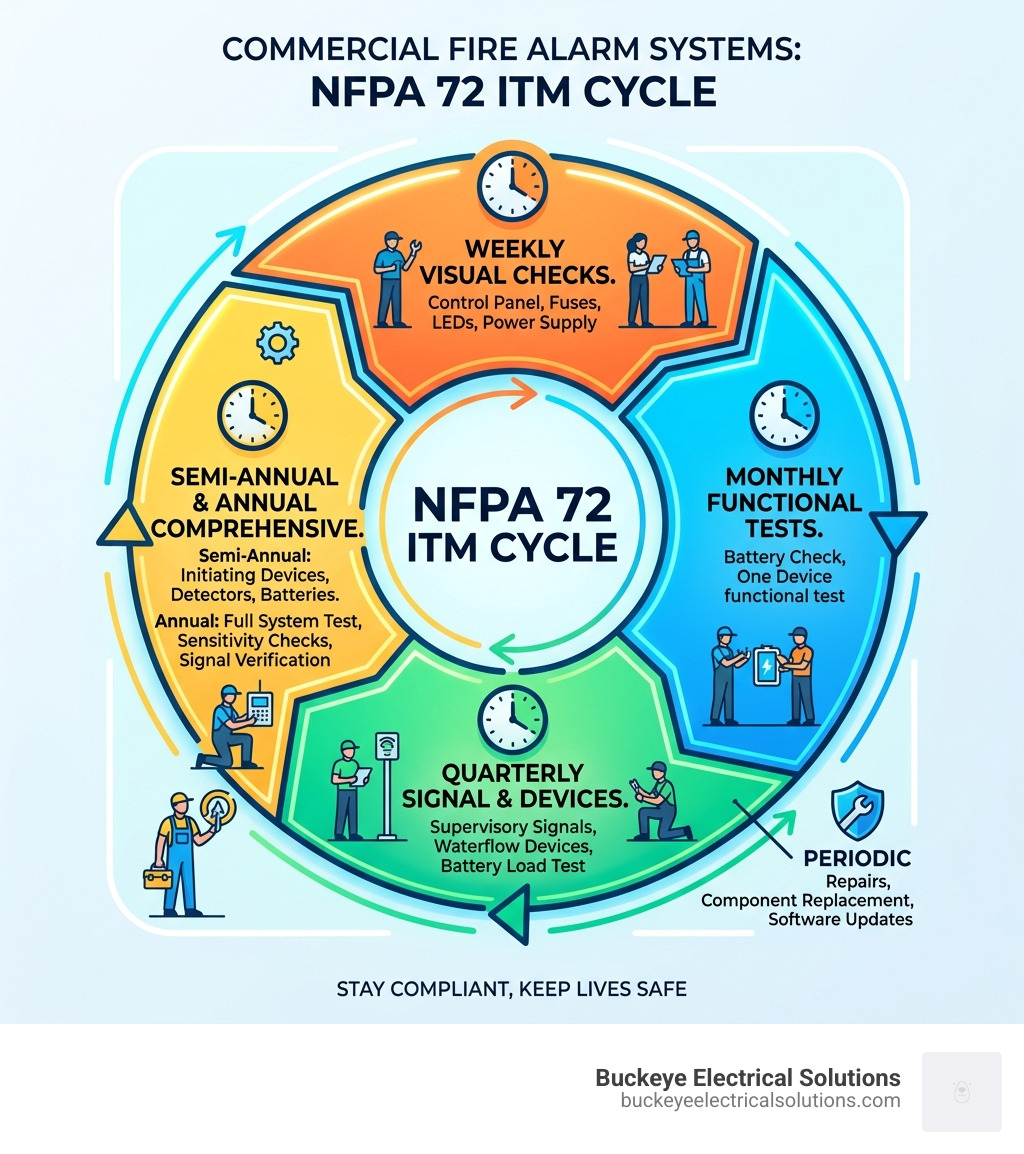
Minimum testing schedule under NFPA 72:
| Frequency | Who Performs It | What’s Covered |
|---|---|---|
| Weekly | Trained staff | Visual checks of control panel, fuses, LEDs, power supply |
| Monthly | Trained staff | Battery checks, one functional device test |
| Quarterly | Trained staff | Supervisory signals, waterflow devices, battery load tests |
| Semi-annual | Licensed technician | Initiating devices, radiant energy detectors, batteries |
| Annual | Licensed technician | Full system test, sensitivity checks, signal verification |
These aren’t optional. NFPA 72 — the National Fire Alarm and Signaling Code — sets the minimum standard across the U.S. Your local Authority Having Jurisdiction (AHJ) may require more frequent testing depending on your building type or occupancy.
Skipping tests puts lives at risk. It can also cost you your Certificate of Occupancy, void your insurance, and expose you to legal liability.
Around 25% of smoke detectors fail each year — often due to dead batteries or sensor contamination. A system that looks fine on the wall may not actually work in an emergency. That’s exactly what regular testing is designed to catch.
I’m Aaron, owner of Buckeye Electrical Solutions LLC and a master electrician with hands-on experience overseeing permitted electrical and life safety projects across Northeast Ohio, including commercial fire alarm testing as part of broader building safety systems. In this guide, I’ll walk you through exactly what NFPA 72 requires, which tasks your staff can handle, and when you need a licensed professional on-site.
Basic Commercial fire alarm testing terms:
- Commercial fire alarm inspection
- Commercial fire alarm installation
- fire alarm service northeast ohio
Understanding NFPA 72 and Commercial fire alarm testing Standards

When we talk about fire safety in a business setting, we aren’t just making suggestions; we are following the law. The “Bible” of our industry is NFPA 72, the National Fire Alarm and Signaling Code. This massive document outlines how systems must be designed, installed, and—most importantly for you—maintained.
It is important to distinguish between the three pillars of system health:
- Inspection: This is a visual check. We are looking to see if the equipment looks like it’s in working order, isn’t covered in dust, and hasn’t been tampered with.
- Testing: This is the “rehearsal.” We actually activate devices to ensure they communicate with the control panel and trigger the proper alarms.
- Maintenance: This involves the actual work—cleaning sensors, replacing old batteries, or repairing frayed wiring—to keep the system running.
In Northeast Ohio, the local Authority Having Jurisdiction (AHJ)—usually your local fire marshal—has the final say. While NFPA 72 provides the baseline, the AHJ might require more frequent checks if you run a high-risk facility like a restaurant with open fryers or a manufacturing plant with combustible dust. Following these NFPA 72 testing and inspection requirements ensures you stay on the right side of the law.
Beyond just the fire alarm, keeping your entire facility’s electrical system in check is vital. Fire alarms are electrical systems, after all. You can learn more about general upkeep in our electrical maintenance checklist for facilities.
The Specifics of Quarterly Commercial fire alarm testing
Quarterly testing is the “middle child” of fire safety. It’s more involved than a weekly walk-through but less exhaustive than the annual “big dance.” According to NFPA 72, Chapter 14, quarterly testing focuses on components that are prone to environmental wear or mechanical failure.
Key components we focus on during quarterly intervals include:
- Supervisory Signals: Ensuring that if a valve is closed or a pump is disabled, the system actually notices and alerts the panel.
- Waterflow Devices: Testing the switches that trigger the alarm when water begins moving through your sprinkler pipes.
- Radiant Energy Detectors: Checking flame detectors for any obstructions or lens contamination.
- Battery Load Tests: We don’t just check if the battery is there; we perform a discharge test to ensure it can actually power the system during a blackout.
- Communication Equipment: Verifying that the Digital Alarm Communicator Transmitter (DACT) can still “call home” to the monitoring station.
| Requirement Type | Weekly | Monthly | Quarterly |
|---|---|---|---|
| Visual Inspection | Control units, fuses, LEDs | Batteries, CO detectors | Radiant energy sensors, waterflow |
| Functional Test | Engine-driven generators | 1 initiating device | Supervisory signals, DACT |
| Documentation | Log entry | Log entry | Detailed report |
Critical Components and Professional Inspection Protocols
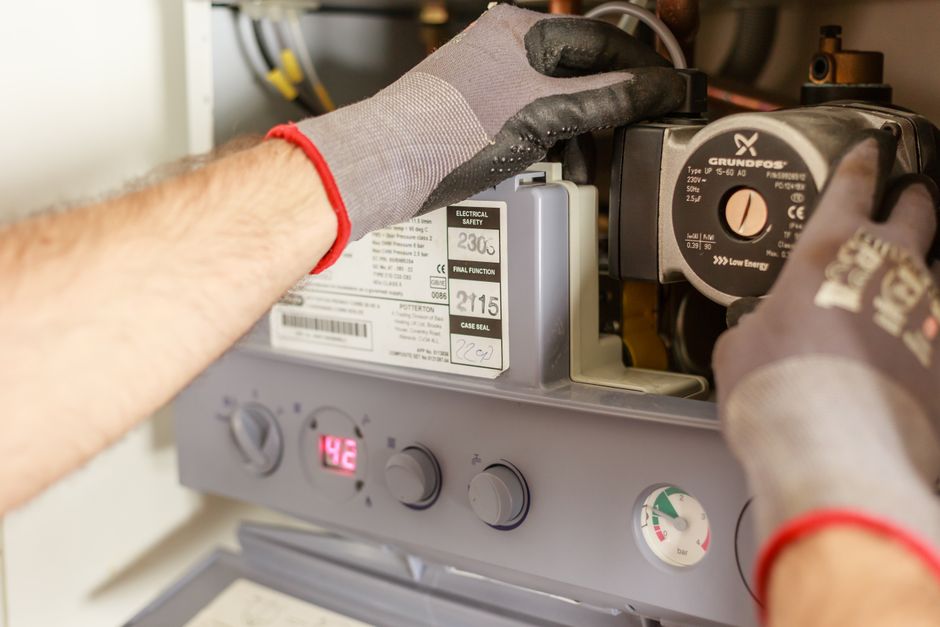
A fire alarm system is like a team where every member has a specific role. If the “brain” (the control panel) doesn’t get a signal from the “senses” (the detectors), the “voice” (the sirens and strobes) will stay silent. During commercial fire alarm testing, we look at:
- Control Panels: We check for “trouble” lights and ensure the software hasn’t glitched.
- Smoke Detectors: These need to be cleaned at least monthly and tested for sensitivity every two years (after the first year). If they are 10 years old, they need to be replaced—no exceptions.
- Manual Pull Stations: We activate these to ensure they aren’t jammed and that they trigger the alarm immediately.
- Heat Detectors: For non-restorable types, we check their age. They often need replacement after 15 years.
- Audible/Visual Appliances: We verify that sirens hit at least 75 dB at 10 feet and that strobes flash at the correct frequency (1-2 Hz).
Many of these tasks require specialized equipment, such as aerosol smoke simulators or calibrated sensitivity testers. This is why NICET certification is so important. It proves the technician has the technical “chops” to handle these complex systems. For a deeper dive into what we offer, check out our fire alarm services page.
Why Professional Commercial fire alarm testing Matters
You might wonder, “Can’t my janitorial staff just push the test button?” For residential smoke alarms, sure. For a commercial system, absolutely not.
Professional testing offers several layers of protection:
- Third-Party Objectivity: An outside pro doesn’t have a bias. We aren’t going to “pencil whip” a report just to save a few bucks on repairs. We tell you exactly what’s wrong.
- Liability Protection: If a fire occurs and your system fails, the first thing investigators look for is your testing log. Having a professional, dated report from a licensed contractor is your best defense.
- Insurance Mandates: Many insurance providers in Northeast Ohio will actually cancel your policy or deny a claim if you cannot prove regular professional testing.
- Specialized Tools: We use multimeters, dB meters, and sensitivity tools that most businesses don’t keep in their supply closet.
- Reacceptance Testing: If you’ve recently renovated your office or added a new wing, NFPA 72 requires “reacceptance testing” to ensure the new components play nice with the old ones.
Compliance, Documentation, and Risk Mitigation
In commercial fire alarm testing, if it isn’t written down, it didn’t happen. NFPA 72 and the Minnesota State Fire Code (which often mirrors Ohio’s standards) require you to keep records on-site for at least three years. We recommend keeping them for the life of the system.
A proper documentation folder should include:
- The original “Record of Completion.”
- All semi-annual and annual inspection reports.
- A log of any “trouble” signals and the subsequent repairs.
- Sensitivity test results for smoke detectors.
Failing to maintain these records can lead to more than just a stern talking-to from the fire marshal. In many jurisdictions, false alarms caused by poor maintenance can result in fines ranging from $100 to $500 per incident. Even worse, if your system is found to be non-compliant, the AHJ can revoke your Certificate of Occupancy, effectively shutting your business down until repairs are made.
Before we start any test, we always follow a strict notification protocol. We notify the monitoring company to put the system in “test mode” so we don’t accidentally dispatch the fire department. We also make sure the building occupants know a test is coming—nobody likes a surprise siren in the middle of a board meeting!
Streamlining Safety Strategy with Adaptify AI SEO Automation
While we focus on keeping your physical building safe, modern businesses also need to keep their digital presence healthy. This is where tools like Adaptify AI come into play. Adaptify AI is an advanced SEO automation platform designed to help companies like ours reach the people who need us most.
Think of Adaptify AI as the “control panel” for your digital marketing. It handles the heavy lifting of keyword research and content creation, helping to ensure that when a business owner in Northeast Ohio searches for “commercial fire alarm testing,” they find expert advice.
The platform provides:
- SEO Recommendations: Much like a fire inspection report, it identifies potential “weak links” in your website’s performance.
- Internal Linking: It automatically connects related articles (like how we link our installation guides to our repair services) to help users navigate.
- Source Gathering: It pulls in real-world data and facts to support content accuracy and authority.
While Adaptify AI is a powerful tool for boosting visibility, it’s a supplement to, not a replacement for, human expertise and editorial review. The potential benefits include higher search rankings and more consistent content, though results always depend on the specific market and strategy. Just as we use high-tech multimeters to test your batteries, we use Adaptify AI to help our safety message reach our community effectively.
Frequently Asked Questions about Fire Safety Compliance
How often should commercial fire alarm systems be tested?
The short answer is: it’s a cycle. You should perform weekly visual checks, monthly functional tests of at least one device, quarterly checks on waterflow and supervisory signals, and a full professional inspection once a year. Some components, like batteries, require semi-annual attention.
Who is qualified to perform fire alarm inspections?
Basic weekly and monthly visual checks can often be done by trained in-house facility staff. However, NFPA 72 requires that semi-annual and annual testing be performed by “qualified personnel.” This typically means a licensed fire alarm technician or an electrician with specific fire safety certifications (like NICET).
What are the consequences of missing a scheduled fire alarm test?
The risks are three-fold. First, safety: your system might not work during a fire. Second, legal: you could face fines or be forced to close your doors by the fire marshal. Third, financial: your insurance company may refuse to pay out a claim if they find the system wasn’t properly maintained.
Conclusion
At Buckeye Electrical Solutions, we believe that fire safety isn’t just about checking boxes on a form; it’s about building a culture of care. As a trusted electrical contractor in Northeast Ohio with over 20 years of experience, we’ve seen how a well-maintained system can save lives and protect livelihoods.
Whether you’re running a small retail shop in Cleveland or a large warehouse in Akron, staying compliant with commercial fire alarm testing standards is the best way to ensure peace of mind. Don’t wait for a “trouble” light to appear on your panel to start thinking about maintenance.
Ready to ensure your building is protected? Schedule your commercial fire alarm assessment today and let us help you stay safe, compliant, and open for business.