Why Fire Alarm False Alarms Are a Bigger Problem Than Most Ohio Homeowners Realize
Fire alarm false alarms are one of the most frustrating and misunderstood safety issues in homes and businesses across Ohio. They wake you up at 2 AM, interrupt your workday, and make you want to rip the detector off the ceiling. But ignoring them or disabling them can be genuinely dangerous.
Quick answer: Most common causes of fire alarm false alarms
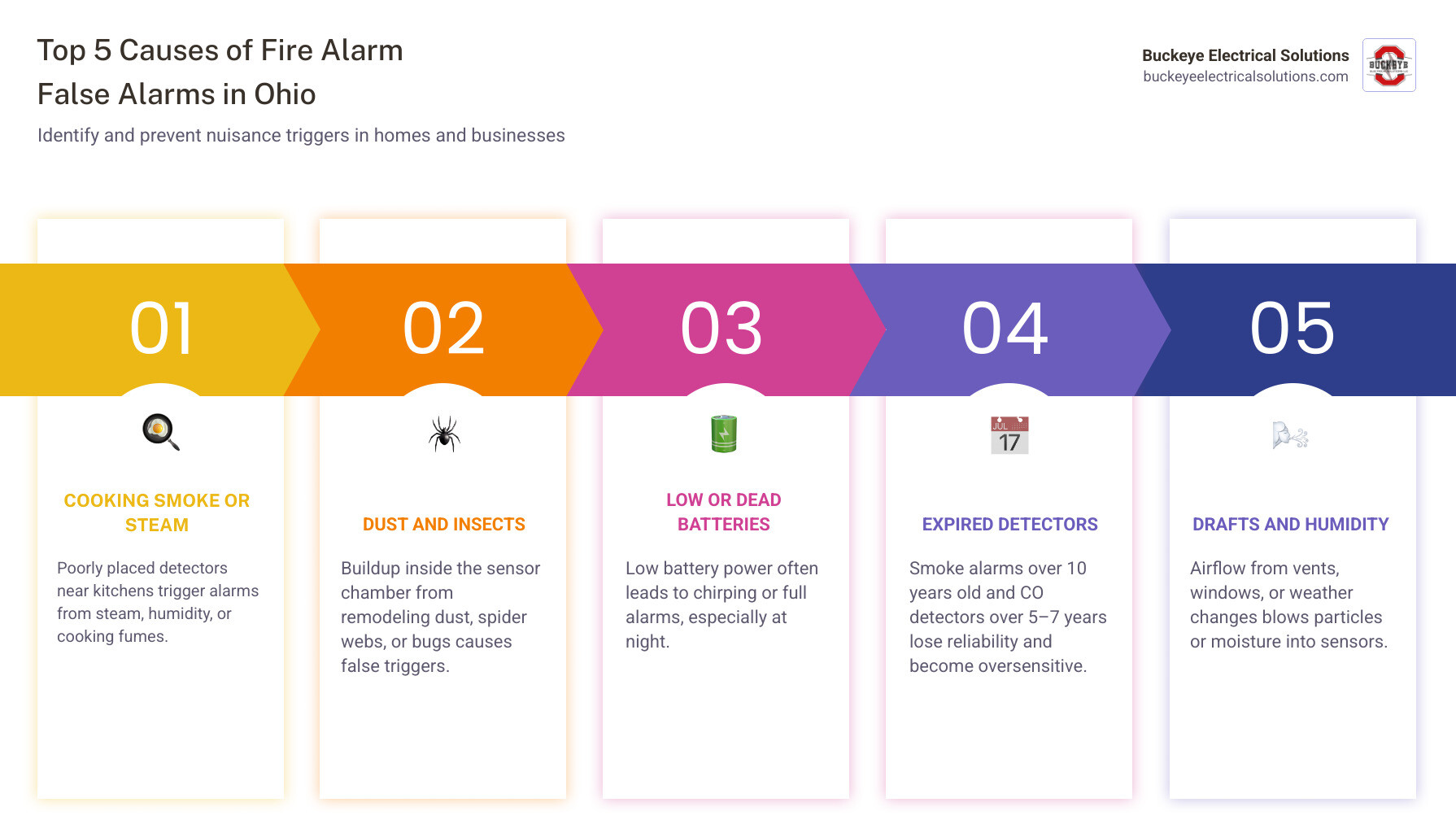
- Cooking smoke or steam near a poorly placed detector
- Dust, insects, or debris inside the sensor chamber
- Low or dead batteries triggering a chirp or full alarm
- High humidity from showers or weather changes
- Expired detectors – smoke alarms last 10 years; CO alarms often last 5-7 years depending on the model
- Drafts from windows or vents blowing particles into the sensor
- Remodeling dust or chemical fumes during home projects
The pattern seen by fire departments and service providers is clear: a large share of automatic alarm activations turn out to be nuisance or non-fire events. For Ohio property owners, that means repeated disruptions, avoidable service calls, and a higher chance that occupants start dismissing alarms instead of responding appropriately.
Beyond the cost and inconvenience, there is a safety issue that often gets overlooked. When fire departments, especially volunteer or combination departments common in parts of Ohio, respond repeatedly to nuisance alarms, resources may be tied up when real emergencies happen elsewhere. Repeated unwanted alarms can also train people to hesitate, mute devices too quickly, or ignore a warning that later turns out to be real.
At the same time, not every “false alarm” is truly false. What looks like a nuisance may still point to a hidden problem, such as a venting issue, combustion byproducts, an aging detector, or an electrical condition that deserves inspection.
This guide covers what Northeast Ohio homeowners and property managers need to know: what causes false alarms, how to respond safely, how to reduce them through better maintenance and placement, and when it makes sense to call a licensed electrician.
I’m Aaron, owner of Buckeye Electrical Solutions LLC and a master electrician with hands-on experience diagnosing and resolving fire alarm false alarms across residential and commercial projects in Northeast Ohio. Whether it’s a single chirping detector or a full interconnected hardwired system acting up, I’ll walk you through exactly what to do.
Important Fire alarm false alarms terms:
What Fire Alarm False Alarms Mean and Why They Matter in Ohio
A false alarm is an alarm signal caused by something other than an actual fire. In homes, that often means steam, cooking residue, dust, bugs, low batteries, or an aging detector. In commercial buildings, it can also involve system faults, construction dust, poor detector selection, or monitoring issues.
The tricky part is this: from your point of view it may look false, but from the alarm’s point of view it sensed something worth reacting to. That is why we treat every activation seriously first, then troubleshoot second.
Fire alarm false alarms vs. true emergencies
A nuisance alarm is an unwanted alarm with no actual fire emergency. But a “no visible smoke” situation does not automatically mean “no danger.”
Hidden hazards can include:
- Smoldering wiring inside a wall
- Overheated electrical components
- Fireplace backdrafting
- A failing furnace or water-heater vent
- Carbon monoxide from fuel-burning equipment or an attached garage
If an alarm sounds, your first move is not detective work. Your first move is safety:
- Get people moving.
- Check for smoke, flame, burning odor, or signs of illness.
- Evacuate if there is any doubt.
- Call 911 when appropriate.
Why repeated alarms strain fire departments and neighborhoods
Repeated nuisance alarms create real public-safety problems. According to False alarm, repeated false alarms can create alarm fatigue, where people begin ignoring warnings that may later turn out to be real.
That matters in Ohio communities, especially where volunteer or combination fire departments may cover large areas. Every unnecessary dispatch can mean:
- Apparatus and firefighters tied up on a non-emergency
- Slower response to real fires, crashes, or medical calls
- Added wear, fuel use, and staffing strain
- Reduced public confidence in alarm systems
In practice, fire departments in the U.S. and abroad report that a substantial share of automatic fire alarm responses are nuisance or non-fire events. The exact percentage varies by department, occupancy type, and reporting method, but the operational burden is well recognized.
How Ohio homes and businesses can be affected differently
In a single-family home, the main issue is safety and reliability. In an apartment, condo, or monitored building, one bad device can affect many occupants. In commercial properties, repeated alarms may trigger local enforcement, service calls, reporting requirements, or fire watch obligations depending on the situation and authority having jurisdiction.
Ohio communities may handle repeated false alarms differently, so local ordinances matter. For businesses, monitoring center coordination, testing notification, and proper maintenance are essential.
The Most Common Causes of Fire Alarm False Alarms
Most false alarms are preventable. The usual suspects are boring, which is oddly good news, because boring problems are fixable.
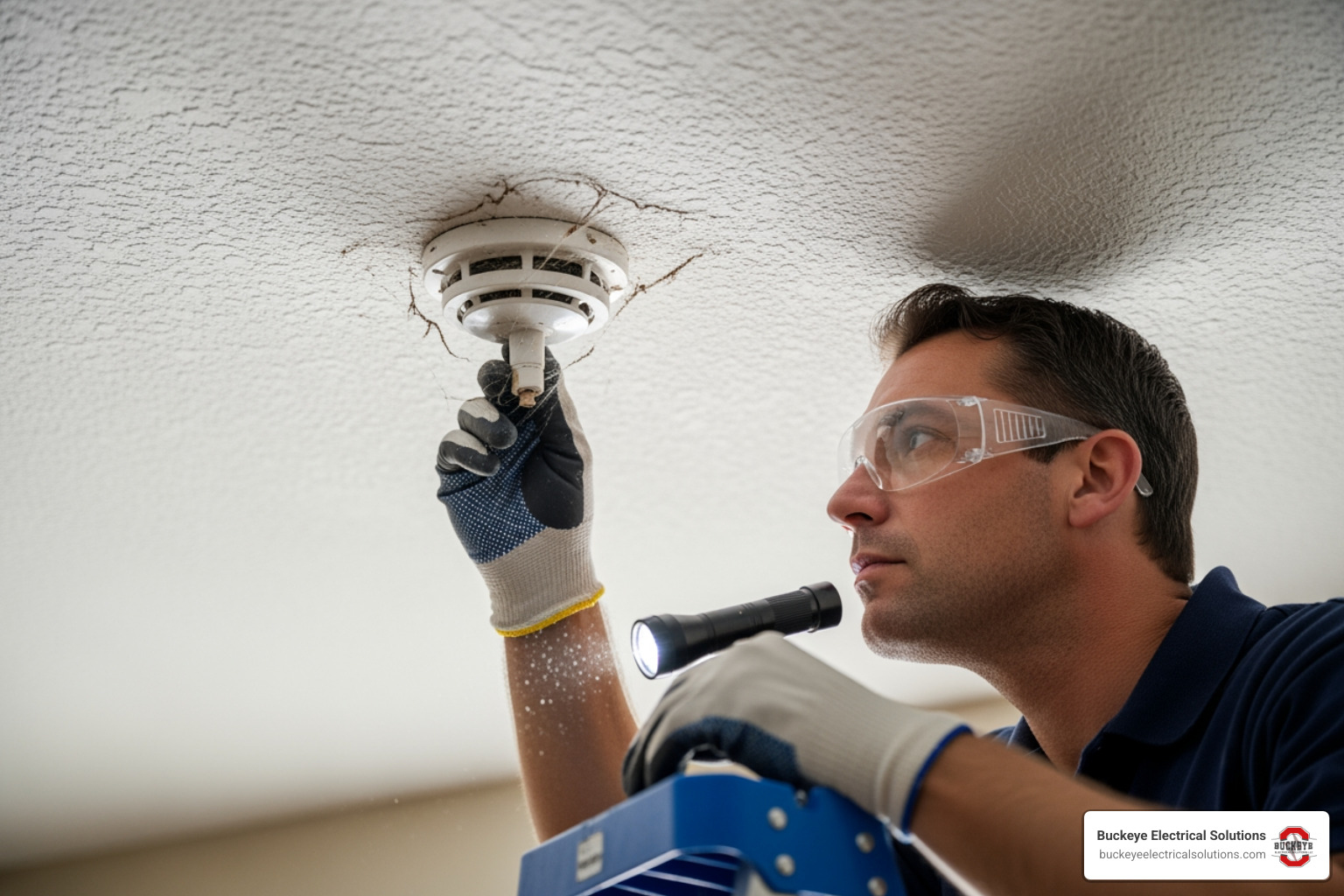
Fire alarm false alarms from placement, humidity, dust, and insects
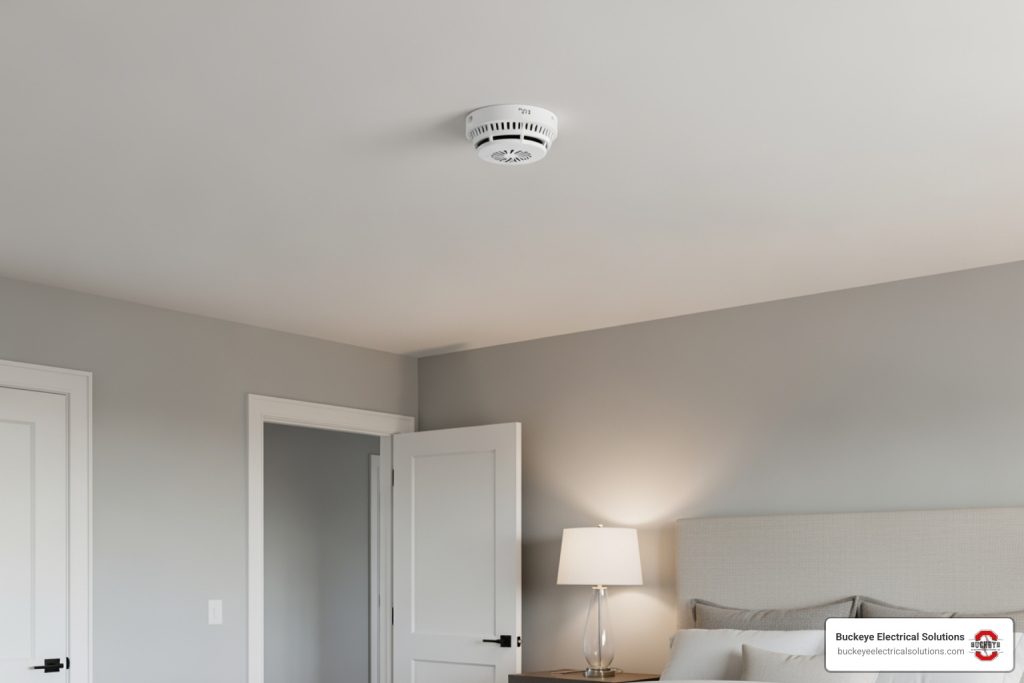
Poor placement is one of the biggest causes of Fire alarm false alarms.
Common examples include:
- Smoke alarms too close to kitchens
- Alarms outside bathrooms where steam rolls out after showers
- Units near HVAC supply vents or return grilles
- Detectors near windows or drafty doors
- Devices installed in dusty or unfinished spaces
Humidity and steam can scatter particles in ways some detectors interpret as smoke. Dust buildup inside the sensing chamber can do the same. Spiders and small insects are surprisingly talented at causing very loud 3 AM drama.
A few practical examples:
- The detector outside the bathroom goes off after hot showers
- The hallway detector sounds whenever toast becomes “artisan”
- Renovation dust triggers alarms during sanding or painting
- Fireplace smoke puffs into the room and trips a nearby alarm
Battery issues, power problems, and end-of-life warnings
Low batteries do not always produce a full alarm. Often they create chirping. But weak backup batteries in hardwired units can also contribute to erratic behavior, especially overnight when temperatures drop slightly and battery voltage changes.
Check for:
- Low battery chirp
- Loose battery drawer
- Missing backup battery in a hardwired alarm
- Breaker issues affecting hardwired power
- End-of-life warning tones
- Devices that reset poorly after outages
Nighttime chirping is common because cooler temperatures can expose a battery that is already on its last legs.
Smoke alarms vs. carbon monoxide alarms: different triggers, different risks
Smoke alarms and CO alarms do different jobs.
Smoke alarms respond to combustion particles. Common triggers:
- Cooking smoke
- Burnt food
- Steam or humidity
- Dust and insects
- Fireplace smoke
- Aerosol sprays or fumes
CO alarms respond to carbon monoxide gas. Common causes of real CO alarms:
- Furnace venting problems
- Cracked flue or exhaust vent
- Malfunctioning gas water heater
- Fuel-burning appliance issues
- Vehicle exhaust from an attached garage
CO is odorless and colorless, so a CO alarm with “no obvious problem” may still be warning you about something deadly. If people have headache, nausea, dizziness, or confusion, treat it as an emergency.
Why older alarms become unreliable
Smoke alarms generally have a 10-year service life. CO alarms are commonly replaced every 5 to 7 years, depending on the model. As they age, sensors can drift, become contaminated, or turn oversensitive.
Signs an alarm is simply too old:
- Yellowed or brittle plastic
- Frequent nuisance alarms after cleaning
- Random chirping or end-of-life signals
- Date code approaching or past replacement age
- Multiple units from the same install year acting up
If your devices are aging together, replacing the whole set often makes more sense than swapping one by one. For more on full upgrades, see From Old to Bold: Navigating Fire Alarm System Replacement.
What to Do When an Alarm Goes Off but You Do Not See Fire
If a smoke alarm sounds with no visible smoke
Use this order:
- Assume it could be real.
- Check people first, especially children, older adults, and anyone sleeping.
- Look for smoke, burning smell, overheated appliances, or cooking sources.
- If there is any uncertainty, evacuate and call 911.
- If you confirm there is no fire, use the hush feature if your model allows it.
- Ventilate the area.
- Clean the initiating alarm once safe to do so.
Many alarms have a hush button that temporarily lowers sensitivity for several minutes. Only use it after you have confirmed there is no fire.
If a CO alarm sounds and nobody feels sick
Do not assume it is false.
Take these steps:
- Move everyone to fresh air.
- Call 911 or your gas utility if advised locally.
- Do not re-enter until it is safe.
- Arrange follow-up inspection of fuel-burning appliances, vents, and related electrical equipment if needed.
A CO event may exist even if no one feels symptoms yet. That is especially true at lower levels or early in the exposure.
How to identify the initiating alarm in interconnected systems
Interconnected hardwired systems make troubleshooting harder because one alarm can trigger every unit in the house.
Look for:
- A flashing LED on the initiating unit
- The device closest to steam, cooking, or dust
- A unit in the room where the event started
Some manufacturers use a fast blinking light to identify the alarm that first triggered the chain. If one room keeps causing whole-house alarms, a useful field check is the “room-swap test”: move the suspected alarm with another compatible unit from a different location. If the problem follows the device, the unit is likely bad. If it stays in the room, the room conditions are likely the issue.
After a nuisance event, a full reset may involve disconnecting AC power, removing the battery, holding the test button briefly, then restoring power and battery. Follow your manufacturer instructions.
When not to ignore the alarm
Never get too comfortable with repeat alarms. What looks like a nuisance can be:
- A hidden electrical fire
- Smoldering wiring
- A failing appliance
- A venting problem producing CO
- A detector that is correctly sensing a real hazard before you can see it
Recurring nighttime alarms, repeated alarms in one area, or alarms tied to furnace or water-heater operation deserve professional attention. If your system keeps acting up, start with How to Repair Fire Alarm with These 5 Easy Changes.
How to Prevent False Alarms with Better Maintenance and Placement
Best placement practices for smoke and CO alarms
For most homes, best practice includes alarms:
- In each bedroom
- Outside each sleeping area
- On every level of the home
To reduce nuisance alarms:
- Keep smoke alarms out of kitchens and use a hallway location instead
- Aim for about a 10-foot buffer from cooking appliances where layout allows
- Avoid installation right outside steamy bathrooms
- Keep units away from strong drafts, windows, and supply vents
- Install CO alarms near sleeping areas and where required by applicable rules
- Pay attention to attached garages and fuel-burning appliance locations
As an Ohio electrical contractor, we also remind clients that Ohio’s 2023 NEC adoption includes expanded GFCI requirements in several locations, but those rules are situational and separate from smoke/CO alarm placement. Alarm circuits and nearby receptacles should still be evaluated correctly during upgrades.
Cleaning, testing, and replacement schedule for homeowners
A simple maintenance schedule prevents many nuisance alarms:
- Test monthly
- Clean every 6 months, or more often in dusty homes
- Replace batteries as needed or at least yearly for replaceable-battery units
- Replace smoke alarms at 10 years
- Replace CO alarms at 5 to 7 years, based on manufacturer guidance
Good cleaning methods:
- Vacuum exterior vents with a soft brush attachment
- Use compressed air if the manufacturer permits it
- Wipe the outside gently
- Avoid spraying cleaners or paint near the alarm
Always check the date label on the back or side of the unit.
Best practices for interconnected hardwired smoke alarm systems
Hardwired systems are excellent for whole-home safety, but they should be maintained as a system, not as random ceiling gadgets.
Best practices:
- Check the breaker if multiple alarms lose power
- Replace backup batteries when required
- Use compatible devices from the same manufacturer family
- Label the circuit clearly
- Keep install dates consistent across the system
- Replace aging groups together when practical
- Outlet has no voltage; could indicate breaker, GFCI, switch, or wiring issue
If your hardwired system is due for an update, From Panel to Protection: Mastering Fire Alarm Installation and Maintenance is a helpful next read.
When to replace one alarm and when to replace the entire set
Replace one unit when:
- It was damaged
- It is clearly defective but the rest are newer and matching
- It is the only outlier in age or model
Replace the entire set when:
- All units were installed around the same time
- Several devices are nearing end of life
- You have mixed brands or incompatible models
- You are getting repeated nuisance alarms across the network
- A remodel changed room layout or code requirements
For new system planning, see New Fire Alarm System: Here’s How to Get It Done Right.
| Alarm behavior | Likely causes | Priority level |
|---|---|---|
| Alarm after cooking | Detector too close to kitchen, cooking smoke, poor ventilation | Medium |
| Alarm after shower | Steam, humidity, placement near bathroom | Medium |
| Chirp every minute | Low battery, end-of-life warning, loose battery tray | High |
| Whole house alarms with no smoke | One initiating unit, dust, age, humidity, wiring issue | High |
| Repeated late-night alarms | Weak battery, aging sensor, temperature shift, possible hidden hazard | High |
| CO alarm activation | Possible CO event, venting problem, appliance issue | Urgent |
Ohio Policies, Repeated Alarm Fines, and Commercial Building Responsibilities
How local fire departments handle repeated false alarms
Many fire departments track repeat nuisance alarms and may escalate enforcement over time. Outside Ohio, examples include citation programs and rolling tracking periods, such as the models described by False Fire Alarm Reduction Program guidance and Seattle nuisance alarm policy.
The exact penalty structure in Ohio depends on the local jurisdiction, but the pattern is familiar:
- Warning or education first
- Documentation of repeated incidents
- Service or mitigation requirement
- Possible fees or cost recovery in some cases
For commercial properties, preventing repeated dispatches is part safety issue, part operations issue.
Ohio legal considerations for false alarms and misuse
Ohio distinguishes between accidental nuisance alarms and intentional misuse. Intentional or reckless false reporting can carry criminal consequences under Ohio false alarm law. In some circumstances, charges for false alarm responses may also be assessed under Ohio assessment of charge.
The practical takeaway:
- Do not intentionally trigger or misuse fire alarm equipment
- Do not pull manual stations as a joke
- Investigate recurring accidental alarms and fix the cause
- Check local municipal rules for repeat residential or commercial alarms
Commercial fire alarm management to reduce nuisance dispatches
Commercial systems need a formal approach. Helpful guidance from Managing and reducing false alarms and Reducing false alarms FAQ points to a few consistent best practices:
- Keep a fire alarm logbook
- Record every activation, cause, and corrective action
- Use the right detector type for the space
- Consider heat detection instead of smoke detection in cooking-heavy or dusty areas where appropriate
- Notify the monitoring company before testing
- Protect detectors during painting, sanding, and construction
- Train staff on safe alarm investigation and reporting procedures
- Coordinate with your alarm provider on panel signals and device identification
When a professional system evaluation makes sense
Call for a professional evaluation when you have:
- Frequent unexplained activations
- Mixed-age or mixed-brand interconnected devices
- Panel troubles or supervisory signals
- Sensitivity issues after cleaning
- Suspected improper wiring
- Renovation-related layout changes
- Code upgrade questions for commercial occupancy
For business systems, start with Professional Fire Alarm Solutions for Your Business and From Blueprint to Blaze Protection: Mastering Commercial Fire Alarm Installation.
Frequently Asked Questions About Fire Alarm False Alarms
How often should smoke and CO detectors be tested, cleaned, and replaced?
Test monthly. Clean about every 6 months, or sooner in dusty conditions. Replace smoke alarms at 10 years. Replace CO alarms at 5 to 7 years based on the unit’s listing and manufacturer instructions.
Why do smoke alarms often go off at night for no reason?
Usually there is a reason, even if it is annoying and invisible. The most common are weak batteries, cooler nighttime temperatures affecting battery voltage, dust in the chamber, aging sensors, or humidity changes. Repeated nighttime alarms should not be ignored.
What should I check if one room keeps triggering the whole interconnected system?
Check the initiating unit, the room conditions, nearby bathroom steam, kitchen vapors, drafts, and device age. A room-swap test with a compatible unit can help determine whether the problem follows the alarm or stays with the room.
Conclusion
Fire alarm false alarms are frustrating, but they are usually telling you something useful: the detector is dirty, old, badly placed, underpowered, or sensing a real issue you cannot see yet.
Our short prevention checklist:
- Test alarms monthly
- Clean them every 6 months
- Replace weak batteries promptly
- Keep smoke alarms away from steam and cooking sources
- Replace smoke alarms at 10 years and CO alarms at 5 to 7 years
- Treat recurring alarms as a system problem, not just a noisy ceiling problem
For many Ohio homes, replacing the full set of interconnected alarms is the smartest move once they age together. For commercial buildings, a documented maintenance plan and professional system review can reduce nuisance dispatches, protect occupants, and avoid unnecessary response issues.
If you need help troubleshooting a stubborn detector, upgrading an aging hardwired system, or reviewing a commercial setup in Northeast Ohio, we can help. You can also explore Detailed Reviews of the Top 10 Fire Alarm Services in Northeast Ohio or learn more about our commercial services.