What Is 100 Amp Residential Service — and Is It Enough for Your Home?
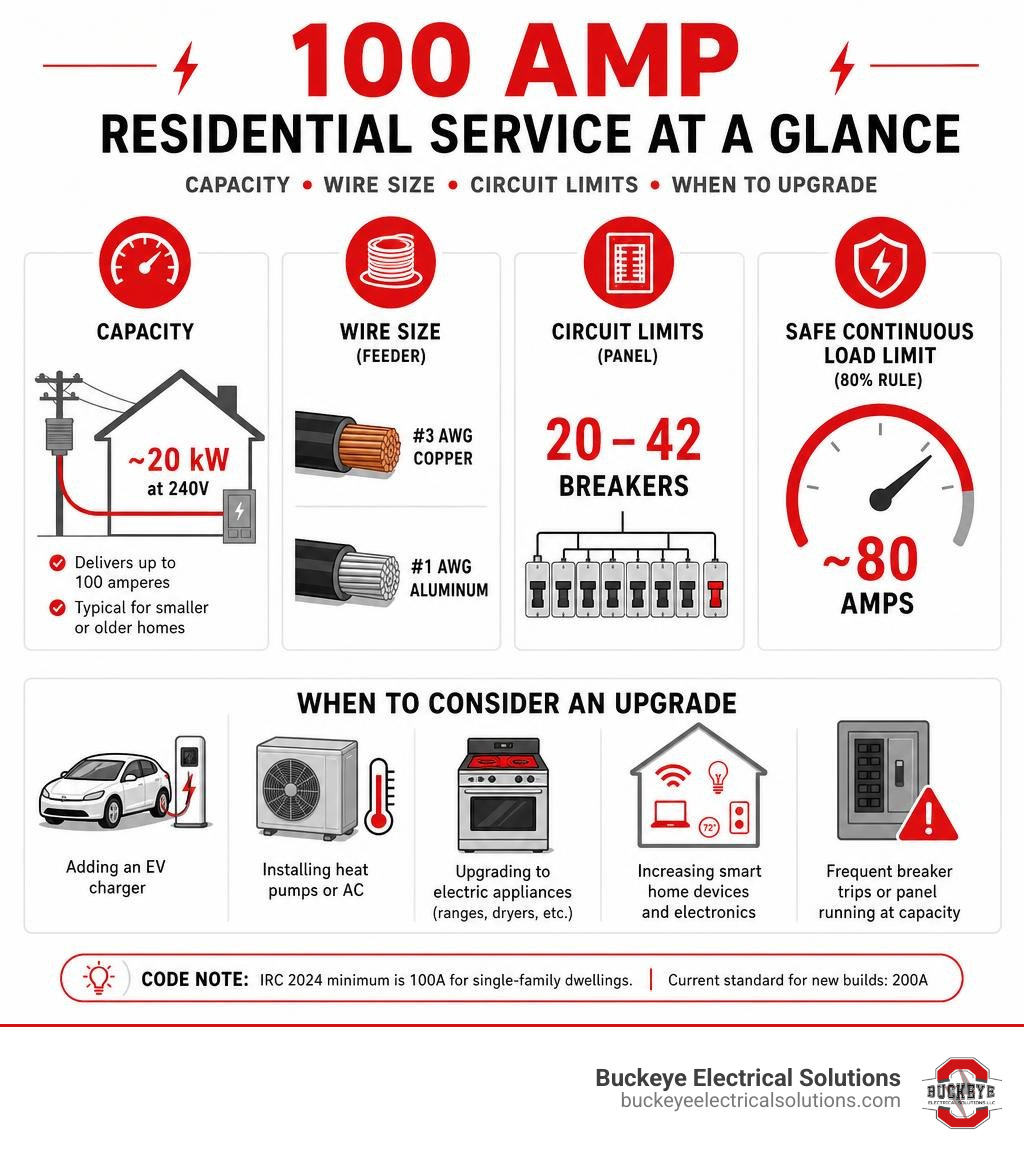
100 amp residential service is the electrical supply configuration that delivers up to 100 amperes of current to your home from the utility grid. Here’s a quick breakdown of what that means in practice:
| Factor | Detail |
|---|---|
| Power capacity | ~20 kW at 240V |
| Typical homes | Smaller or older homes, condos, apartments |
| Minimum wire size | #3 AWG copper or #1 AWG aluminum (feeder) |
| Panel circuit range | 20 to 42 breakers |
| IRC 2024 minimum | 100A for single-family dwellings |
| Current standard for new builds | 200A |
| Safe continuous load limit | ~80 amps (80% rule) |
It sounds like plenty of power. And for many Ohio homes — especially those built before the 1990s with gas appliances and modest electrical loads — it genuinely is.
But here’s the thing: electricity demand keeps growing. EV chargers, heat pumps, induction ranges, and smart home devices are pushing older 100-amp panels to their limits. One data point worth knowing: monitored real-world usage shows a typical home’s highest recorded 6-second peak was around 17 kW — roughly 70 amps at 240V — with an average draw of just 3.33 amps. That gap between peak and average is exactly why understanding your actual load matters before assuming you need an upgrade.
Whether your 100-amp panel is holding up fine or quietly struggling, this guide walks you through everything you need to know — wire sizing, panel capacity, upgrade triggers, and smarter ways to stretch what you’ve got.
I’m Aaron, owner of Buckeye Electrical Solutions LLC, and I’ve directed dozens of permitted 100 amp residential service upgrades and panel replacements across Northeast Ohio. That hands-on experience shapes everything in this guide, so you’re getting real-world insight — not just code tables.
100 amp residential service vocab explained:
Understanding 100 Amp Residential Service and Its Applications
When we discuss a home’s electrical service, we are referring to the total capacity of the electrical system to deliver power from the utility company’s lines to your individual appliances. Measured in amperes (amps), this capacity determines how many high-draw devices you can operate simultaneously.
A standard 100 amp residential service can safely deliver approximately 20 kilowatts (kW) of power at 240 volts. For several decades, this was the standard for single-family homes across Northeast Ohio. In older housing stock—such as homes built in Akron or Cleveland between the 1960s and the late 1980s—a 100-amp panel remains highly common. Houses built before the 1960s often started with even smaller 60-amp services (frequently utilizing old fuse boxes), making a 100-amp panel an upgrade at the time.
While older or smaller homes with gas heating, gas water heaters, and gas cooking ranges typically operate comfortably within this limit, modern electrical demands are shifting. According to the IRC 2024 Electrical Service Size Standards, a 100-amp service is legally established as the minimum electrical service size for a single-family dwelling (IRC § E3601.2). However, local utility companies (POCOs) often enforce their own requirements that exceed these minimums, and 200-amp service has quickly become the standard for modern new construction.
Sizing the Arteries: Wire Requirements for 100 Amp Residential Service
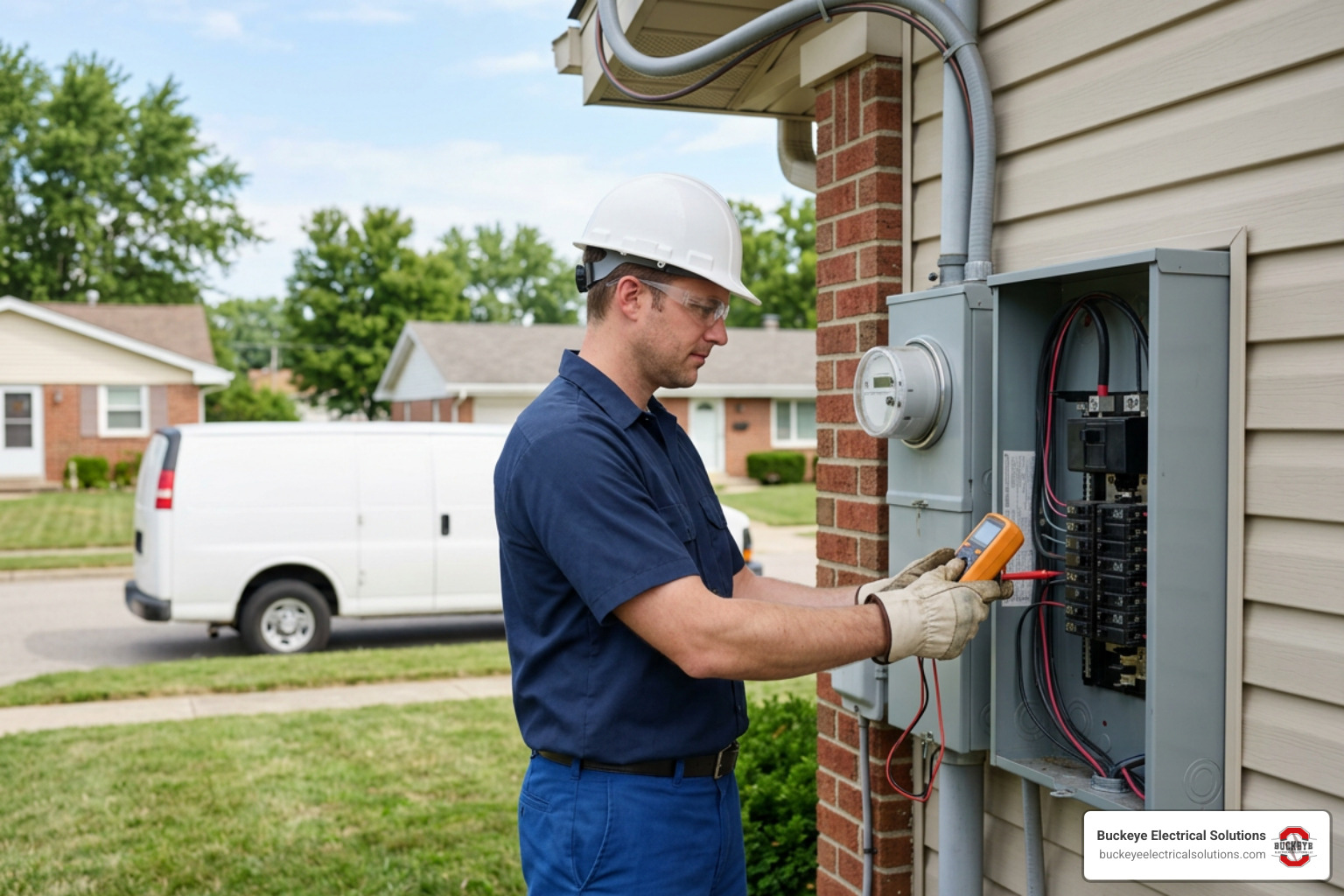
Think of your electrical panel as the heart of your home’s electrical system, and the service wires as the main arteries. If those arteries are too small, they will restrict electrical flow, overheat, and create severe safety hazards.
To ensure a safe installation, the wire feeding a 100-amp panel must be sized correctly according to the National Electrical Code (NEC) and applicable local enforcement. According to the NEC 2023 Wire Sizing Guidelines, the minimum wire size for a standard 100-amp circuit or feeder is #3 AWG copper or #1 AWG aluminum when calculated using standard ampacity tables (such as NEC Table 310.16) under typical 75°C terminal temperature limits.
Copper vs. Aluminum Wire Types
When selecting wire for a 100-amp installation, we generally compare copper and aluminum. Both materials are approved by code when installed with the correct terminations, but they have distinct differences in physical size, weight, and overall cost.
- Copper (#3 AWG): Copper is highly conductive, physically stronger, and more resistant to terminal expansion and contraction. However, copper is significantly more expensive—often costing 40% to 60% more than aluminum.
- Aluminum (#1 AWG): Aluminum is much lighter and highly cost-effective, saving homeowners significant material expenses on long runs. Modern aluminum wiring utilizes AA-8000 series aluminum alloy, which has corrected historical issues with creeping and expansion.
Common wire insulation types used for these runs include THWN, XHHW-2, and SER (Service Entrance Cable) configurations. For a detailed breakdown of wire selections by application, you can refer to the 100 Amp Wire Size Guide.
Critical Sizing Factors for a 100 Amp Residential Service
Selecting the correct wire size isn’t as simple as reading a single number off a chart. Several physical and environmental factors must be considered during the planning process:
- Voltage Drop: Over long distances, electrical resistance causes voltage to drop. For feeder runs exceeding 75 to 100 feet (such as running power to a detached garage or workshop), we typically recommend upsizing the conductor (e.g., using #2 AWG copper or #1/0 AWG aluminum) to keep voltage drop below 3% and prevent flickering lights.
- Ambient Temperature Correction: If the service wires are routed through hot environments, such as a sunny roof deck or an unconditioned Ohio attic in mid-summer, the wire’s continuous ampacity must be derated.
- The 83% Rule for Service Entrance Conductors: Generally, for a main residential service entrance (the wire coming from the utility meter to your main service panel), NEC 310.12 allows the conductors to be sized at 83% of the service rating. Under this specific residential provision, #4 AWG copper or #2 AWG aluminum is typically permitted, provided it serves as the main power supply for the entire dwelling. For more details on this process, see our guide on How to Wire a 100 Amp Breaker Box Safely and Effectively.
Panel Capacity: How Many Breakers Can You Safely Install?
A common point of confusion for homeowners is the relationship between the physical number of circuit breakers in a panel and the panel’s total amperage rating.
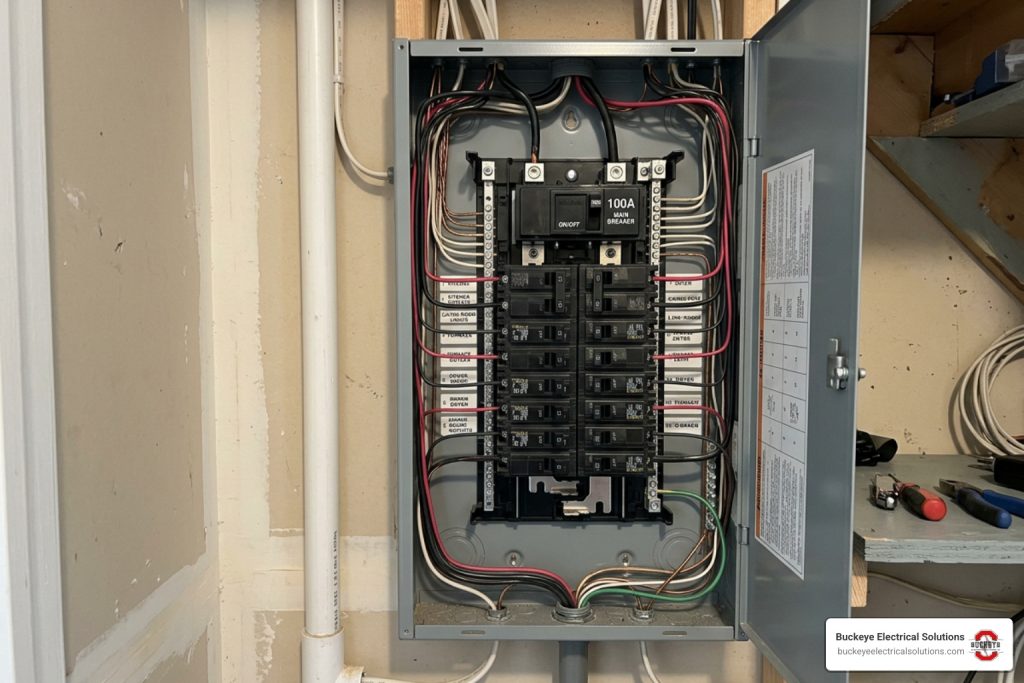
A standard 100-amp panel typically features a physical layout that accommodates a minimum of 20 circuits, with a theoretical maximum of up to 42 breakers under older NEC guidelines. However, having 30 breakers in a 100-amp panel does not mean you can draw 15 or 20 amps from all of them at the same time.
For continuous loads (loads that run for three hours or more), we must apply the 80% rule. This means a 100-amp panel should not handle a continuous draw exceeding 80 amps (or approximately 19.2 kW at 240V).
To manage this capacity safely, larger appliances—such as electric clothes dryers, water heaters, central air conditioners, and kitchen ranges—must be placed on their own dedicated circuits. This ensures that a single high-draw appliance won’t overload a shared circuit and trip the breaker. For a comprehensive look at how these rules govern your home’s breaker box, check out The NEC Book Bible.
Is 100 Amps Enough, or Is It Time to Upgrade?
Determining whether a 100-amp service is sufficient depends entirely on your home’s unique “load diversity”—which is the statistical likelihood of which appliances you run at the exact same time. If you are planning home renovations, adding high-draw appliances, or looking to future-proof your property, upgrading to a 150-amp or 200-amp panel is a highly effective option. You can learn more about these benefits in our article on the Benefits and Costs of an Electrical Panel Upgrade.
Is a 100 Amp Residential Service Sufficient for Modern Homes?
In many cases, a 100 amp residential service is perfectly adequate for small-to-medium-sized homes (typically under 1,800 square feet) that utilize natural gas or heating oil for space heating, water heating, and cooking.
However, if you are moving toward full electrification, a 100-amp service can quickly become a bottleneck. High-demand modern upgrades include:
- Electric Vehicle (EV) Chargers: A standard Level 2 EV charger typically demands 32 to 40 amps of continuous power.
- Heat Pumps: Transitioning from a gas furnace to an electric heat pump (especially with auxiliary electric heat strips for cold Ohio winters) can add 30 to 60 amps of load.
- Induction Cooktops: Upgrading from a gas range to an induction stove adds another significant 240V load.
Before making any major changes, we highly recommend performing a formal load calculation. You can use The Home Electrical Inspection Checklist to inventory your current appliances and assess your system’s headroom.
Safety, Code, and Practical Considerations for Upgrades
In Ohio, electrical installations are subject to local jurisdictions, which may apply the 2023 NEC or other adopted code requirements depending on your location and project scope. When upgrading or replacing a panel, several safety and code requirements generally come into play:
- Grounding Electrode Systems: Modern codes typically require updating your grounding system, which often involves driving two copper ground rods spaced at least six feet apart.
- AFCI and GFCI Requirements: Replacing a panel may trigger modern Arc-Fault Circuit Interrupter (AFCI) and Ground-Fault Circuit Interrupter (GFCI) requirements. Ohio’s 2023 NEC adoption includes expanded GFCI requirements in several locations, qualifying specific rules (like kitchens) as situational rather than universal.
- Permits and Insurance: Service upgrades require coordination with your local utility company and building department. It is critical to note that unpermitted electrical work can complicate insurance claims if a hazard arises in the future.
To help identify potential issues with your current panel, we’ve outlined common problems we find during inspections:
| Panel Component / Symptom | Likely Causes | Priority Level |
|---|---|---|
| Warm or hot panel cover | Overloaded circuits, loose termination screws, or failing breakers | High |
| Rust or white powder inside enclosure | Water entering through the service entrance cable or high basement humidity | High |
| Outlet has no voltage; could indicate breaker, GFCI, switch, or wiring issue | Tripped breaker, failed GFCI receptacle, loose connection, or improper wiring | Medium |
| Flickering lights when large appliances start | Voltage drop, loose neutral connection, or undersized service conductors | Medium |
| Buzzing or crackling sounds from the panel | Active arcing at a breaker connection or a loose busbar joint | High |
| Missing physical bonding jumper | Improper wiring or bootleg ground in the main panel | High |
Smart Electrification: Staying on 100 Amps Without Upgrading
If a full service upgrade is outside of your current budget—which is a common planning estimate of $1,500 to $4,000 depending on local site conditions and AHJ requirements—there is good news. You can often fully electrify your home on an existing 100-amp panel by utilizing smart load-management technologies and highly efficient appliances.
- Smart Splitters and Load Controllers: These devices allow two high-draw appliances (like an EV charger and a clothes dryer) to share a single 240V circuit. If you turn on the dryer, the smart splitter temporarily pauses power to the EV charger, resuming it automatically when the dryer cycle finishes.
- Power-Smart Level 2 Chargers: Rather than installing a standard 40-amp charger, you can opt for a smart Level 2 charger configured for 16 amps. Operating at 240V, a 16-amp charger can still deliver roughly 100 miles of range overnight, which easily covers typical daily driving needs.
- 120V Heat Pump Water Heaters: Traditional electric water heaters require a dedicated 30-amp, 240V circuit. Modern 120-volt heat pump water heaters can plug into a standard wall outlet and draw minimal power, saving significant panel capacity.
- Variable-Speed HVAC Systems: Inverter-driven variable-speed heat pumps eliminate the massive “inrush” current spike typical of older, single-stage air conditioners, keeping your peak electrical demand well within safe limits.
Frequently Asked Questions About 100 Amp Residential Service
Can I run a modern EV charger on a 100-amp panel?
Yes, in many cases you can. While a standard 40-amp Level 2 charger may overload a 100-amp panel that already supports other electric appliances, you can utilize a power-smart 16-amp Level 2 charger, a smart circuit splitter, or a dynamic load-shedding device to safely charge your vehicle without upgrading your service.
What is the minimum wire size required for a 100-amp service entrance?
Under standard residential code provisions (the 83% rule), the minimum service entrance wire size is typically #4 AWG copper or #2 AWG aluminum. However, if you are running a standard feeder or subpanel circuit that does not carry the entire load of the dwelling, you must generally use #3 AWG copper or #1 AWG aluminum, subject to local AHJ approval.
Does Ohio code require upgrading a 60-amp panel to 100 amps during a home sale?
Generally, the National Electrical Code does not retroactively require home sellers to upgrade an existing, safe 60-amp panel simply because the home is being sold. However, many mortgage lenders (including FHA/VA programs) and private home insurance companies enforce their own strict guidelines that mandate a minimum 100-amp service before closing or issuing a policy.
Conclusion
A 100 amp residential service is a reliable and time-tested option that still serves millions of homes beautifully. However, as Northeast Ohio winters demand robust heating and modern homeowners embrace electric vehicles, understanding your panel’s true capacity is more important than ever.
Whether you can comfortably stay on your existing 100-amp panel using smart load-management tech or genuinely need to transition to a 200-amp service, the best first step is a professional load calculation and a comprehensive safety inspection.
At Buckeye Electrical Solutions, we bring over 20 years of trusted electrical contracting experience to homes across Northeast Ohio. If you have questions about your panel’s safety or want to explore your options, contact us today to learn more about our Buckeye Electrical Solutions Residential Electrical Services.