Why Fire Alarm Service Matters for Ohio Homes and Businesses
Getting a professional fire alarm service means having your system inspected, tested, maintained, and — if needed — repaired or upgraded by a licensed technician. Here’s a quick breakdown of what that typically involves:
| Service Type | What It Includes |
|---|---|
| Inspection & Testing | Check all detectors, pull stations, panels, and notification devices |
| Maintenance | Clean sensors, replace batteries, verify wiring and power supply |
| Monitoring | 24/7 central station connection that alerts emergency responders |
| Repair & Upgrades | Fix faulty components or retrofit outdated systems |
| Compliance Documentation | Records required by NFPA 72 and local Ohio fire codes |
Fire departments respond to over a million fires annually, causing billions of dollars in property damage. A working, well-maintained fire alarm system is one of the most effective tools you have to protect your building and the people inside it.
Yet many property owners don’t think about their fire alarm until something goes wrong — or until a code inspector flags a violation.
Regular service keeps your system reliable, reduces false alarms, and helps you stay compliant with Ohio fire codes and NFPA 72 standards. Whether you own a home in Lorain or manage a commercial property in Cuyahoga County, the stakes are the same: early detection saves lives.
I’m Aaron, owner of Buckeye Electrical Solutions LLC, and I’ve overseen dozens of permitted fire alarm and life safety projects across Northeast Ohio for residential and commercial clients. That hands-on fire alarm service experience is what this guide is built on.
What is a Fire Alarm System and How Does It Work?
At its core, a fire alarm system is an integrated network of life-safety devices working together to detect fire, smoke, carbon monoxide, or other emergencies. It is designed to alert occupants and emergency personnel so they can act quickly. Understanding how these components work together highlights why professional oversight is so critical to Ensuring the safety of your property and people.
The system relies on three distinct functional areas:
- Initiating Devices: These are the inputs. They detect the physical signs of a fire. Examples include smoke detectors (photoelectric or ionization), heat sensors, manual pull stations, and waterflow switches connected to fire sprinkler lines.
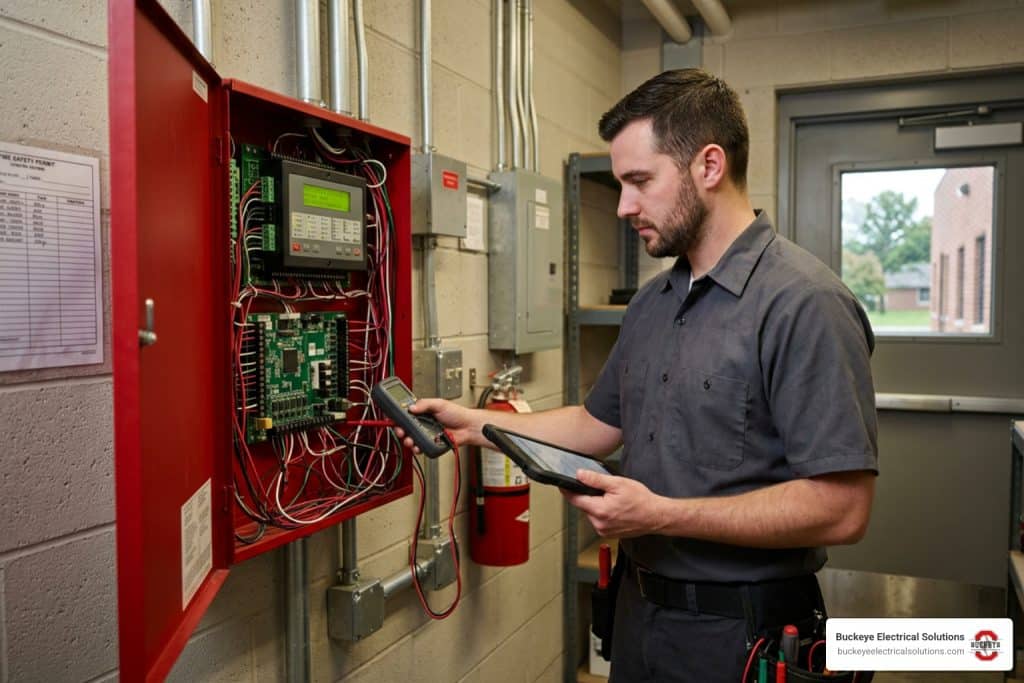
- The Control Panel: This is the brain of the system. It receives signals from the initiating devices, monitors the integrity of the system’s wiring, transmits status updates, and activates the outputs.
- Notification Appliances: These are the outputs. They warn building occupants using horn strobes, sirens, flashing lights, or voice evacuation systems.
The entire system is powered by a reliable primary power supply (typically a dedicated branch circuit from the main electrical panel) and backed up by a secondary battery system. If the primary power fails, the backup battery automatically takes over to ensure uninterrupted protection. Regular fire alarm service ensures these complex pathways always communicate seamlessly.
Why Professional Fire Alarm Service and Maintenance is Essential
A fire alarm system is not a “set-it-and-forget-it” asset. Over time, dust accumulates in detector chambers, batteries degrade, and electrical connections can loosen or corrode.
Routine maintenance is legally mandated by local Ohio fire codes and the National Fire Protection Association (NFPA 72) standards. Failing to keep up with these standards can result in hefty municipal fines, the loss of your occupancy permit, or denied insurance claims in the event of a fire.
Beyond legal compliance, proactive maintenance has a massive operational benefit: it reduces false alarms. Industry data shows that regular inspection and maintenance of fire alarm systems can reduce false alarms by up to 70%. False alarms are more than just a nuisance; they can lead to costly fire department dispatch fees and cause “alarm fatigue,” where occupants begin ignoring real alerts because they assume it is another error.
Investing in professional fire alarm solutions for your business ensures your system remains responsive when seconds count, while keeping operations running smoothly.
Key Components That Require Regular Servicing
During a standard fire alarm service call, our technicians systematically inspect, clean, and test several critical components to verify they meet strict performance standards.
- Smoke and Heat Detectors: These must be cleaned to remove dust, pollen, and debris that cause false alarms or delayed activation. We also verify their sensitivity levels using specialized diagnostic tools.
- Manual Pull Stations: These mechanical devices are physically tested to ensure the internal switch triggers the control panel instantly when pulled.
- Horn Strobes and Speakers: We measure decibel levels and strobe flash synchronization to ensure they meet ADA compliance and are capable of alerting everyone in the building.
- Control Panels and Backup Batteries: We perform load tests on the backup batteries to ensure they can power the system during a blackout. We also check the primary power circuit. Outlet has no voltage; could indicate breaker, GFCI, switch, or wiring issue.
Keeping an eye on these components between professional visits is highly recommended. You can learn more about daily and weekly facility checks in our guide on how to conduct fire alarm checks.
Below is a diagnostic reference of common fire alarm issues we resolve during routine maintenance:
| Common Fire Alarm Issue | Likely Causes | Priority Level |
|---|---|---|
| Persistent trouble light on panel | Depleted backup battery or broken circuit loop | High |
| Nuisance chirping or false alarms | Dirty sensor chamber, age-related drift, or moisture | Medium |
| Notification appliances fail to sound | Blown fuse on NAC card, improper wiring, or device failure | Critical |
| Ground fault warning on control panel | Damaged wire insulation touching metal conduit or water intrusion | High |
Types of Fire Alarm Systems for Ohio Buildings
The architecture of your fire alarm system depends heavily on your building’s size, occupancy type, and safety requirements. When evaluating your needs, we look at how to implement reliable fire alarm systems and monitoring that match your specific property profile.
Conventional Fire Alarm Service and Setup
Conventional fire alarm systems are structured around physical “zones.” The building is divided into specific areas (for example, Zone 1: First Floor, Zone 2: Second Floor). All initiating devices in a given area are wired together on a single circuit.
If a smoke detector triggers on the second floor, the control panel indicates an active alarm in “Zone 2.” However, it cannot tell you exactly which room or detector triggered the alarm. Because of this limitation, conventional systems are best suited for smaller commercial buildings, retail shops, or simple residential layouts. They are highly cost-effective to install and maintain but require manual searching to locate the exact source of a fire. If your existing setup is reaching the end of its operational life, we can help you navigate a seamless fire alarm system replacement.
Addressable Fire Alarm Service and Integration
For larger, more complex buildings, addressable fire alarm systems are the industry standard. In an addressable system, every single detector, pull station, and module has a unique digital “address.”
When a device is triggered, the control panel displays the exact location of the emergency (e.g., “Smoke Detector, Room 304, Third Floor East”). This level of precision allows building managers and arriving firefighters to locate the hazard instantly. Addressable systems also allow for advanced integrations with building automation systems (BAS), enabling the fire alarm to automatically shut down HVAC fans to prevent smoke spread, recall elevators to the ground floor, and unlock access control doors for safe evacuation. Keeping these complex networks functional requires specialized quarterly fire alarm testing to verify all digital pathways and relays are communicating flawlessly.
Compliance with Ohio Fire Codes and Regulations
Staying compliant with fire codes in Ohio requires navigating a layered framework of national standards and state-specific amendments. The state enforces the Ohio Fire Code (OFC), which heavily references NFPA 101 (Life Safety Code) and NFPA 72 (National Fire Alarm and Signaling Code).
Additionally, electrical installations must comply with the National Electrical Code (NEC). It is important to note that Ohio’s 2023 NEC adoption includes expanded GFCI requirements in several locations, qualifying specific rules (such as kitchen requirements) as situational rather than universal. Our team ensures that any auxiliary power or dedicated circuits feeding your life safety systems are fully compliant with these updated standards.
Compliance requirements are also overseen by the local Authority Having Jurisdiction (AHJ), which includes local fire marshals and building departments across Northeast Ohio. Whether your property is in Cuyahoga, Lake, Summit, Ashtabula, or Geauga County, we coordinate directly with your local AHJ to ensure all system designs, installations, and testing documentation meet local expectations perfectly.
Please note that all project pricing, system designs, and maintenance estimates are subject to change based on your specific site conditions, building occupancy classification, and local AHJ requirements.
Frequently Asked Questions about Fire Alarm Systems
How often should commercial fire alarm systems be inspected in Ohio?
Under the Ohio Fire Code and NFPA 72, most commercial fire alarm systems require a comprehensive annual test of all initiating and notification devices, along with semi-annual inspections of key components like control panels and backup batteries. Some high-occupancy or high-hazard facilities may require quarterly testing.
What is the difference between monitored and non-monitored fire alarm systems?
A non-monitored (or local) system only rings inside the building to alert occupants. A monitored system is connected 24/7 to a UL-listed central station. When an alarm triggers, the monitoring station instantly verifies the signal and dispatches the local fire department, providing protection even when the building is completely empty.
What certifications should a fire alarm service company hold?
You should always choose a service provider whose technicians hold NICET (National Institute for Certification in Engineering Technologies) certification in Fire Alarm Systems. In addition, the company must be licensed by the State of Ohio and hold proper liability insurance to perform electrical and life safety work.
Conclusion
Your fire alarm system is the single most important line of defense protecting your property and the people inside it. Keeping it in peak condition requires professional expertise, a deep understanding of local codes, and consistent attention to detail.
At Buckeye Electrical Solutions, we bring over 20 years of trusted electrical contracting experience to every project. As a premier provider of residential and commercial electrical repair, installation, and maintenance in Northeast Ohio, we are dedicated to keeping your building safe, compliant, and secure.
Ready to schedule your next inspection or upgrade? Contact us today to learn more about our comprehensive fire alarm services and let us help you protect what matters most.