What You Need to Know About Cable Outlet Installation
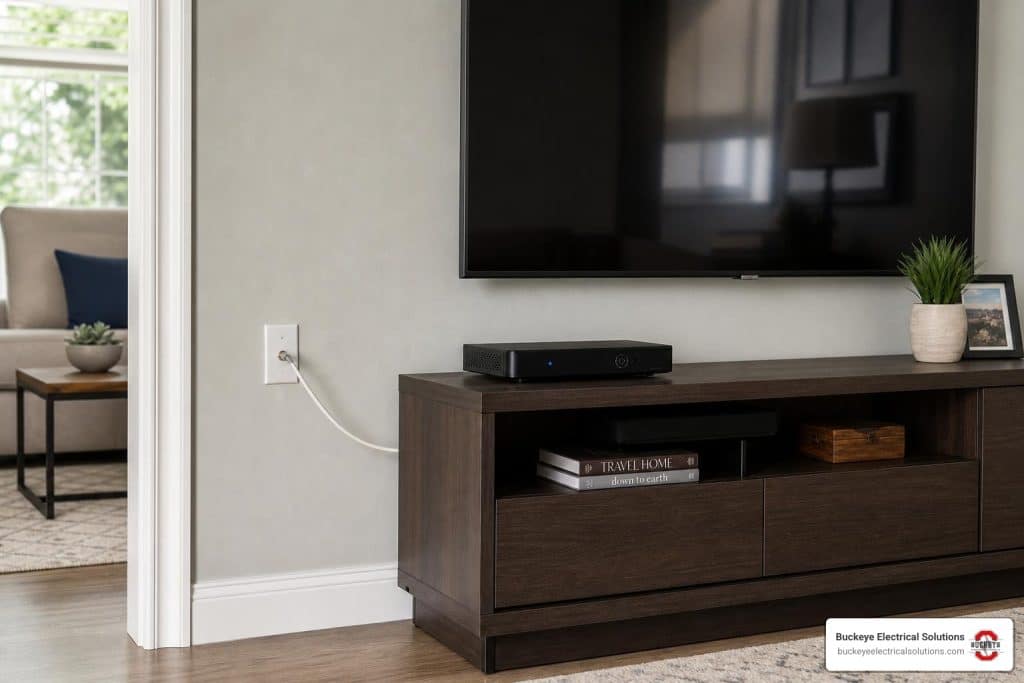
Cable outlet installation is the process of adding a coaxial (coax) wall outlet so your TV, modem, or cable box can connect cleanly through the wall — instead of through a hole drilled in the baseboard or a cable dangling across the floor.
Here’s a quick overview of what’s involved:
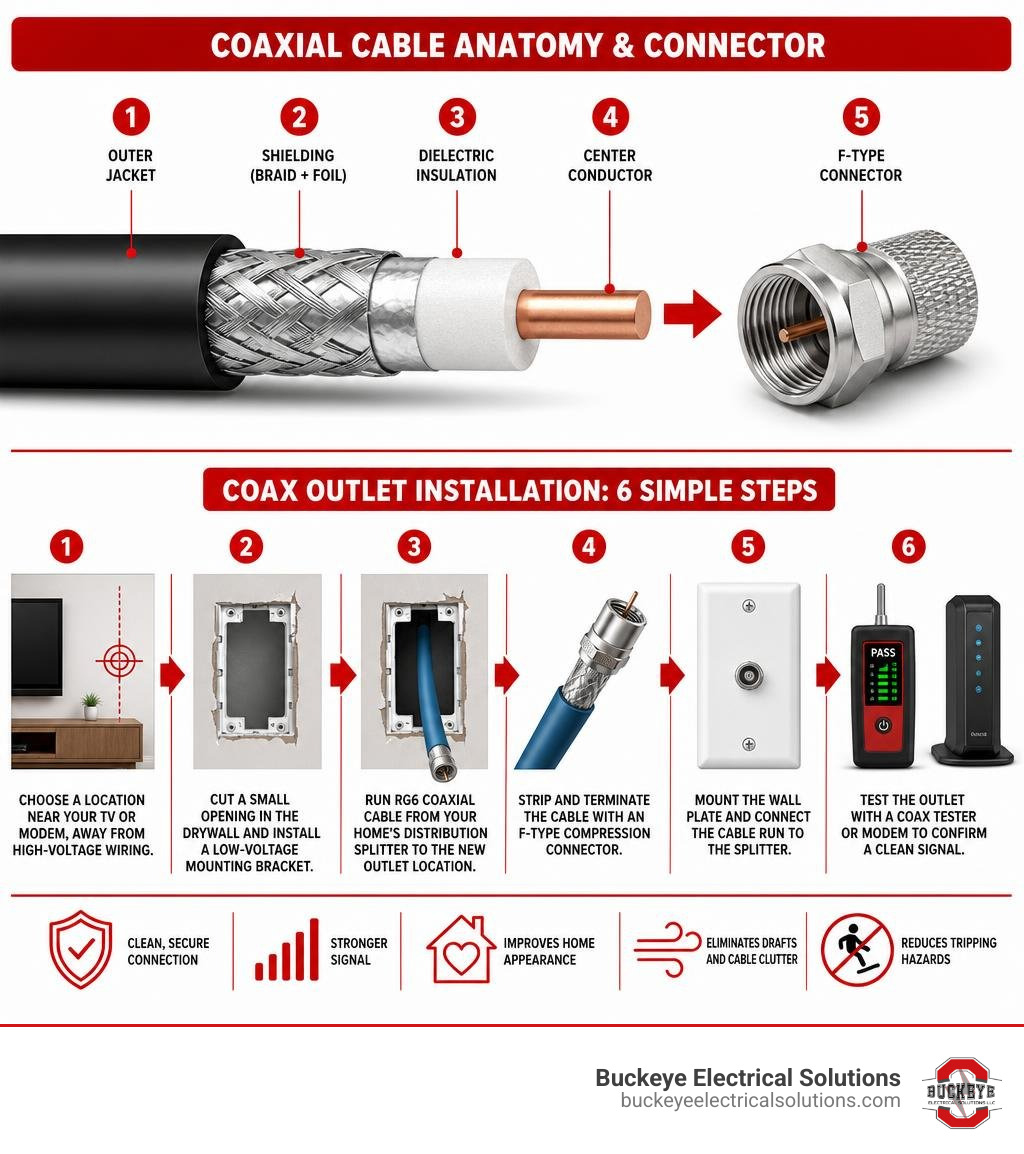
- Choose a location near your TV or modem, away from high-voltage electrical wiring
- Cut a small opening in the drywall and install a low-voltage mounting bracket
- Run RG6 coaxial cable from your home’s distribution splitter to the new outlet location
- Strip and terminate the cable with an F-type compression connector
- Mount the wall plate and connect the cable run to the splitter
- Test the outlet with a coax tester or modem to confirm a clean signal
Professional installation typically ranges from $75 to $500, depending on site conditions, wall access, and cable routing complexity. A straightforward DIY install can cost as little as $25 in materials, though multi-story runs or finished-wall fishing often call for a licensed professional.
In many Northeast Ohio homes, coaxial cable enters a room through a rough hole in the wall or baseboard — unsightly, drafty, and a potential tripping hazard. A proper coax outlet fixes all of that. It creates a clean, secure connection point that looks professional and protects your cable signal over the long run.
Signal quality matters too. Coax cables and their connectors all carry a small amount of electrical resistance. The longer the cable run and the more connectors in the system, the weaker the signal. Runs over 100 feet can cause noticeable performance issues for both internet and TV.
I’m Aaron, owner of Buckeye Electrical Solutions LLC, a licensed electrical contractor serving Northeast Ohio with decades of hands-on experience in residential wiring — including cable outlet installation as part of larger home upgrades and remodels. In this guide, I’ll walk you through everything you need to know to plan, install, and test a coax outlet the right way.
Cable outlet installation terms to learn:
Planning Your Cable Outlet Installation
The best coax outlet is the one that lands exactly where your equipment needs it, without forcing the cable to take a scenic tour through your house.
Start by deciding what the outlet will serve:
- A cable modem or gateway
- A TV or cable box
- A home office network setup
- A wall-mounted TV
- An antenna or structured media panel
For modems and routers, location matters. A modem needs a clean coax signal, while a router needs good Wi-Fi coverage. If your modem-router combo is stuffed behind a TV, inside a cabinet, or buried under game controllers and mystery remotes, performance can suffer.
Before cutting drywall, think through:
- Distance from the splitter: Shorter cable runs usually mean less signal loss.
- Wall access: Basement, attic, crawlspace, or unfinished utility areas make routing easier.
- Stud location: Use a stud finder so your new wall plate does not land directly on framing.
- Electrical wiring nearby: Coax is low-voltage wiring, but it should not be tangled with high-voltage branch-circuit wiring.
- Exterior walls: Avoid them when practical because insulation, fire blocking, masonry, and moisture concerns can make routing harder.
- Future access: Leave a service loop where appropriate so the cable can be re-terminated later without replacing the entire run.
In Ohio, electrical work must be planned with current code requirements in mind. Ohio’s 2023 NEC adoption includes expanded GFCI requirements in several locations, and specific requirements, including kitchens and similar areas, are situational rather than universal. While coax is low-voltage and not the same as a 120-volt receptacle circuit, the routing still needs to be safe, protected, and separated from line-voltage wiring.
If your project also involves adding or relocating a standard electrical receptacle for a TV, modem, or entertainment center, review our guide to installing electrical outlets safely. Coax and power often show up in the same room, but they should not be treated like the same system.
Essential Tools and Materials for DIY Coax Setup
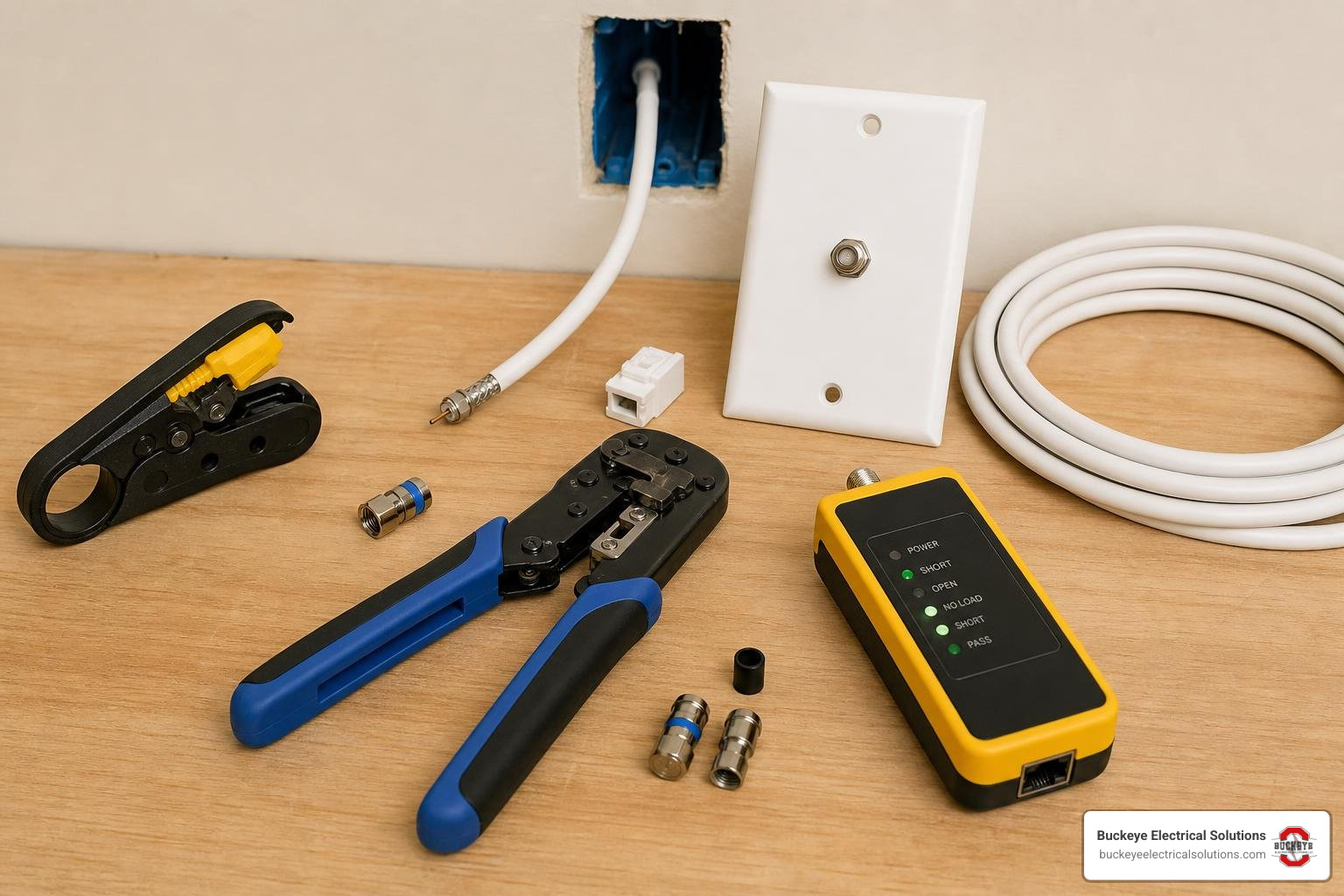
For a clean DIY coax outlet, gather everything before you start. Nothing ruins weekend momentum like realizing the one connector you bought is the wrong size.
You will typically need:
- RG6 coaxial cable: RG6 is preferred for modern TV and internet service. RG6 Quad Shield can help in areas with more signal interference.
- F-type compression connectors: These create a secure, professional termination.
- Coax compression crimper: Used to compress the F-connector onto the cable.
- Coax cable stripper: Makes clean, accurate cuts through the jacket and dielectric.
- Coax cutter: A sharp, square cut helps the connector seat properly.
- Low-voltage mounting bracket: Also called an old-work low-voltage bracket.
- Coax wall plate: The finished faceplate your cable screws onto.
- Drywall saw: For cutting the wall opening.
- Stud finder: Helps avoid studs, pipes, and hidden surprises.
- Fish tape or pull rods: Useful for routing cable through finished walls.
- Coax tester or toner: Helps identify and verify cable runs.
- 7/16-inch wrench: Commonly used for snugging coax fittings at splitters.
- Non-contact voltage tester: Used to check for nearby energized electrical wiring before cutting.
- Protective eyewear and gloves: Drywall dust and cable strands are not spa treatments.
- Labels or tape: Label both ends of each cable run.
For more detail on wall plates and wiring devices, manufacturer instructions such as Leviton installation documentation and Leviton AFCI/GFCI instructions are useful references for understanding how electrical devices differ from low-voltage coax components.
Step-by-Step Guide to DIY Coax Outlet Installation
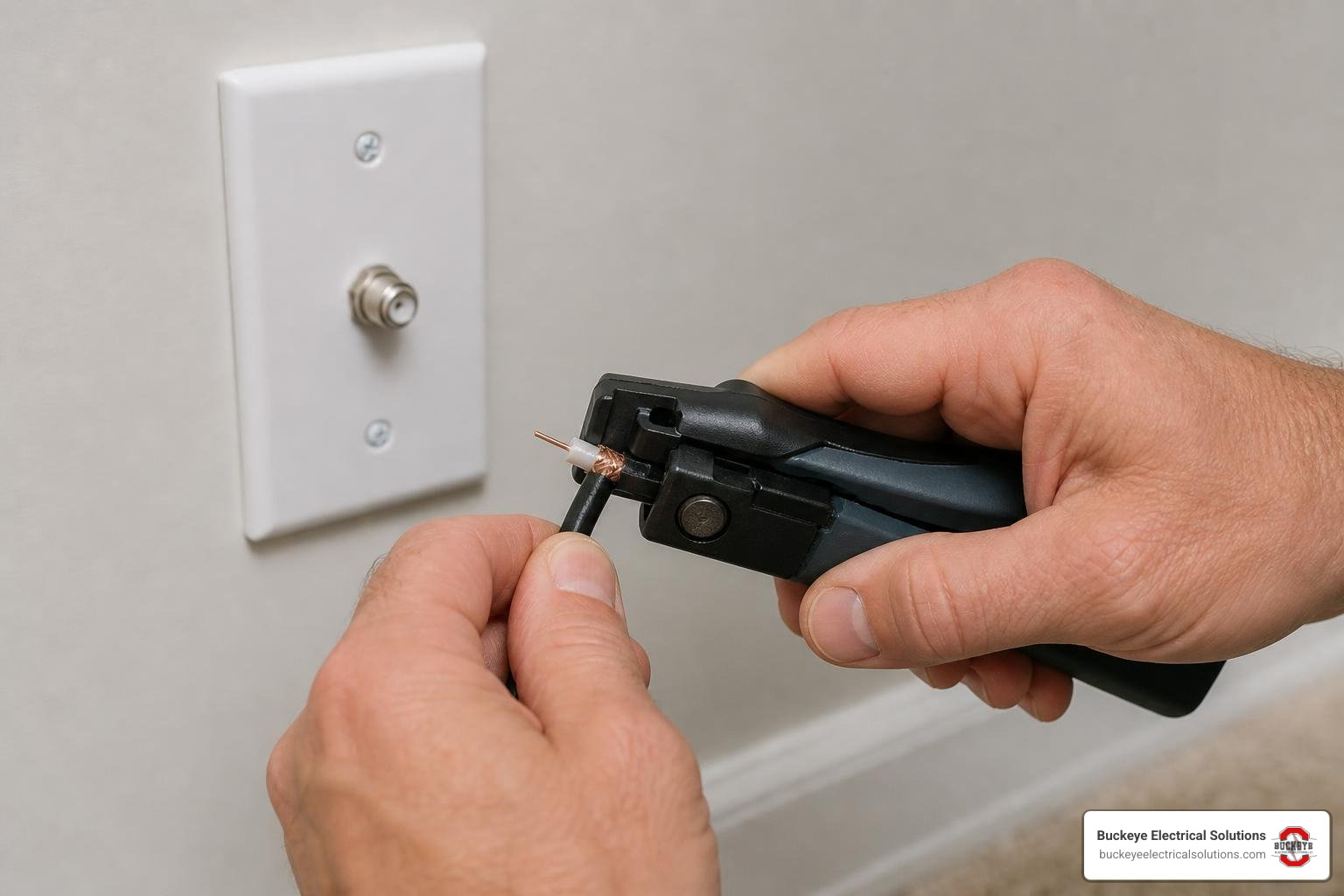
This guide assumes you are installing a low-voltage coax outlet, not a new electrical receptacle. If you encounter electrical wiring, damaged wiring, aluminum branch-circuit wiring, or any unclear power issue, stop and call a licensed Ohio electrician.
A typical installation can take around three hours, but timing depends heavily on access. A short basement-to-wall run may be simple. Fishing between floors in a finished home can turn into a puzzle box with drywall.
Preparing the Wall and Cable for Cable Outlet Installation
Choose the outlet location
Pick a spot close to the TV, modem, or media cabinet. Standard low-voltage wall plates are often installed at a similar height to nearby receptacles, but match the layout of the room and equipment.
Check the wall cavity
Use a stud finder to locate studs. Also scan for signs of plumbing, ductwork, or electrical wiring. Use a non-contact voltage tester near the work area. It is not for testing coax signal, but it can help identify nearby energized electrical wiring.
Mark the opening
Hold the low-voltage mounting bracket against the wall and trace the inside opening. Many retrofit low-voltage brackets need a small rectangular cutout. Cut carefully; drywall is easier to remove than to put back. Ask anyone who has learned this the crunchy way.
Cut the drywall
Use a drywall saw and keep the blade shallow. Avoid plunging deeply into the wall cavity.
Install the low-voltage bracket
Insert the bracket into the opening and tighten the side clamps or wings until it sits snugly against the drywall. Low-voltage brackets are different from electrical boxes. Do not run coax through an electrical box containing 120-volt wiring.
Route the coax cable
Run RG6 from the distribution point, splitter, structured media panel, basement, attic, or service entry area to the new opening. Keep the route practical and protected.
Good routing habits include:
- Avoid sharp bends and kinks.
- Keep coax separated from high-voltage wiring.
- Do not staple or clamp so tightly that the cable jacket is crushed.
- Avoid unnecessary splices and connectors.
- Seal exterior penetrations if the cable passes through an outside wall.
- Leave enough extra cable at both ends for service.
NEC rules for line-voltage cable securing do not apply to coax in exactly the same way, but they are a helpful reminder that wiring should be supported and protected. For electrical cable requirements, see the ICC sample reference for No. Code Description 334.30.
Prepare the cable end
Cut the coax square. Use a coax stripper to remove the outer jacket and expose the shielding, dielectric insulation, and center conductor. Many F-type connector installations use a strip length around 3/4 inch total, but follow the connector and stripper instructions.
Be careful not to nick the center conductor. Fold the braid back evenly over the jacket. Trim away loose foil or braid strands that could touch the center conductor. The white dielectric should remain clean and intact.
Terminating and Mounting the Cable Outlet Installation
Install the F-type compression connector
Push the connector onto the prepared coax until the dielectric sits flush inside the connector and the center conductor extends straight through the opening.
Compress the connector
Place the connector in the compression crimper and squeeze until fully seated. A properly installed compression connector should not twist or pull off by hand.
Inspect the termination
Check for:
- No loose braid strands touching the center conductor
- Straight center conductor
- Connector fully seated
- No crushed cable jacket
- No sharp bends behind the wall plate
Connect the wall plate
Screw the terminated coax onto the back of the coax wall plate. Hand-tighten, then snug gently if needed. Avoid overtightening.
Mount the faceplate
Fold the cable carefully into the wall cavity and fasten the wall plate to the bracket.
Label the cable
At the distribution point, label the new run with the room name. Future you will be grateful. Future you may even say nice things about present you.
For broader home wiring concepts, our house electrical outlet wiring masterclass explains how standard electrical outlet wiring differs from low-voltage systems like coax.
For another general overview of coax wall plate installation, see How to Install a Coax Outlet – The Home Depot.
Activating and Testing Your New Coax Outlet
A new wall plate is only useful if the other end is connected to signal. Many “dead” coax outlets are simply disconnected at the splitter.
Here is how activation usually works:
Find the service entry or distribution point
Look for a house box, structured media panel, basement splitter, utility room, or area where coax cables converge.
Identify the splitter
A splitter usually has one input port and multiple output ports. The input receives the provider signal. The outputs feed rooms.
Photograph before changing anything
Take a clear picture before moving cables. This helps restore the original setup if needed.
Find your new cable run
Use labels, a coax toner, or a continuity tester to identify the cable that goes to the new outlet.
Connect to an output port
Attach the new cable to an open output port on the splitter. If there is no open port, do not automatically add a larger splitter. Too many splits can weaken the signal. It may be better to disconnect an unused room or have the system evaluated.
Check splitter compatibility
Make sure the splitter is rated for the type of service being used. Internet, TV, satellite, and MoCA setups may have different requirements. If MoCA adapters or filters are present, do not remove them unless you know their purpose.
Test the outlet
Use a coax tester to verify continuity. For internet service, connect the modem and confirm it locks onto signal. You can also compare modem performance or speed tests before and after relocation, but signal levels are best evaluated with proper test equipment.
A multimeter may be useful for certain continuity or resistance checks, but it is not the same as a cable signal meter. If the outlet is intermittent, weak, or only works when the cable is bent a certain way, suspect a poor connector, damaged cable, bad splitter port, or excessive signal loss.
Cost references such as How Much Does Coax Cable Installation Cost? and How Much Does It Cost to Install a Coaxial Cable Outlet? commonly place professional coax outlet installation in the broad $75 to $500 range, but actual pricing in Ohio depends on site conditions, access, materials, and any AHJ requirements.
Professional vs. DIY Cable Outlet Installation
DIY coax installation can be a good fit when the cable path is open, the wall is accessible, and you are comfortable cutting drywall and terminating connectors. Professional installation is often the better choice when the project involves finished walls, multi-story routing, exterior penetrations, complex splitters, or nearby electrical systems.
| Installation option | Likely causes of added complexity | Priority level | Homeowner considerations | When to call Buckeye Electrical Solutions |
|---|---|---|---|---|
| Simple DIY wall plate replacement | Existing coax already in wall, old plate damaged, connector accessible | Low | Good beginner project if no electrical wiring is involved | If the cable is damaged, too short, or signal is unreliable |
| New outlet on same floor with basement access | Drilling through floor plate, routing through joists, identifying splitter | Medium | Requires careful drilling, routing, and labeling | If you are unsure where electrical wiring runs |
| Finished-wall cable fishing | Fire blocking, insulation, hidden pipes, limited access | Medium to high | Mistakes can mean drywall repair | If you want a clean finish with less wall damage |
| Multi-story coax run | Long cable path, signal loss, inaccessible cavities | High | Longer runs and added connectors may weaken signal | If the run may exceed practical length or needs testing |
| Modem relocation | Splitter configuration, signal level, Wi-Fi placement | Medium | Moving the modem can affect internet reliability | If service drops, speeds fall, or splitter wiring is unclear |
| Outlet near electrical upgrades | Coax and 120-volt wiring in same area | High | Low-voltage and line-voltage systems must remain separated | If any standard receptacle, GFCI, or circuit work is involved |
Professional installation offers a few major benefits:
- Cleaner wall plate placement
- Safer routing around existing electrical systems
- Better cable protection
- Proper connector termination
- Less guesswork at the splitter
- Reduced chance of weak or intermittent signal
- Help with related electrical work, such as adding a nearby receptacle
If your project includes adding an electrical outlet along with the coax outlet, see How to Add an Electrical Outlet (2026): DIY – No Electrician Needed for general background, then check Ohio and local AHJ rules before starting. For outdoor electrical boxes or weather-exposed installations, product instructions such as Hubbell MR420 outdoor recessed wall outlet enclosure instructions show how much wall type, sealing, and code compliance matter.
Frequently Asked Questions about Coax Outlets
Can a cable provider install a new coax outlet?
Sometimes, yes. A cable provider technician may install or activate a coax outlet as part of setting up internet or TV service. However, provider work is often focused on getting service connected, not necessarily on custom finished-wall routing, patch-free interior fishing, or coordinating with electrical upgrades.
A provider may handle:
- Exterior service drops
- Basic cable routing
- Modem or cable box activation
- Connecting an existing outlet to signal
- Replacing a splitter or connector related to service
A licensed electrician or qualified low-voltage installer is often better suited for:
- Clean in-wall routing
- Finished-room wall plate placement
- Routing through attics, basements, and crawlspaces
- Working near existing electrical systems
- Coordinating coax with new receptacles, TV mounting, or remodel work
- Code-aware separation from line-voltage wiring
If you are unsure who to call, think of it this way: the provider brings the signal; we help make the installation clean, safe, and practical inside the home.
What should I do if the newly installed outlet has no voltage?
Outlet has no voltage; could indicate breaker, GFCI, switch, or wiring issue.
First, clarify what kind of outlet you mean. A coax outlet is not tested the same way as a standard electrical receptacle. For coax, you are usually checking signal, continuity, or connection to a splitter. For a standard receptacle, you are checking electrical voltage.
Use the right tool:
- Use a coax tester or toner for coax cable runs.
- Use a voltage tester or receptacle tester only for electrical circuits.
- Use provider equipment or signal testing tools to verify cable internet signal.
If a nearby electrical receptacle has no power, the issue could involve a breaker, GFCI device, switch, or wiring problem. If you suspect energized wiring, improper wiring, a bootleg ground, damaged insulation, or any unsafe condition, stop work and contact a licensed electrician.
How does Ohio’s electrical code affect low-voltage coax wiring?
Ohio’s 2023 NEC adoption includes expanded GFCI requirements in several locations. Specific rules, including kitchens and similar areas, are situational rather than universal, so the exact requirement depends on the installation location and the authority having jurisdiction.
For coax specifically:
- Keep low-voltage coax separated from high-voltage electrical wiring.
- Do not run coax through electrical boxes used for 120-volt wiring.
- Use low-voltage brackets and proper wall plates.
- Protect cable from sharp edges, crushing, and moisture.
- Avoid unsafe holes through framing or exterior walls.
- Follow applicable local requirements for fireblocking and penetrations.
Professional installation helps reduce the chance of unsafe routing, especially during remodels or when coax is installed near receptacles, GFCI devices, or home office circuits. If you are reviewing inspection results or trying to understand outlet-related findings, our guide to decoding electrical inspection results may help.
Is RG6 better for cable outlet installation than older coax cable?
In most modern homes, yes. RG6 is generally preferred over older RG59 for cable internet, digital TV, and longer residential runs. RG6 has better shielding and lower signal loss than many older coax types.
RG6 Quad Shield can be a smart choice where interference is a concern, such as near certain electronics or longer cable paths. That said, cable type is only part of the equation. Signal reliability also depends on:
- Connector quality
- Splitter quality
- Cable length
- Bend radius
- Moisture protection
- Proper termination
- Whether the cable is damaged or crushed
If an older coax line is brittle, kinked, poorly terminated, or routed through questionable areas, replacing it may be better than trying to reuse it.
Why does my coax outlet have a weak or intermittent signal?
Likely causes include:
- Loose F-type connector
- Braid strand touching the center conductor
- Damaged or kinked cable
- Too many splitters
- Wrong splitter type
- Disconnected cable at the distribution point
- Excessive cable length
- Moisture in an exterior connection
- Old RG59 cable
- Poorly installed wall plate
- Signal level issue from the provider side
Start with the simple checks: tighten fittings gently, inspect the wall plate connection, and verify the cable is connected to the splitter output. If the run is long, hidden, or difficult to trace, testing equipment can save a lot of guesswork.
Conclusion
A clean coax outlet does more than make a room look finished. It protects the cable, improves connection reliability, reduces clutter, and gives your TV, modem, or home office equipment a proper connection point.
For straightforward projects, DIY cable outlet installation may be manageable with the right tools, RG6 cable, compression connectors, and patience. For finished walls, multi-story runs, modem relocation, unclear splitter wiring, or work near electrical circuits, professional help can save time and prevent bigger headaches.
At Buckeye Electrical Solutions, we help Northeast Ohio homeowners with professional electrical services and low-voltage installation support for finished rooms, home offices, entertainment spaces, remodels, and equipment upgrades. With over 20 years of experience, we focus on clean workmanship, safe routing, and prompt project completion.
If you want a cleaner wall plate, better equipment placement, or help routing coax around existing electrical systems, contact Buckeye Electrical Solutions through our services page and we will help you get wired for success.