What Every Ohio Homeowner Should Know About Their Electrical Service
Standard residential electrical service is the system that delivers electricity from your utility company into your home — and its capacity directly affects what you can safely power, now and in the future.
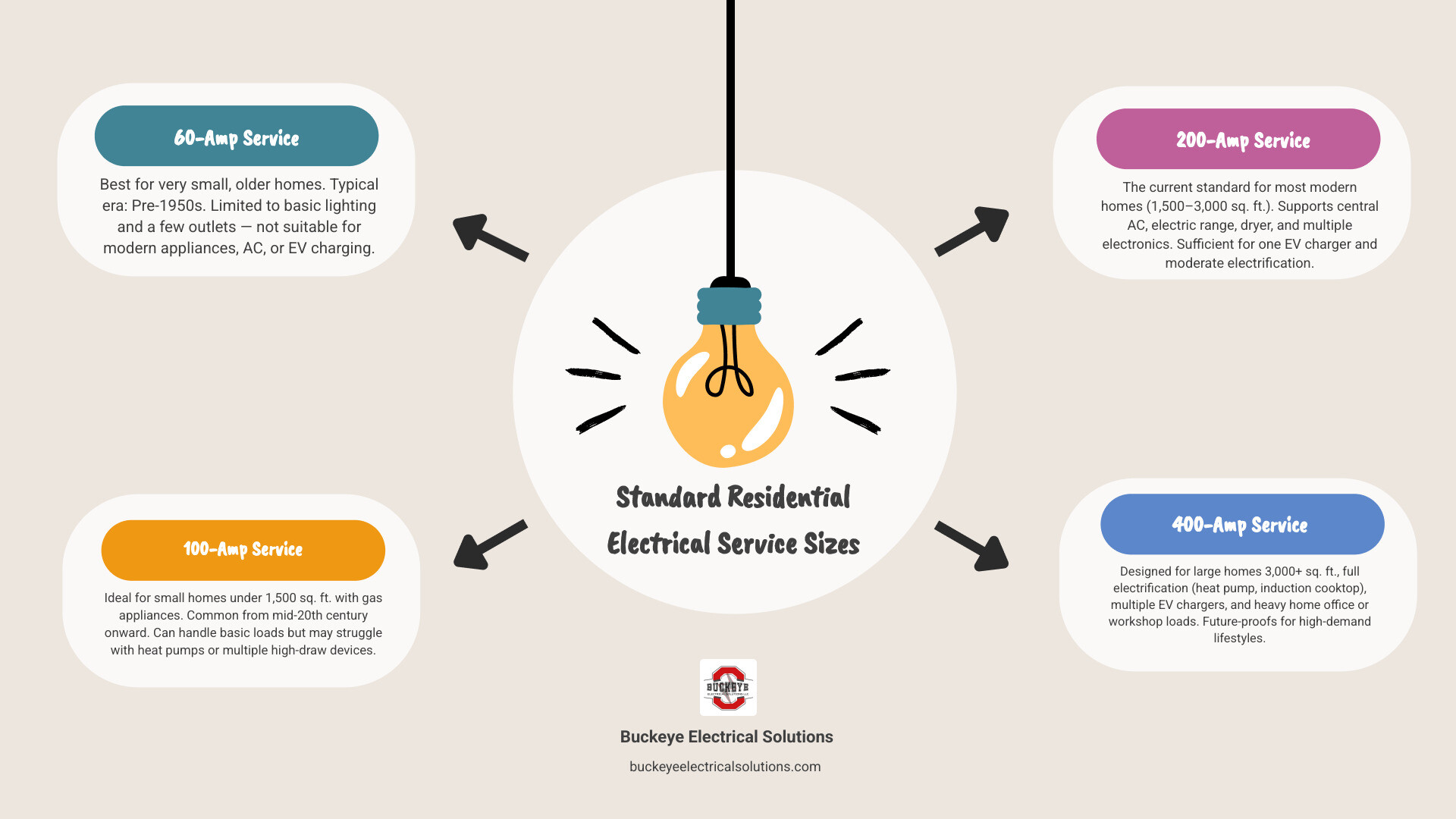
Here’s a quick overview of the most common service sizes:
| Service Size | Best For | Typical Era |
|---|---|---|
| 60-amp | Very small, older homes | Pre-1950s |
| 100-amp | Small homes under 1,500 sq. ft., gas appliances | Mid-20th century to present |
| 200-amp | Most modern homes, 1,500–3,000 sq. ft. | Current standard |
| 400-amp | Large homes 3,000+ sq. ft., full electrification, EV charging | High-demand modern homes |
More than 30 million homes in the U.S. are at least 50 years old. Many of them are still running on electrical systems that were never designed to handle today’s loads — air conditioning, EV chargers, heat pumps, and always-on electronics.
If your home is one of them, understanding your service capacity is the first step toward knowing what upgrades you may need — and what’s safe to add.
I’m Aaron Estep, owner of Buckeye Electrical Solutions and a licensed master electrician who has directed more than 60 permitted standard residential electrical service upgrades and installations across Northeast Ohio. In this guide, I’ll walk you through everything you need to know to assess your home’s electrical capacity with confidence.
Standard residential electrical service definitions:
What is a Standard Residential Electrical Service?
To understand how power safely makes its way into your living room, it helps to look at the physical pathway electricity takes. The term standard residential electrical service refers to the complete system that connects the local utility grid to your home’s internal wiring.
This pathway generally consists of several key components:
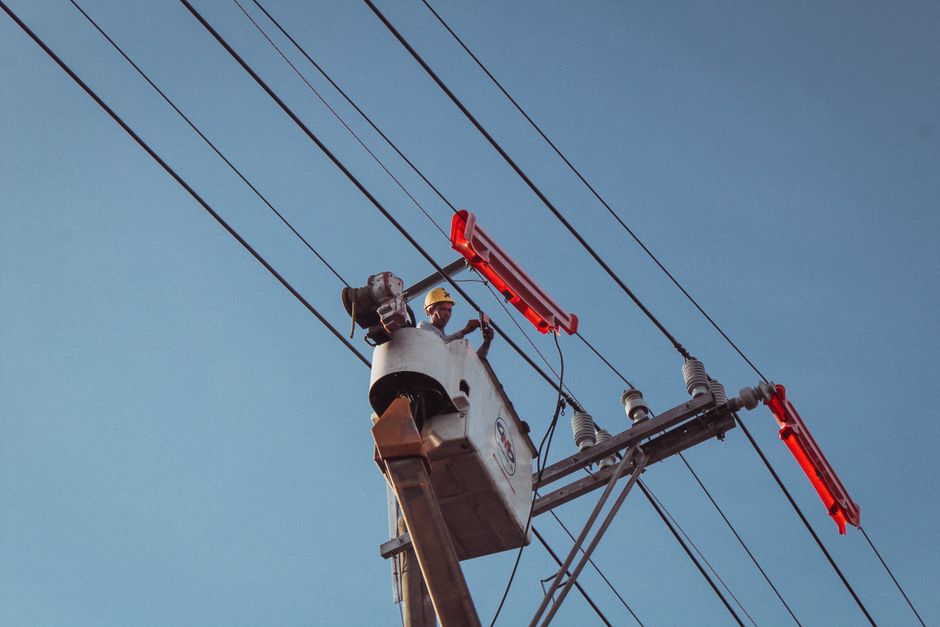
- The Service Drop or Service Lateral: This is the physical connection from the utility pole to your home. An overhead connection is called a service drop, while an underground connection is a service lateral. In standard single-phase residential applications, this connection consists of three wires: two insulated 120-volt “hot” wires and one bare neutral wire.
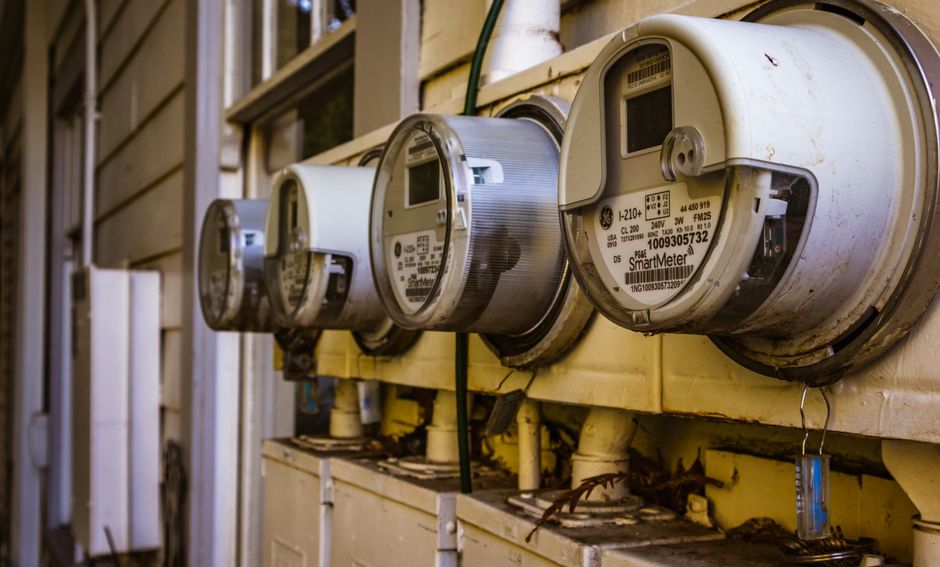
- The Electric Meter: Mounted on the exterior of your home, this device measures the exact amount of electricity your household consumes.
- The Main Breaker Panel: Often called the breaker box or distribution panel, this is the central nervous system of your home’s electrical system. It houses the main service disconnect and individual circuit breakers that protect your home from overloads.
- Distribution Wiring: The branch circuits that run from individual breakers through your walls to feed your lights, outlets, and appliances.
In the United States, standard residential systems operate on a single-phase, 120/240-volt system. This setup is highly versatile: it allows standard household electronics to run on 120 volts (using one hot wire and the neutral wire), while heavy-duty appliances like central air conditioners, electric clothes dryers, and electric ranges run on 240 volts (utilizing both hot wires simultaneously). For a deeper dive into how these elements are installed, you can read the essential guide to home electrical installation.
Sizing and safety requirements for these components are typically governed by national standards, such as the IRC 2024 Chapter 36 Services guidelines, which outline how service-entrance conductors must be insulated, supported, and routed into the building.
Sizing Your Service: 100-Amp, 200-Amp, and 400-Amp Options
When we talk about the size of an electrical service, we are referring to its amperage (amp) capacity. Amperage is a measure of the volume of electrical current that can safely flow through your main electrical panel at any one time. Choosing the right capacity depends on your home’s square footage, heating systems, and modern high-demand additions like electric vehicles (EVs).
Sizing a Standard Residential Electrical Service for Modern Demands
Sizing a home’s electrical service is not a matter of guesswork; it requires a formal load calculation. Under National Electrical Code (NEC) Article 220, professional electricians use a multi-step demand factor formula. This formula accounts for the square footage of the home (typically calculated at 3 volt-amperes per square foot for general lighting and receptacles), dedicated appliance circuits, and the specific nameplate ratings of large equipment like HVAC systems.
Historically, older building codes allowed for smaller services. However, modern building standards, including IRC Section E3601.2, typically require a minimum of a 100-ampere, 3-wire service for any single-family dwelling.
While a 100-amp service is legally compliant as a minimum, it is rarely sufficient for modern, all-electric living. For instance, a 2,400 square-foot home utilizing gas appliances and no EV charger has a calculated load of roughly 115 amperes — already exceeding the 100-amp minimum. If you add a 40-amp Level 2 EV charger, a 3-ton heat pump, and a heat pump water heater to that same home, the calculated demand can quickly climb to around 183 amperes.
This is why a 200-amp service has become the practical industry standard for new home construction and modern renovations. It provides the necessary headroom to add modern conveniences without overloading the system. You can read more about why the bare minimum might fall short in our article on why a 100-amp residential service might not be enough.
For exceptionally large homes (typically 3,000 square feet or more) or homes featuring extensive electric heating, multiple EV chargers, pool heaters, and high-end workshops, a 400-amp service is often recommended. In residential settings, a 400-amp service is frequently configured using dual 200-amp breaker panels fed from a single meter socket, which is often a more practical and cost-effective approach than sourcing a single 400-amp residential panelboard. To determine if this high-capacity option is right for you, check out our guide on 400-amp electrical panel upgrades.
To learn more about how code-enforcing bodies view these requirements, you can review the technical breakdown of the IRC 2024 Electrical Service Size: 100-Amp Minimum and 200-Amp Standard.
Sizing Service Conductors and the 83% Rule
Once the overall service size (such as 100, 200, or 400 amps) is determined, the service-entrance conductors must be sized to match. This is where electricians apply a specific mathematical concession known as the 83% rule, which is typically found in Section 310.12 of the modern National Electrical Code.
The 83% rule applies specifically to single-phase dwelling services and individual dwelling feeder conductors rated between 100 and 400 amperes. Because residential electrical loads are highly diverse and rarely run at maximum capacity simultaneously, the code allows the service conductors to be sized to handle 83% of the service rating rather than 100%.
Let’s look at how this math works for a standard 200-amp service:
- Multiply the service rating by 0.83: $$200 \text{ A} \times 0.83 = 166 \text{ A}$$
- This means the service-entrance conductors only need a minimum rated ampacity of 166 amperes at 75°C.
- Referring to the standard conductor ampacity tables, this allows the use of:
- 2/0 AWG Copper (rated for 175 amps at 75°C)
- 4/0 AWG Aluminum (rated for 180 amps at 75°C)
For a 100-amp service, the math is: $$100 \text{ A} \times 0.83 = 83 \text{ A}$$ This allows for the use of #4 AWG Copper (rated for 85 amps) or #2 AWG Aluminum (rated for 90 amps).
This rule provides significant cost savings, especially when using aluminum service-entrance cables, which are standard, reliable, and highly cost-effective for large service feeds when installed with proper torque and anti-oxidant joint compounds. For a complete technical breakdown of these calculations, you can read about sizing a residential service using the 83% rule or consult this technical reference on how to size service-entrance conductors and feeder cables.
How to Determine Your Home’s Electrical Service Capacity
If you are planning to buy an older home or are preparing to install a new high-demand appliance, you need to know your existing capacity. Fortunately, you can gather a lot of information just by looking at your electrical equipment.
Identifying Your Standard Residential Electrical Service Amperage
To safely locate and identify your service size, follow these steps:
- Locate Your Main Service Panel: This is typically found in a utility room, basement, garage, or on the exterior wall of your home. It is the panel that is physically closest to where the outdoor electric meter is mounted.
- Identify the Main Breaker: Open the panel door. At the very top (or occasionally the bottom) of the panel, you will see a large, double-pole circuit breaker that is physically separated from the rest of the individual branch breakers. This is your main service disconnect.
- Read the Amperage Rating: Look for a number printed, stamped, or embossed on the handle of this main breaker switch.
- If it reads 100, you typically have a 100-amp service.
- If it reads 200, you typically have a 200-amp service.
- If you see a fuse block labeled “MAIN” instead of a breaker, your home likely utilizes an older fuse panel, which is commonly rated at 60 amps or less.
- Check the Outdoor Electric Meter: If the main panel is unlabeled or difficult to read, walk outside and look at your electric meter. Modern digital meters often display a classification rating. Look for the designation CL200 on the meter faceplate, which indicates that the meter itself has a physical capacity of 200 amps. While a CL200 meter indicates 200-amp physical capacity, your actual service size is still limited by the rating of your main breaker and service-entrance conductors.
- Differentiate Main Panels from Subpanels: Be careful not to mistake a subpanel for your main panel. Subpanels are secondary panels installed to add circuit capacity in specific areas of the home (like a finished basement or garage). Subpanels do not increase your home’s overall electrical service capacity; they are fed directly from the main panel. The main panel is always the one containing the primary service disconnect closest to the meter.
For safety and flexibility, some homeowners install their main breaker panel outside next to the meter. To learn more about this configuration, read about having a 200-amp breaker box outside.
Safety Warning: Never remove the metal dead-front cover of your electrical panel yourself. While looking at the breakers with the door open is perfectly safe, removing the safety cover exposes live, uninsulated busbars. Always contact a certified local electrician to perform a physical inspection of your system’s interior.
When to Upgrade Your Electrical Service and Panel
An electrical service that was perfectly adequate thirty years ago may be struggling to keep up with modern life today. Overloading an outdated system is not just frustrating; it poses a genuine safety hazard.
If you are living in an older home, keep an eye out for these common warning signs that your electrical service is insufficient or failing:
- Flickering or Dimming Lights: If your lights briefly dim when your refrigerator, microwave, or central air conditioner kicks on, your system is experiencing a momentary voltage drop because it cannot supply enough current instantly.
- Frequent Breaker Trips: If you cannot run a vacuum cleaner and a hair dryer in the same room without tripping a breaker, your branch circuits — and potentially your main panel — are overloaded.
- Outdated Fuse Boxes: Fuses are not inherently unsafe, but they are outdated. Because older fuse boxes were typically limited to 30-amp or 60-amp capacities, they are highly prone to overloading in modern homes.
- Knob-and-Tube or Aluminum Wiring: Homes built between the late 1800s and 1930s often utilize knob-and-tube wiring, which lacks a grounding conductor. Similarly, homes wired with single-strand aluminum wiring in the late 1960s and early 1970s require careful inspection, as poor terminations on non-rated devices can lead to loose connections and fire hazards. If your home features these older materials, you can read our guide on old house electrical upgrades to learn how to address them safely.
If you decide to upgrade, a standard transition from a 100-amp to a 200-amp service typically costs between $1,500 and $4,000, while upgrading to a 400-amp service typically ranges from $3,000 to $8,000. These estimates are highly dependent on local site conditions, utility company requirements, and local authority having jurisdiction (AHJ) permitting fees. For a complete breakdown of project expectations, see our guide on panel upgrade or replacement costs.
To help you assess your system, here is a quick-reference table of common household electrical symptoms:
| Symptom | Likely Causes | Priority Level |
|---|---|---|
| Flickering lights when large appliances start | Momentary voltage drop; undersized service or utility-side issue | Medium |
| Frequent individual circuit breaker trips | Overloaded branch circuit; too many devices on one line | High |
| Warm-to-the-touch panel cover or buzzing noises | Loose connections; failing circuit breaker; potential safety hazard | Immediate |
| Outlet has no voltage; could indicate breaker, GFCI, switch, or wiring issue | Tripped GFCI; loose wire termination; improper wiring or bootleg ground | High |
| Frequent burning smells near outlets or panel | Arcing wires; melting insulation; potential fire risk | Immediate |
Safety, Grounding, and Generator Integration Requirements
Your electrical service does not just bring power in; it also contains critical safety pathways designed to redirect dangerous currents away from your family and electronics.
When upgrading or installing a standard residential electrical service, several key safety systems must be addressed:
- The Grounding Electrode System: This system physically bonds your electrical panel to the earth. It typically consists of a copper grounding electrode conductor connected to two driven copper-clad steel ground rods spaced at least six feet apart, as well as a connection to your home’s metal underground water piping (if present). This pathway safely dissipates high-voltage surges, such as those from lightning strikes, into the ground.
- Surge Protection: Modern electrical codes, including those adopted in many Ohio jurisdictions, require a whole-house Type 1 or Type 2 surge protective device (SPD) to be installed at or immediately adjacent to the main service panel. This protects your home’s sensitive electronic appliances from transient voltage surges originating from the utility grid.
- Emergency Disconnects: Recent code updates typically require an outdoor emergency disconnect switch to be installed on the exterior of the home. This allows first responders (such as firefighters) to safely cut off all power to the structure from the outside before entering during an emergency.
- Generator Integration: If you are planning to install a standby or portable generator, your service size directly dictates how it must be integrated. To operate safely, a generator must connect to your home via a dedicated transfer switch (either manual or automatic). This switch physically isolates your home from the utility grid when the generator is running. Do not backfeed electricity through improper transfer equipment (such as a double-male extension cord plugged into an outlet); doing so can send high-voltage electricity back into the utility lines, putting utility workers at risk of electrocution. To ensure your backup system is sized correctly, read about how size matters when choosing a backup generator.
Frequently Asked Questions About Residential Electrical Services
What is the minimum electrical service size required for new homes in Ohio?
Under general building codes, such as IRC Section E3601.2, the absolute minimum required size for a single-family dwelling is a 100-ampere, 3-wire service. However, in modern construction practice across Northeast Ohio, a 200-ampere service is the standard to accommodate modern cooling, heating, and vehicle charging demands.
Additionally, while some Ohio jurisdictions have adopted the 2023 NEC (National Electrical Code) rules, these requirements are highly situational rather than universal. For instance, expanded ground-fault circuit interrupter (GFCI) protection is typically required in kitchens, bathrooms, unfinished basements, garages, and outdoor receptacles, but the exact application and enforcement can vary significantly depending on local code adoption and your specific project scope.
How does my electrical service size affect whole-house generator sizing?
Your home’s electrical service size acts as the baseline for sizing a backup generator. Whole-house standby generators are typically rated in kilowatts (kW) or watts, while larger commercial systems may also use kVA ratings.
When installing a generator, an electrician must perform a detailed load calculation. If you have a 200-amp service and wish to back up the entire home seamlessly, you will generally require a larger generator (typically 20kW to 26kW) paired with a 200-amp automatic transfer switch. Alternatively, you can use a smaller generator paired with a transfer switch that only powers selected critical circuits (like your refrigerator, heating system, sump pump, and select lights).
Can unpermitted electrical service upgrades affect my home insurance?
Yes. Upgrading an electrical service is a major structural modification that requires both a permit from your local building department and coordination with your utility company.
The local Authority Having Jurisdiction (AHJ) must inspect and approve the installation to ensure it complies with all safety codes. If an electrical fire occurs and an investigation reveals that the service panel was upgraded without permits or inspections, unpermitted work can complicate insurance claims and may lead to a denial of coverage. Working with a licensed, insured electrical contractor is the best way to guarantee your project is fully permitted, inspected, and compliant.
Conclusion
Your home’s standard residential electrical service is the foundation of your daily comfort and safety. Whether you are living in an older Northeast Ohio home with a tired 100-amp panel, or you are looking to prepare your home for an electric vehicle or a standby generator, understanding your electrical capacity is the first step toward a safer, more efficient home.
Because working with service-entrance conductors involves handling live utility lines that cannot be turned off by a standard breaker, these projects are strictly the domain of licensed professionals.
At Buckeye Electrical Solutions, our team of certified electricians has spent over 20 years helping homeowners across Northeast Ohio upgrade, repair, and maintain their electrical systems safely and efficiently. We handle the entire process — from load calculations and permitting to utility coordination and final inspection — so you can enjoy reliable power without the stress.
If you are ready to evaluate your home’s electrical capacity or plan an upgrade, contact us today to schedule a professional consultation. Discover how we can help you power your home safely by exploring our residential electrical services.