Why a Generator Sizing Guide Is the First Step to Reliable Backup Power
A good generator sizing guide can mean the difference between a generator that works when you need it most — and one that fails, overloads, or wastes money every time it runs.
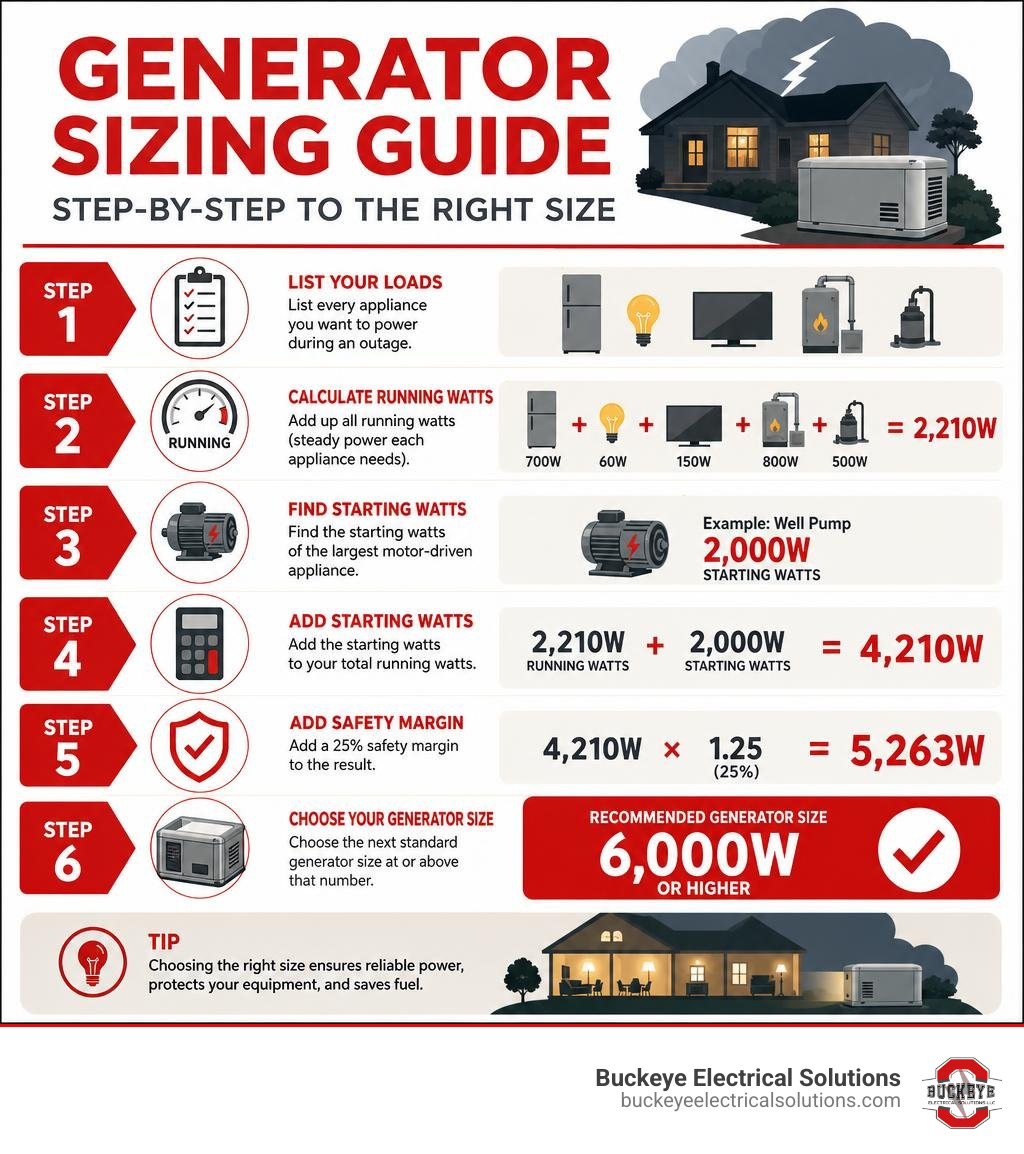
Here is a quick answer to help you size your generator:
| Step | What To Do |
|---|---|
| 1 | List every appliance you want to power during an outage |
| 2 | Add up all running watts (steady power each appliance needs) |
| 3 | Find the starting watts of the largest motor-driven appliance |
| 4 | Add that starting watts figure to your total running watts |
| 5 | Add a 25% safety margin to the result |
| 6 | Choose the next standard generator size at or above that number |
Getting the size wrong has real consequences. A generator that is too small can overload, stall, or cause connected equipment to operate improperly. A generator that is too large burns more fuel than needed and runs inefficiently — and in diesel units, prolonged light loading can create maintenance concerns.
Neither outcome is good. And in Northeast Ohio, where ice storms and summer thunderstorms can knock out power for days, picking the right size matters even more.
I’m Aaron, owner of Buckeye Electrical Solutions LLC and a master electrician who has directed more than 60 permitted electrical projects across the region — including whole-home upgrades and standby generator installations that required precise load calculations. In this generator sizing guide, I’ll walk you through exactly how to size your generator correctly, step by step.
To help you get started, we have put together resources covering electrical generator service, a detailed generator installation guide, and tips for setting up a safe portable generator hookup.
The Ultimate Generator Sizing Guide for Ohio Homeowners
A generator is not sized by guessing, by square footage alone, or by picking the biggest unit that fits the budget. It is sized by calculating the electrical load you expect it to carry during an outage.
For Ohio homes, that often means deciding whether you want to power:
- Essentials only: refrigerator, furnace blower, sump pump, lights, internet, medical equipment
- Comfort loads: microwave, garage door opener, well pump, selected outlets
- Larger loads: central air conditioning, electric range, electric dryer, electric water heater
- Whole-home loads: nearly everything, with or without load management
The right generator capacity protects system reliability, helps avoid equipment damage, improves fuel efficiency, and gives your transfer switch and electrical panel a safer operating setup. For installation planning, our backup generator installation guide explains what homeowners should expect before the work begins.
Why You Need a Generator Sizing Guide
A generator sizing guide helps you avoid two expensive mistakes.
First, an undersized generator may overload when motors start. That can cause voltage sag, breaker trips, generator shutdown, overheating, or damage to sensitive equipment. If your sump pump, refrigerator, furnace blower, and well pump all try to run at once, a small generator can get bullied fast.
Second, an oversized generator costs more to buy, install, fuel, and maintain. Generators usually operate best when they carry a healthy portion of their rated load. Running a large unit lightly for long periods can waste fuel and reduce efficiency.
Correct sizing helps with:
- Equipment protection
- Fuel economy
- Generator lifespan
- Transfer switch compatibility
- Safer operation
- Better outage performance
- Future planning
In short: generator sizing is not about bragging rights. Nobody needs a “monster generator” if a properly sized one will do the job better.
How to Use a Generator Sizing Guide for Accurate Calculations
To size a generator accurately, you need three things:
- A list of what you want to power
- The running watts for each item
- The starting watts for motor-driven equipment
You can usually find wattage on the appliance nameplate, in the manual, or by converting volts and amps:
| Formula | Use |
|---|---|
| Watts = Volts x Amps | When the label lists voltage and amperage |
| Kilowatts = Watts / 1,000 | To convert watts to generator kW |
| kW = kVA x Power Factor | Often used for commercial or larger systems |
Residential generators are usually rated in watts or kilowatts, while larger systems may also use kVA.
For most homes, a 25% safety margin is a common planning estimate. For homes with several motors, such as central air conditioning, sump pumps, well pumps, and refrigeration equipment, a larger margin may be appropriate. For whole-home and commercial systems, we recommend a professional load calculation rather than relying only on appliance charts.
Running Watts vs. Starting Watts: The Core of Generator Sizing
Running watts are the steady power an appliance needs after it is already operating. Starting watts, also called surge watts or inrush current, are the extra power needed for a few seconds when a motor starts.
This matters because motors are demanding at startup. A refrigerator may run at a modest wattage but need several times more power when the compressor kicks on. Pumps, air conditioners, furnace blowers, and power tools behave the same way.
Common examples:
| Load Type | Running Watts | Starting Watts |
|---|---|---|
| Refrigerator/freezer | Moderate | Often much higher |
| Sump pump | Moderate to high | High |
| Furnace blower | Moderate | Higher at startup |
| Central AC | High | Very high |
| Lights/TV/router | Usually steady | Little or no surge |
Starting current for motors can be 5 to 10 times running current for a brief moment. Some consumer guides simplify this as starting watts being 2 to 3 times running watts, but larger motors and compressors can demand more.
Understanding Resistive vs. Inductive Loads
Not all electrical loads behave the same.
Resistive loads convert electricity directly into heat or light. Examples include incandescent lights, space heaters, toasters, and some electric cooking elements. These loads are usually straightforward because their starting and running wattage are nearly the same.
Inductive loads use motors or magnetic fields. Examples include refrigerators, HVAC equipment, sump pumps, well pumps, compressors, and furnace blowers. These loads need extra starting power and can affect voltage stability.
Non-linear loads include some electronics, battery chargers, computers, and variable-speed equipment. These may create power quality concerns in larger systems, especially commercial applications.
For deeper technical background, resources like Generator Sizing Guides from Generator Source discuss how commercial and industrial loads are evaluated. For Ohio homeowners, the practical takeaway is simple: motors matter.
The Bicycle Momentum Analogy for Motor Starting
Think of motor starting like riding a bicycle uphill.
Starting from a dead stop takes a big push. Once you are moving, it takes much less effort to keep going. Electric motors behave similarly. At startup, a motor has no momentum, so it briefly pulls high current. Once spinning, it settles into its normal running load.
That startup demand is why locked rotor amps, starting watts, and voltage dip matter. If the generator cannot handle that short surge, the motor may stall, lights may dim, or the generator may trip offline.
This is also why you usually do not add every appliance’s starting watts together. In many residential calculations, we add all running watts and then add the largest single starting surge. That assumes not every motor starts at the exact same instant. For complex homes or businesses, sequencing and load management become more important.
Step-by-Step Load Calculation Methods for Ohio Homes
There are four main ways to size a generator:
- Load summation method
- Billing history method
- Real-time measurement
- Online calculators
Each has its place.
| Method | Accuracy | Likely Causes | Priority Level |
|---|---|---|---|
| Load summation | Good for homes | Missing appliances, using estimated watts, ignoring starting loads | High |
| Billing history | Useful for whole-home trends | Utility bills may not show true peak demand or outage priorities | Medium |
| Real-time measurement | Very good when done correctly | Measuring during a low-load season or missing startup surges | High |
| Online calculators | Helpful for planning | Generic assumptions, incomplete appliance lists | Medium |
Online tools can be useful for early planning. For example, a home standby generator calculator can help you think through appliance categories. Just remember: a calculator is not a permit-ready electrical design.
The Load Summation Method Explained
This is the most common homeowner-friendly method.
Step 1: Make an appliance inventory.
List everything you want to run during an outage:
- Refrigerator
- Freezer
- Furnace blower
- Sump pump
- Well pump
- Lights
- Internet equipment
- Medical equipment
- Microwave
- Garage door opener
- Central AC or window AC
- Electric water heater, if needed
Step 2: Find running watts.
Use the nameplate or manual whenever possible. If you only see amps, use:
Watts = Volts x Amps
Example:
A 120V appliance drawing 6 amps uses about 720 watts.
Step 3: Add all running watts.
Example:
| Appliance | Running Watts |
|---|---|
| Refrigerator | 700 |
| Freezer | 600 |
| Furnace blower | 800 |
| Sump pump | 1,000 |
| Lights and outlets | 1,200 |
| Internet and electronics | 300 |
| Microwave | 1,200 |
| Total running watts | 5,800 |
Step 4: Add the largest starting surge.
If the sump pump has the largest starting requirement at 3,000 watts, add that to the running load:
5,800 + 3,000 = 8,800 watts
Step 5: Add a safety margin.
8,800 x 1.25 = 11,000 watts
In this example, we would look at the next standard generator size at or above 11 kW, then verify voltage, transfer switch type, fuel source, and installation conditions.
Ohio Electrical Codes and GFCI Requirements
Generator installation involves both load sizing and safety requirements.
Ohio jurisdictions may apply the 2023 NEC or other adopted code requirements, depending on location and project scope. Specific rules, such as kitchen GFCI protection, can be situational depending on circuit type, location, equipment, and how the NEC language applies to the installation. That is one reason we do not recommend treating internet checklists as final code guidance.
Important code and safety considerations include:
- Proper transfer switch installation
- Correct grounding and bonding
- Overcurrent protection
- Generator disconnecting means
- GFCI protection where required
- Weather-rated equipment
- Conductor sizing
- Fuel piping requirements
- Working clearance around electrical equipment
- Local AHJ permitting and inspection
Improper wiring, bootleg ground conditions, and unsafe generator connections can create shock and fire hazards. Do not backfeed a home through a dryer outlet or standard receptacle. That can backfeed utility lines and endanger lineworkers, neighbors, and your own equipment.
Advanced Sizing Factors: Motors, Future Growth, and Environmental Derating
Once you have a basic wattage estimate, you still need to think about real-world conditions.
A good generator plan accounts for:
- Motor starting loads
- Load growth
- Seasonal demand
- Future additions
- Fuel type
- Runtime expectations
- Temperature and humidity
- Maintenance access
- Transfer switch limitations
Ohio homes can have very different seasonal loads. In winter, the priority may be furnace blowers, boiler controls, heat tape, freezers, and sump pumps. In summer, central AC and dehumidification may dominate the load.
If you expect to add a hot tub, EV charger, larger AC system, workshop equipment, or finished basement, tell your electrician before sizing the generator. Future expansion is much easier to plan before installation than after the concrete pad is poured and the transfer switch is mounted.
Accounting for Motor Starting Loads and Soft Starters
Motor loads deserve extra attention.
Motor nameplates may include horsepower, amps, voltage, phase, and sometimes NEMA code letters. Those NEMA letters help estimate locked-rotor kVA, which is the apparent power needed when the motor starts.
For homes, we usually see motor starting concerns with:
- Central air conditioners
- Heat pumps
- Sump pumps
- Well pumps
- Sewage ejector pumps
- Refrigerators and freezers
- Air compressors
- Furnace blowers
In some cases, a soft starter or variable frequency drive can reduce starting current. Soft starters may reduce the hard jolt of startup by ramping voltage. VFDs can ramp motor speed more gradually. These devices are not right for every appliance, but they can be valuable in some generator applications, especially where a large motor would otherwise force a much bigger generator.
Environmental and Operational Derating in Ohio
Generators are engines, and engines care about their environment.
Ohio does not have the extreme elevation challenges found in mountainous states, but elevation can still slightly reduce output depending on the exact location and manufacturer specifications. Heat, humidity, snow, ice, and airflow restrictions are usually more practical concerns here.
Key Ohio factors include:
- Summer humidity can increase operating stress
- Winter cold can affect batteries and starting reliability
- Snow and leaves can block airflow if the unit is not kept clear
- Ice can create access and drainage issues
- Seasonal load shifts can change what the generator must support
Placement matters too. Generators must never run indoors, in garages, in sheds, or near open windows. Carbon monoxide is not “a little dangerous.” It is deadly. Outdoor standby generators also need manufacturer-required clearances for airflow, exhaust, service access, and distance from openings.
For generators expected to run for long periods, avoid loading them at their absolute maximum continuously. Many sizing practices aim to keep sustained operation below full rated capacity, often around 70% to 80% depending on generator type and application. Commercial or prime-power systems may require additional thermal margin.
Selecting the Right Generator Type and Transfer Switch
The right generator is not just about kW. It is also about how you plan to use it.
Most Ohio homeowners choose among three categories:
| Generator Type | Best For | Notes |
|---|---|---|
| Portable generator | Essentials, temporary backup | Requires safe manual connection and fuel management |
| Inverter generator | Sensitive electronics, quieter portable use | Usually smaller capacity, cleaner power output |
| Standby generator | Automatic home backup | Permanently installed with transfer switch |
Fuel type also affects sizing and performance.
| Fuel | Advantages | Considerations |
|---|---|---|
| Natural gas | Continuous supply if available, no refueling | Output may be lower than gasoline/diesel ratings; gas meter and piping must be adequate |
| Propane | Good for rural homes, stores well | Tank size and cold-weather vaporization matter |
| Gasoline | Common for portable units | Shorter storage life, manual refueling, fumes |
| Diesel | Efficient for larger loads | Maintenance concerns if lightly loaded for long periods |
For many Ohio homes with existing gas service, natural gas standby generators are convenient. For rural properties without natural gas, propane may be the better fit.
Portable vs. Standby Generators
Portable generators can be a practical option for essential circuits. They are less expensive upfront than standby systems, but they require more homeowner involvement. You need to move the unit outside, connect it safely, manage fuel, and start it manually.
A portable generator should be connected through approved equipment such as a manual transfer switch or properly installed inlet and interlock system where permitted. Our safe portable generator hookup guide explains the basics.
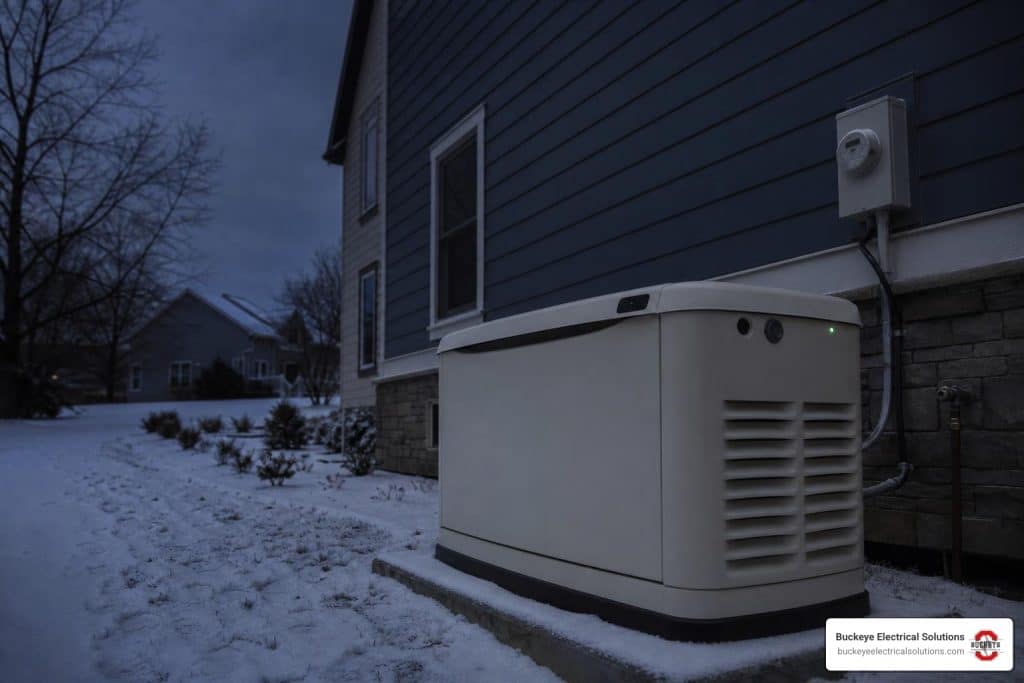
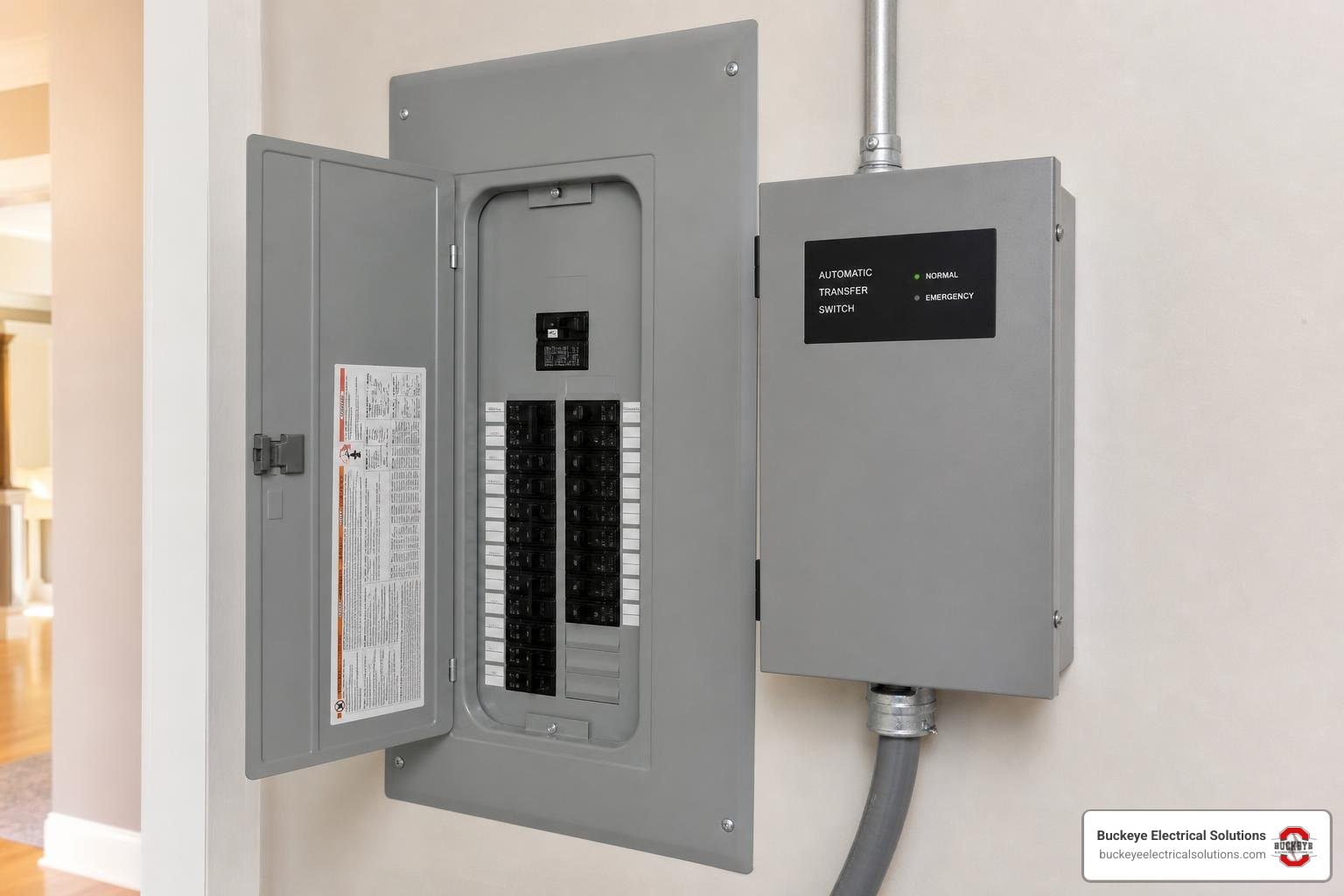
Standby generators are permanently installed outside and paired with an automatic transfer switch. When utility power fails, the transfer switch detects the outage, starts the generator, transfers selected loads or the whole service, and then switches back when utility power returns.
Standby systems are usually best for:
- Medical equipment needs
- Frequent outages
- Sump pump protection
- Whole-home comfort
- Homeowners who travel
- Businesses that cannot tolerate downtime
Choosing the Right Transfer Switch
The transfer switch is the device that prevents generator power and utility power from being connected at the same time. It is one of the most important safety components in the entire system.
Common options include:
Manual transfer switch
Used with many portable generators. You decide when to start the generator and transfer selected circuits.
Load center automatic transfer switch
Often used when backing up selected circuits only. It can be a good choice when you want essentials without powering the full home.
Service-rated automatic transfer switch
Often used for whole-home standby systems. It can serve as service equipment when designed and installed correctly.
Important transfer switch questions include:
- Are we backing up selected circuits or the whole service?
- Is the switch service-rated?
- Does the system need load shedding?
- Is the generator single-phase 120/240V?
- Are large loads like AC, range, dryer, or water heater included?
- Does the installation meet Ohio code and AHJ requirements?
Never backfeed generator power into a home’s wiring without proper transfer equipment. The transfer equipment must isolate the generator from the utility.
Frequently Asked Questions about Generator Sizing
What happens if I buy a generator that is too small?
An undersized generator may overload, trip breakers, shut down, or fail to start motor-driven appliances. You may also see voltage sag, flickering lights, overheating, or equipment that runs poorly.
The biggest problems usually happen when a motor starts. A sump pump, well pump, or air conditioner can demand several times its running wattage for a few seconds. If the generator cannot handle that surge, it may stall or drop voltage enough to affect other connected loads.
Possible results include:
- Generator overload shutdown
- Appliance malfunction
- Shortened generator life
- Damaged motors or electronics
- Loss of critical loads during an outage
This is why we size for both running watts and starting watts.
What should I do if my generator runs but a connected outlet has no voltage?
Outlet has no voltage; could indicate breaker, GFCI, switch, or wiring issue.
Start with simple, safe checks:
- Confirm the generator breaker is on.
- Check whether a GFCI outlet or breaker has tripped.
- Verify the transfer switch is in the correct position.
- Make sure the cord, inlet, and plug are fully seated.
- Check whether the affected circuit breaker in the panel has tripped.
- Stop using the circuit if you smell burning, see damage, or feel heat.
Do not remove panel covers or test energized parts unless you are qualified to do so. Generator systems can involve lethal voltage. If the problem is not obvious, call a licensed electrician.
How does Ohio’s climate affect generator performance?
Ohio weather affects both generator sizing and reliability.
In winter, cold temperatures can make batteries weaker and oil thicker. Standby generators may need cold-weather kits, battery warmers, or maintenance attention depending on model and location. Snow must be kept away from air intakes and exhaust paths.
In summer, humidity and heat can increase operating stress. Cooling loads can also be much higher if you want to run central air conditioning during an outage.
Seasonal planning matters. A generator sized only around winter furnace needs may not support summer AC. A generator sized only around summer comfort may be larger than needed for winter essentials. The best design considers both.
Conclusion
The right generator size gives you reliable backup power without wasting fuel, overloading equipment, or creating avoidable safety hazards. The process starts with a clear load list, accurate running watts, realistic starting watts, and the right safety margin.
For simple portable setups, a careful homeowner estimate can help with early planning. For whole-home standby generators, larger homes, commercial properties, or any system tied into your electrical panel, professional sizing is the smarter route.
At Buckeye Electrical Solutions, we help Ohio homeowners and businesses plan safe, code-compliant generator installations backed by more than 20 years of electrical experience. We evaluate your loads, transfer switch needs, fuel considerations, panel capacity, and local AHJ requirements so your generator is ready when the lights go out.
If you want peace of mind before the next Northeast Ohio storm, schedule a professional generator consultation with Buckeye Electrical Solutions through our electrical services page.