
Why Business Electric Contracts Can Make or Break Your Budget
Business electric contracts are formal agreements between a commercial customer and an electricity supplier that define how much you pay, for how long, and under what terms.
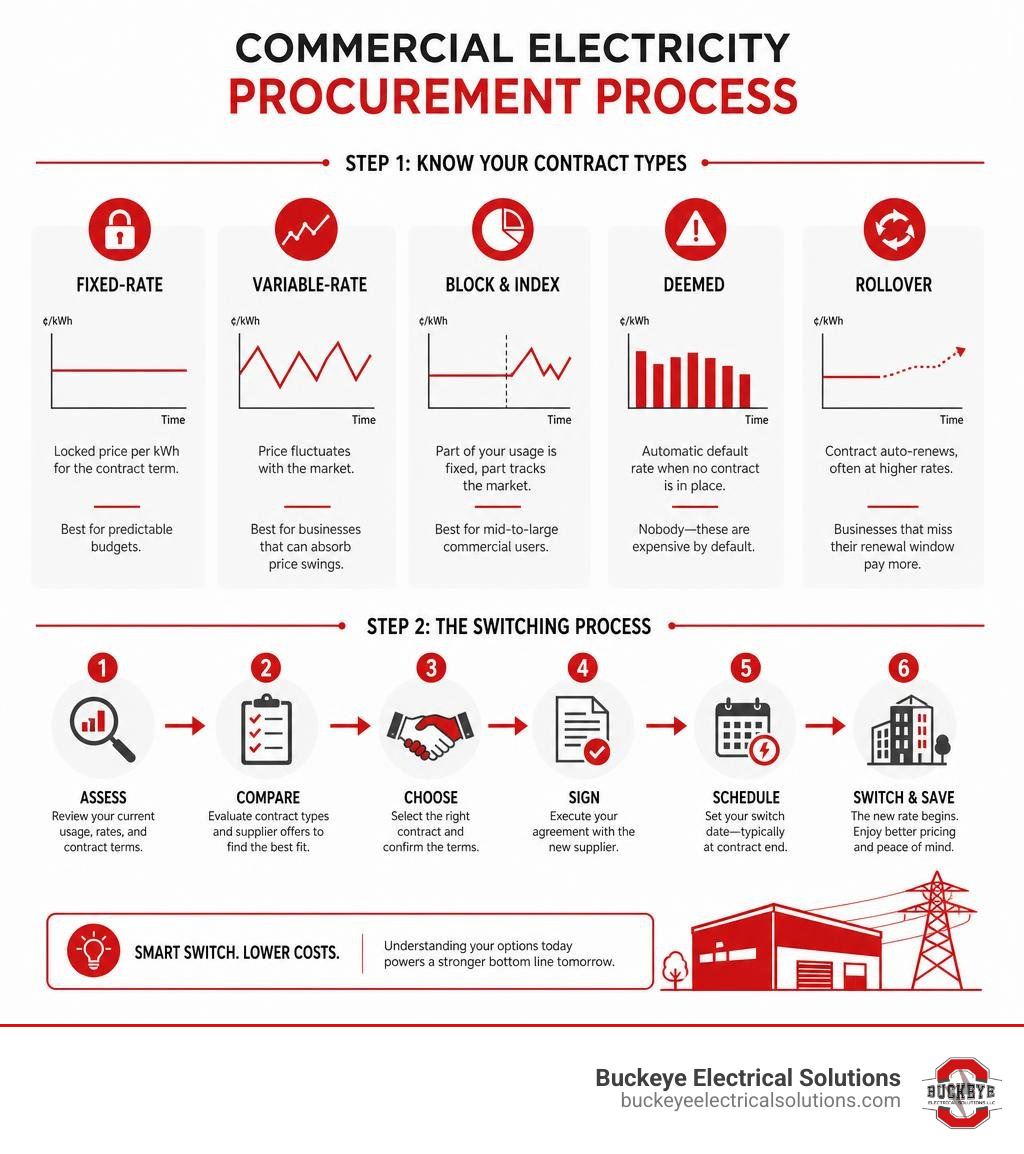
Here’s a quick breakdown of the most common contract types:
| Contract Type | What It Means | Best For |
|---|---|---|
| Fixed-rate | Locked price per kWh for the contract term | Businesses that want predictable bills |
| Variable-rate | Price fluctuates with the market | Businesses that can absorb price swings |
| Block & Index | Part of your usage is fixed, part tracks the market | Mid-to-large commercial users |
| Deemed | Automatic default rate when no contract is in place | Nobody — these are expensive by default |
| Rollover | Contract auto-renews, often at higher rates | Businesses that miss their renewal window |
The average business now pays 14.12¢ per kWh (June 2026) — up 33% since 2020. That’s not a rounding error. For most businesses, electricity is one of the largest controllable operating costs on the books.
And yet, many businesses end up on the worst possible rates simply because they didn’t know their options — or missed a renewal deadline and got rolled into a default contract without realizing it.
This guide explains how commercial electricity supply agreements work, what drives your costs, and how to make smarter contract decisions that protect your bottom line.
I’m Aaron Estep, owner of Buckeye Electrical Solutions LLC and a licensed master electrician based in Northeast Ohio with hands-on experience across dozens of permitted commercial projects — work that puts me right at the intersection of a building’s electrical infrastructure and its business electric contracts. Understanding both sides of the equation is exactly what this guide is built on.
Quick business electric contracts terms:
Understanding the Ohio Deregulated Energy Market
Ohio is a deregulated electricity state. That means many businesses can choose who supplies the generation portion of their electricity, even though the local utility still owns and maintains the poles, wires, transformers, meters, and distribution system.
In plain English: your utility still delivers the power, but you may be able to shop for the company that sells you the electricity itself.
The Public Utilities Commission of Ohio, or PUCO, oversees Ohio’s electric utility market and provides consumer guidance on supplier choice. If you are considering a supplier change, PUCO’s guide to choosing an electric supplier is a helpful starting point.
You can also review Ohio plan information through resources such as Ohio electricity rate comparison tools, but businesses should always read the contract terms carefully before signing. The lowest advertised rate is not always the lowest actual bill.
How Deregulation Shapes Business Electric Contracts
Deregulation separates electricity into two main buckets:
| Part of Service | Who Handles It | Can You Shop It? |
|---|---|---|
| Generation or supply | Retail electric supplier or utility default service | Often, yes |
| Transmission and delivery | Local electric utility | Usually no |
| Metering and outage response | Local electric utility | No |
| Taxes, riders, and regulated fees | Utility, regulators, or government entities | No |
In Ohio, competitive retail electric service providers are often called CRES providers. These suppliers can offer different contract structures, term lengths, renewable options, and pricing formulas.
That choice can be powerful. It can also be confusing. A contract may advertise a low supply rate but include early termination fees, automatic renewal language, minimum usage provisions, demand-related charges, or pass-through costs. The fine print is where the budget gremlins hide.
For Ohio businesses, the goal is not just “find a cheap rate.” The goal is to match the contract to your building, operating schedule, electrical load, and cash-flow needs.
Commercial vs. Residential Electricity Rates
Commercial and residential electricity rates are not built the same way. A home usually has simpler usage patterns: HVAC, appliances, lighting, electronics, and the occasional mystery device someone swears they unplugged.
A business may have lighting, HVAC, motors, refrigeration, compressors, welders, commercial kitchen equipment, office technology, EV chargers, production equipment, elevators, and life-safety systems all operating on different schedules.
Commercial customers may sometimes receive lower energy rates per kilowatt-hour because they use more power, operate at more predictable volumes, or receive service at higher voltages. But that does not automatically mean the total bill is lower or easier to manage. Commercial bills often include demand charges and more complex delivery charges.
| Feature | Residential Structure | Commercial Structure | Likely Causes of Rate Fluctuations | Priority Level for Management |
|---|---|---|---|---|
| Energy charge | Usually simple cents per kWh | May be fixed, variable, indexed, or time-based | Market energy prices, supplier contract terms, usage volume | High |
| Delivery charge | Regulated utility delivery | Regulated utility delivery, sometimes more detailed | Utility tariffs, infrastructure costs, riders | Medium |
| Demand charge | Usually not applied to standard homes | Common for many commercial accounts | Peak equipment startup, HVAC loads, production spikes | High |
| Monthly customer charge | Basic account charge | Basic service or standing charge | Utility tariff class, meter type | Low to Medium |
| Taxes and riders | Simpler structure | May include multiple line items | State/local tax rules, regulatory riders | Medium |
| Contract terms | Often easier to change | Often binding for a set term | Renewal dates, early termination fees, supplier rules | High |
The key difference is control. A household saves mostly by using fewer kWh. A business can save by using fewer kWh, but also by controlling when and how that power is used.
That is why electrical infrastructure matters. Old lighting, overloaded panels, inefficient motors, poor controls, and badly timed equipment startups can make even a “good” supply contract look expensive.
Key Components of Your Commercial Electricity Bill
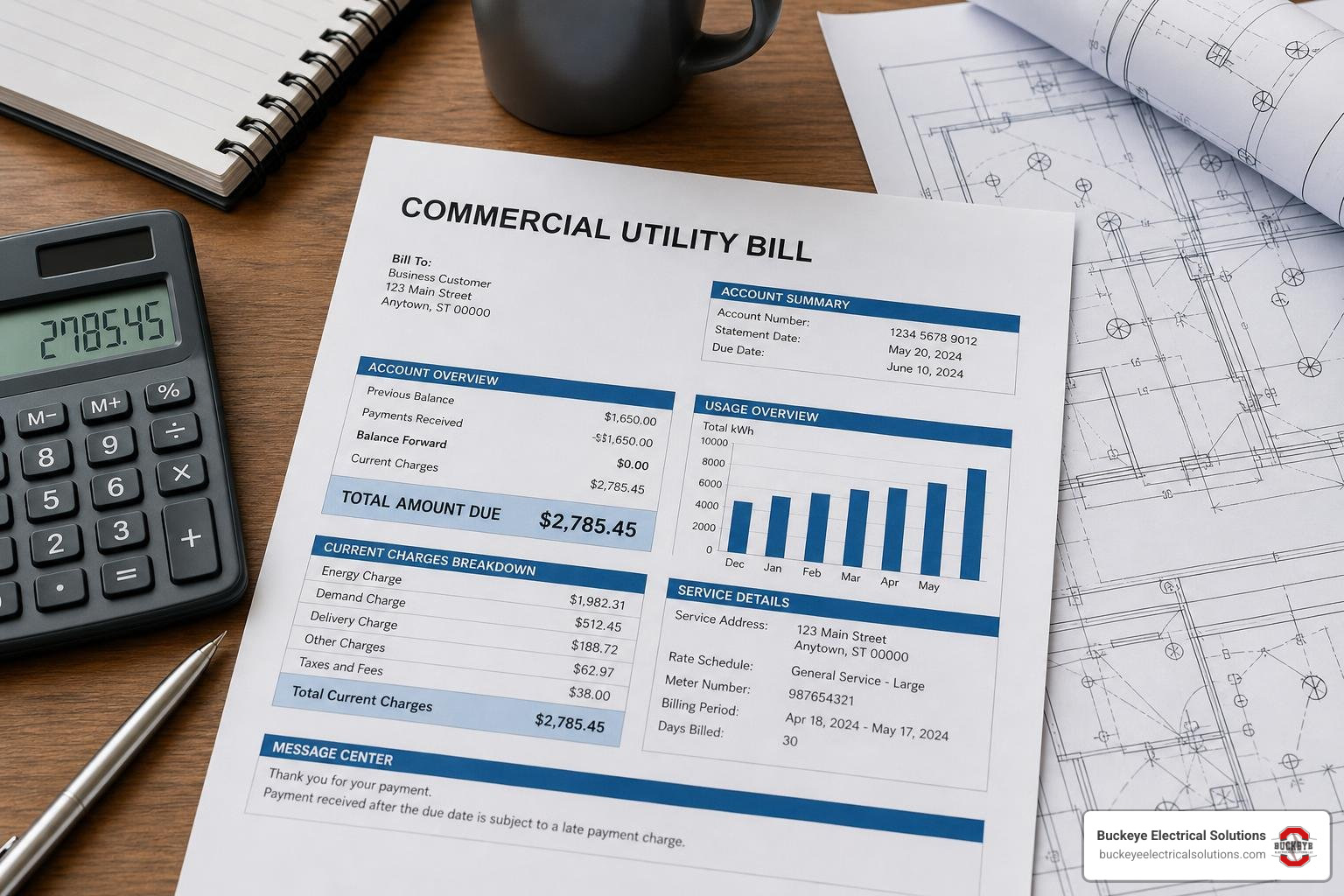
A commercial electric bill can feel like it was written by a committee of engineers, lawyers, and one raccoon with a spreadsheet. But most bills come down to a few major pieces.
| Bill Component | What It Means | What You Can Do About It |
|---|---|---|
| Energy charge | The cost of electricity used, measured in kWh | Shop suppliers if eligible, reduce consumption, improve efficiency |
| Delivery charge | Cost to move electricity through the grid to your building | Usually regulated; manage by understanding tariff class and usage |
| Demand charge | Charge based on highest kW draw during a billing interval | Reduce peak loads, stagger equipment, use controls |
| Standing or customer charge | Fixed monthly charge for having service available | Usually not avoidable, but should be reviewed for accuracy |
| Riders and fees | Utility-approved adjustments and program charges | Review for billing accuracy |
| Taxes | Applicable taxes on electricity service | Usually not negotiable, but exemptions may apply in specific cases |
| Power factor charges | Possible charge if equipment uses power inefficiently | Correct with power factor equipment when appropriate |
Energy charges often get the most attention because they are easy to compare. But for many commercial accounts, demand charges and delivery charges can be just as important.
Before you compare suppliers, pull 12 to 24 months of bills if available. One month rarely tells the full story, especially for seasonal businesses.
Demand Charges and Load Factor Explained
Demand charges are based on your peak power draw, measured in kilowatts, or kW. Energy use is measured in kilowatt-hours, or kWh.
Think of it this way:
- kW is how hard you hit the electrical system at one moment.
- kWh is how much electricity you use over time.
If your facility starts HVAC units, compressors, ovens, pumps, and production equipment all at once, your peak demand can jump. Many utilities measure that peak during a 15-minute or 30-minute interval. Even if the spike is brief, it can affect the entire billing period.
Load factor shows how evenly your business uses electricity.
A simplified formula is:
Load Factor = Total kWh Used / (Peak kW x Hours in Billing Period)
A higher load factor usually means your usage is steadier. A lower load factor means you have sharp peaks compared with total usage.
Why does this matter? Suppliers and utilities like predictable loads. A business with steady usage may be easier to price than one that creates short, intense spikes. Improving load factor can make your operation more attractive during contract negotiations and may lower total costs depending on your rate class and supplier terms.
Ways to improve demand and load factor include:
- Staggering startup times for large equipment
- Using lighting controls and occupancy sensors
- Scheduling high-load processes outside peak periods when practical
- Maintaining HVAC equipment so it does not short-cycle or overwork
- Reviewing motor loads, compressors, and refrigeration equipment
- Considering battery storage or demand management controls where appropriate
- Upgrading inefficient lighting or outdated electrical systems
This is where a qualified commercial electrical contractor can help. We can evaluate whether your building’s electrical setup is helping or hurting your energy strategy.
Types of Business Electric Contracts Available

Not all business electric contracts work the same way. The right choice depends on your usage, risk tolerance, operating schedule, and budget planning needs.
| Contract Type | How It Works | Pros | Watch For |
|---|---|---|---|
| Fixed-rate | Locks in a supply rate for a set term | Predictable budgeting | Early termination fees, pass-through clauses |
| Variable-rate | Rate changes with market conditions | Flexibility, possible savings in falling markets | Price spikes and budget uncertainty |
| Indexed | Rate follows a market index | Transparent market-based pricing | Requires active monitoring |
| Block and index | A set block of power is fixed; remaining usage floats | Balance of stability and flexibility | More complex; best for larger or sophisticated users |
| Time-of-use | Prices vary by time period | Rewards shifting load to lower-cost periods | Requires operational flexibility |
| Green or renewable | Electricity backed by renewable supply or certificates | Supports sustainability goals | Confirm what “renewable” actually includes |
| Pass-through | Certain costs are passed directly to customer | Can be transparent | Budget may vary when fees change |
Fixed-rate contracts are popular because business owners like knowing what to expect. That predictability helps with budgeting, especially when margins are tight.
Variable-rate contracts may look attractive when market prices are low, but they can become painful during volatility. For most small and mid-size businesses, variable contracts require extra caution.
Block and index contracts are more common for larger commercial users with enough load to justify active energy management. They can work well, but they are not “set it and forget it” agreements.
Before signing any contract, look beyond the cents-per-kWh number. Ask:
- What is the full term?
- Is the rate fixed for all months?
- Are there pass-through charges?
- Is there an early termination fee?
- Does the contract auto-renew?
- What happens if usage changes significantly?
- Are demand-related charges affected?
- Are renewable claims backed by certificates or a specific energy source?
- How and when must cancellation or renewal notice be given?
If a contract answer sounds like “trust us,” ask for it in writing. Trust is great. Paper is better.
Deemed, Rollover, and Out-of-Contract Rates
Deemed, rollover, and out-of-contract rates are the budget traps every business should understand.
A deemed rate generally applies when electricity is being used without an agreed supply contract. This can happen when a business moves into a new space and starts using power before arranging service terms.
An out-of-contract rate may apply when a previous agreement ends and no new contract is in place. A rollover or evergreen contract may automatically renew if you do not provide notice during the required window.
These default arrangements are often more expensive than actively negotiated contracts. They also create uncertainty because the business is not intentionally choosing the pricing structure.
To avoid these problems:
- Track contract end dates in your calendar
- Start reviewing options before the renewal window opens
- Keep copies of signed agreements
- Know the notice requirements
- Take meter readings when moving in or out
- Confirm supplier changes in writing
- Review the first bill after any switch
For Ohio businesses moving into a new commercial space, electricity should be part of the move-in checklist, along with locks, internet, signage, and finding out which light switch controls the one hallway light nobody can explain.
Strategic Cost-Reduction and Green Energy Options
Cutting electricity costs is not only about supplier shopping. It is also about making the building easier and cheaper to power.
Here are practical strategies that often help Ohio businesses manage energy costs:
Compare supply contracts carefully
In deregulated markets like Ohio, eligible businesses can compare generation supply offers. Focus on the all-in impact, not just the advertised rate.Reduce peak demand
Stagger equipment startup, tune HVAC schedules, and avoid running every major load at the same time unless operations require it.Upgrade lighting
LED retrofits, occupancy sensors, dimming controls, and daylight harvesting can reduce consumption and improve the workplace environment.Maintain electrical equipment
Loose connections, failing components, overloaded circuits, and aging panels can create safety issues and inefficiency.Use smart controls
Timers, building automation, programmable thermostats, and controlled receptacles can reduce waste.Review power quality
Poor power factor, harmonics, and voltage issues may affect equipment performance and, in some cases, billing.Consider renewable options
Green supply contracts, renewable energy certificates, on-site solar, and power purchase agreements may help meet sustainability goals.
A Power Purchase Agreement, or PPA, is a contract where a business agrees to buy power from a generation project, often renewable, under defined terms. PPAs can vary widely. Some are tied to on-site solar. Others are virtual agreements connected to off-site renewable projects.
Standard PPA documents often define items such as metering, environmental attributes, commercial operation dates, default terms, and billing procedures. For an example of how detailed these agreements can be, review this Power Purchase Agreement.
For Ohio businesses, renewable energy decisions should be reviewed from both the contract side and the facility side. Solar, EV charging, battery storage, and generator systems may require electrical upgrades, utility coordination, permits, inspections, and compliance with the authority having jurisdiction, or AHJ.
Service pricing and project estimates can vary based on site conditions, existing equipment, utility requirements, and AHJ requirements. A clean plan up front helps avoid expensive surprises later.
Navigating Energy Brokers and the Switching Process
Energy brokers can help businesses compare suppliers, gather quotes, and manage paperwork. A good broker can save time. A bad broker can make your contract messier than a panel schedule from 1978.
Before working with a broker, ask:
- Are you independent?
- Which suppliers do you work with?
- How are you paid?
- Is your fee included in the rate?
- Do you receive commission from suppliers?
- Will I see all contract terms before approval?
- What authority does your letter of authority give you?
- Can you enroll my business without final written approval?
- What happens if there is a billing dispute?
A Letter of Authority, or LOA, allows a broker or consultant to speak with suppliers on your behalf. Read it carefully. Some LOAs only allow information gathering. Others may grant broader authority.
If you are also evaluating electrical upgrades, it helps to separate energy supply advice from electrical infrastructure advice. Supplier contracts determine how you buy power. Electrical contractors help determine how safely and efficiently your building uses it.
For help thinking through contractor selection, see our guide: Your Go To Guide Finding The Best Commercial Electrical Contractors.
How to Safely Compare Business Electric Contracts
To compare business electric contracts properly, gather your documents first. The more accurate your usage information, the better your quotes will be.
Essential documents and information needed for switching:
- Legal business name
- Service address
- Billing address
- Current supplier name
- Current utility name
- Utility account number
- Meter number
- Recent electric bills, ideally 12 months
- Current contract end date
- Current rate and term
- Peak demand history, if shown on your bill
- Monthly kWh usage
- Tax exemption documents, if applicable
- Desired contract length
- Renewable energy preference
- Letter of Authority, if using a broker
- Information on planned expansions, EV chargers, new equipment, or schedule changes
When comparing offers, look at:
- Energy rate
- Monthly fees
- Term length
- Auto-renewal language
- Early termination fees
- Pass-through charges
- Swing or bandwidth provisions
- Minimum usage requirements
- Billing method
- Renewable content claims
- Notice requirements
- Dispute process
Avoid mis-selling by slowing the process down. Do not agree to a contract over the phone unless you fully understand the terms and receive written confirmation. Watch for pressure tactics, vague savings claims, or promises that ignore your actual usage profile.
Also remember: switching suppliers does not fix building-side electrical problems. If your facility has outdated lighting, nuisance breaker trips, overloaded circuits, poor controls, or aging gear, you may still be wasting energy after you sign a better contract.
For building-side planning, our guide on what to look for in commercial electrical services can help you evaluate the electrical work that supports long-term savings.
Frequently Asked Questions About Commercial Energy
When is the best time to shop for or renew a business electricity contract?
For many businesses, a practical target is to begin reviewing options 60 to 90 days before the current contract expires. That gives you time to gather bills, compare offers, review terms, and avoid rushed decisions.
Energy markets can be volatile, and timing can affect pricing. Shoulder months, often spring and fall, may sometimes offer more favorable shopping conditions because extreme heating and cooling demand is lower. But market conditions change, so do not rely on season alone.
The best move is to know your contract end date and start early. If you wait until the last week, your negotiating leverage may shrink quickly.
What should I do if a commercial outlet has no voltage?
Outlet has no voltage; could indicate breaker, GFCI, switch, or wiring issue.
Start with simple checks if it is safe to do so:
- See whether nearby outlets or lights are also affected
- Check whether a GFCI device has tripped
- Check the breaker panel for a tripped breaker
- Note whether equipment recently overloaded the circuit
- Stop using the outlet if there are burn marks, heat, buzzing, or odor
Do not open devices or panels unless you are qualified to do so. Commercial wiring can involve shared neutrals, multi-wire branch circuits, dedicated equipment circuits, GFCI protection, and other conditions that require proper testing.
Improper wiring or a bootleg ground can create serious safety concerns and should be evaluated by a licensed electrician when suspected. For more safety guidance, see our electrical troubleshooting article: Dont Get Shocked Expert Advice For Electrical Troubleshooting.
How does Ohio’s 2023 NEC adoption affect my commercial electrical system?
Ohio’s 2023 NEC adoption includes expanded GFCI requirements in several locations. The exact requirements can be situational, depending on the occupancy type, location, equipment, circuit type, and how the space is used.
For example, GFCI rules involving kitchens, wet locations, garages, rooftops, outdoor areas, vending equipment, HVAC equipment, and other commercial spaces may depend on the specific installation. It is not safe to assume one universal rule applies to every business or every receptacle.
For commercial facilities, this matters during:
- Renovations
- Tenant build-outs
- Panel replacements
- Equipment additions
- Kitchen or breakroom upgrades
- Outdoor power additions
- EV charger installations
- Service changes
- Inspection corrections
A licensed electrical contractor can review your project against current Ohio code requirements and the expectations of the local AHJ.
Conclusion
Better business electric contracts can protect your budget, but the contract is only half the story. Your building’s electrical system determines how efficiently, safely, and predictably your business uses power.
In Ohio’s deregulated market, businesses can often compare electricity suppliers for the generation portion of service. But smart decisions require more than chasing the lowest advertised rate. You need to understand contract terms, demand charges, load factor, renewal windows, broker authority, and the condition of your electrical infrastructure.
At Buckeye Electrical Solutions, we help Northeast Ohio businesses connect the dots between electrical systems and operating costs. With more than 20 years of experience in commercial electrical repair, installation, and maintenance, we focus on safe work, practical recommendations, and prompt project completion.
If your next step is a lighting upgrade, panel evaluation, EV charger installation, troubleshooting, or a broader commercial electrical plan, we are ready to help. Learn more about our Commercial Electrical Services and make your energy strategy work harder for your business.