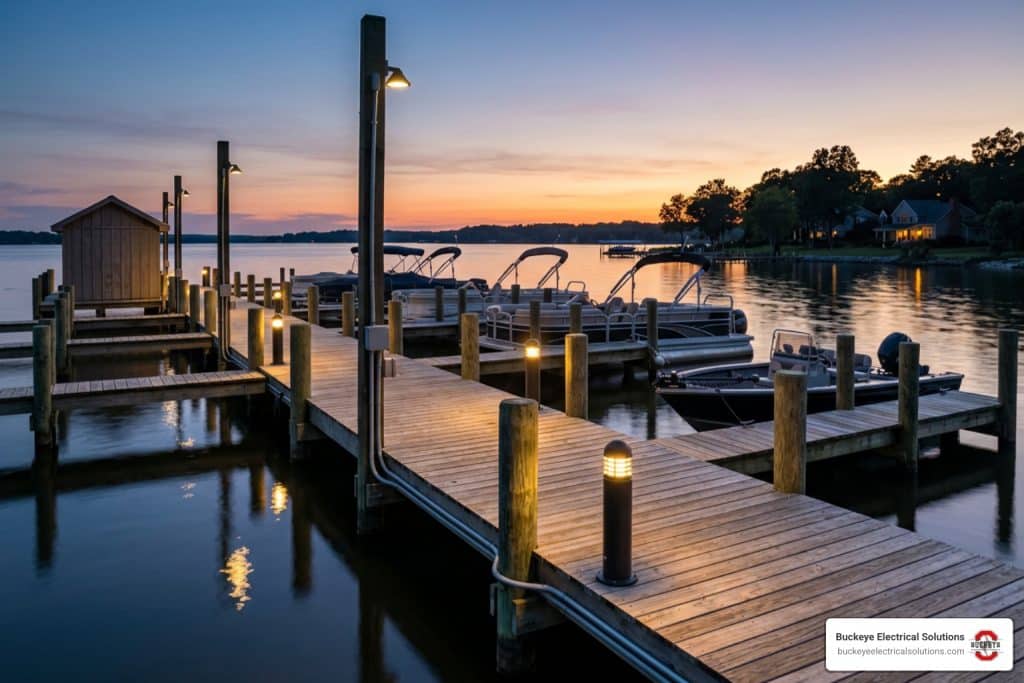
Why Dock Electrical Wiring Is a Life-Safety Issue
Dock electrical wiring requires more care than ordinary outdoor wiring because people, metal structures, and water are close together. A safe design typically depends on properly rated equipment, ground-fault protection, bonding, corrosion-resistant materials, and inspection by the authority having jurisdiction (AHJ).
Quick-reference: dock electrical wiring considerations
| Item | Typical safety approach |
|---|---|
| Ground-fault protection | Feeder and receptacle protection selected under current code and AHJ direction |
| Wet-location equipment | Weatherproof or watertight enclosures rated for the specific location |
| Receptacles and equipment | Located to reduce water exposure and physical damage, subject to AHJ approval |
| Conductors | Listed for wet locations and compatible with equipment terminals; copper is common but not automatically the only option |
| Disconnects | Readily accessible and acceptable to the inspector |
| Wiring method | Approved raceway or cable system rated for wet, corrosive, and exposed conditions |
| Plans and permits | Often required before new or modified dock power is installed |
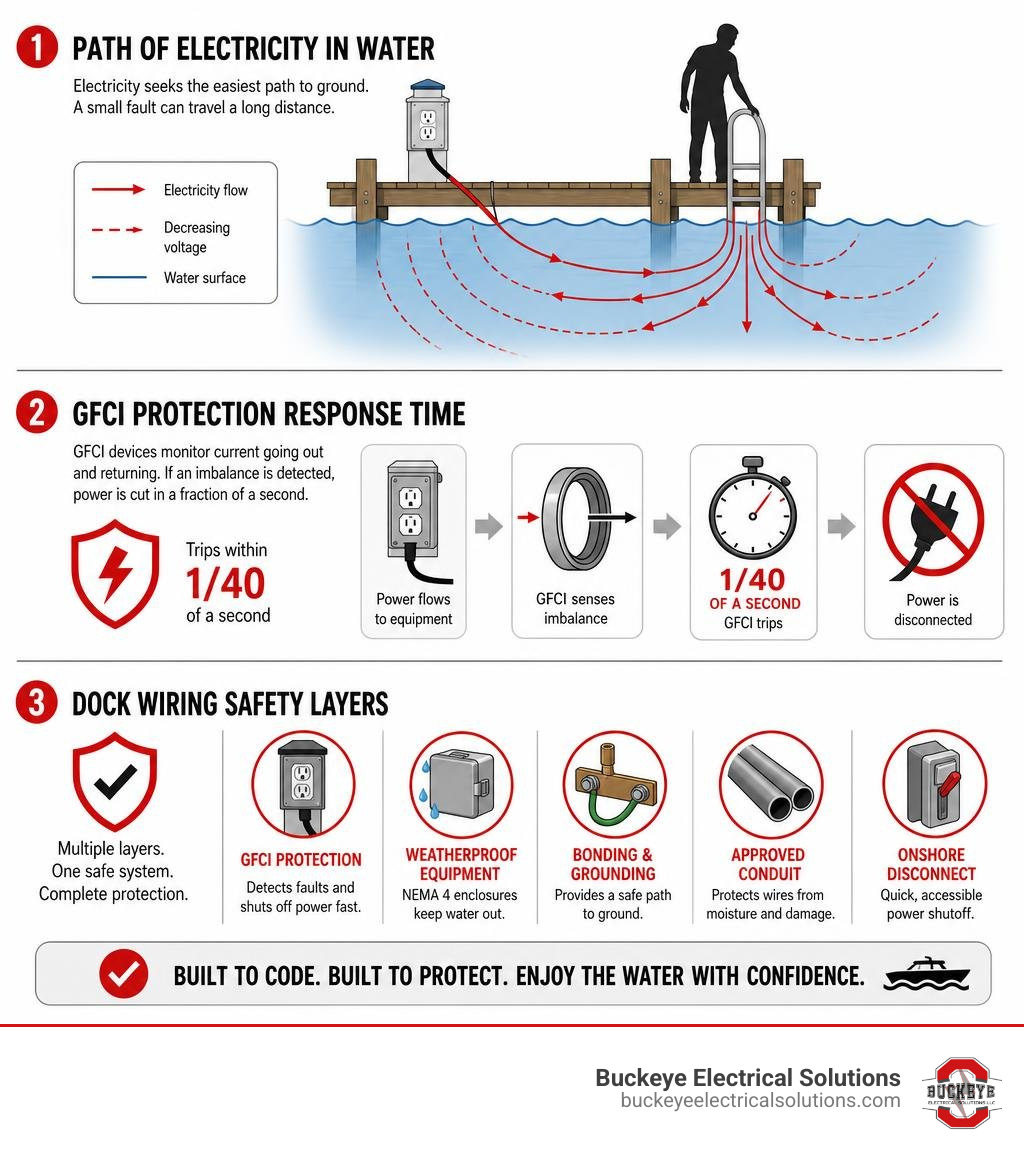
Water and electricity can create shock hazards when a system is damaged, poorly bonded, or not protected correctly. The National Electrical Code (NEC) includes requirements for marinas, boatyards, floating buildings, and related waterfront installations, but the applicable rules depend on the project type, adopted code edition, equipment listing, and local interpretation.
Dock wiring is not simply an outdoor outlet on a pier. It is typically a coordinated system of ground-fault protection, bonding, grounding, approved wiring methods, corrosion-resistant equipment, and inspection. This guide explains the main safety concepts so Ohio property owners can ask better questions before hiring a licensed electrician or submitting plans.
Related electrical safety resources:
National and Ohio Code Considerations for Dock Electrical Wiring
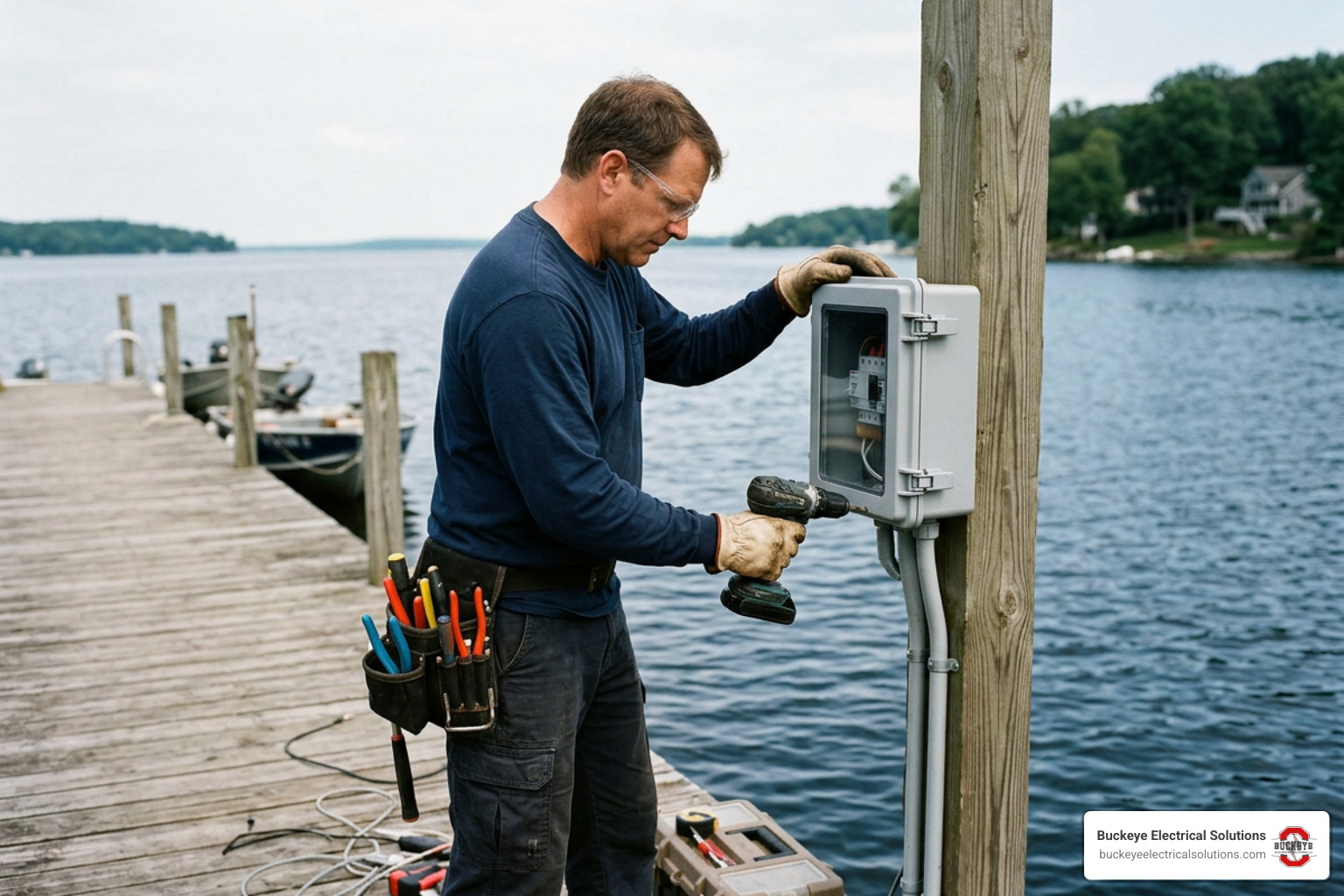
Dock wiring is exposed to moisture, movement, impact, corrosion, and changing water levels. Code officials typically review these projects more carefully than ordinary residential branch-circuit work. The safest starting point is to design around the NEC edition adopted locally, Ohio requirements, manufacturer instructions, and AHJ approval.
For general background on national safety rules, see The NEC Book Bible.
NEC Articles Commonly Involved
Dock and marina work is generally evaluated under NEC Article 555, while floating buildings may involve Article 554. Depending on the project, these articles can affect supply conductors, grounding and bonding, ground-fault protection, shore power, receptacles, and equipment exposed to water.
The NEC also uses the concept of an electrical datum plane for certain waterfront installations. Equipment located below that plane may be treated more restrictively because it can be exposed to flooding, splash, or wet-location conditions. Exact application depends on the structure, water level, equipment location, adopted code edition, and AHJ interpretation.
For a technical overview, consult the NEC Dock Electrical Systems Guide, then verify current requirements with the code edition and inspector that apply to your project.
Ohio Permits and Local Review
In Ohio, electrical work is governed by adopted state and local rules, and the AHJ has the final say on plan review and inspection. New dock power, rewiring, service changes, shore power pedestals, and similar work often require permits before installation begins.
Plan requirements vary by municipality and project type. A local building department may ask for drawings, load calculations, equipment specifications, ground-fault protection details, grounding and bonding notes, and licensed-contractor information before approving the work.
Grounding, Bonding, and GFCI Protection
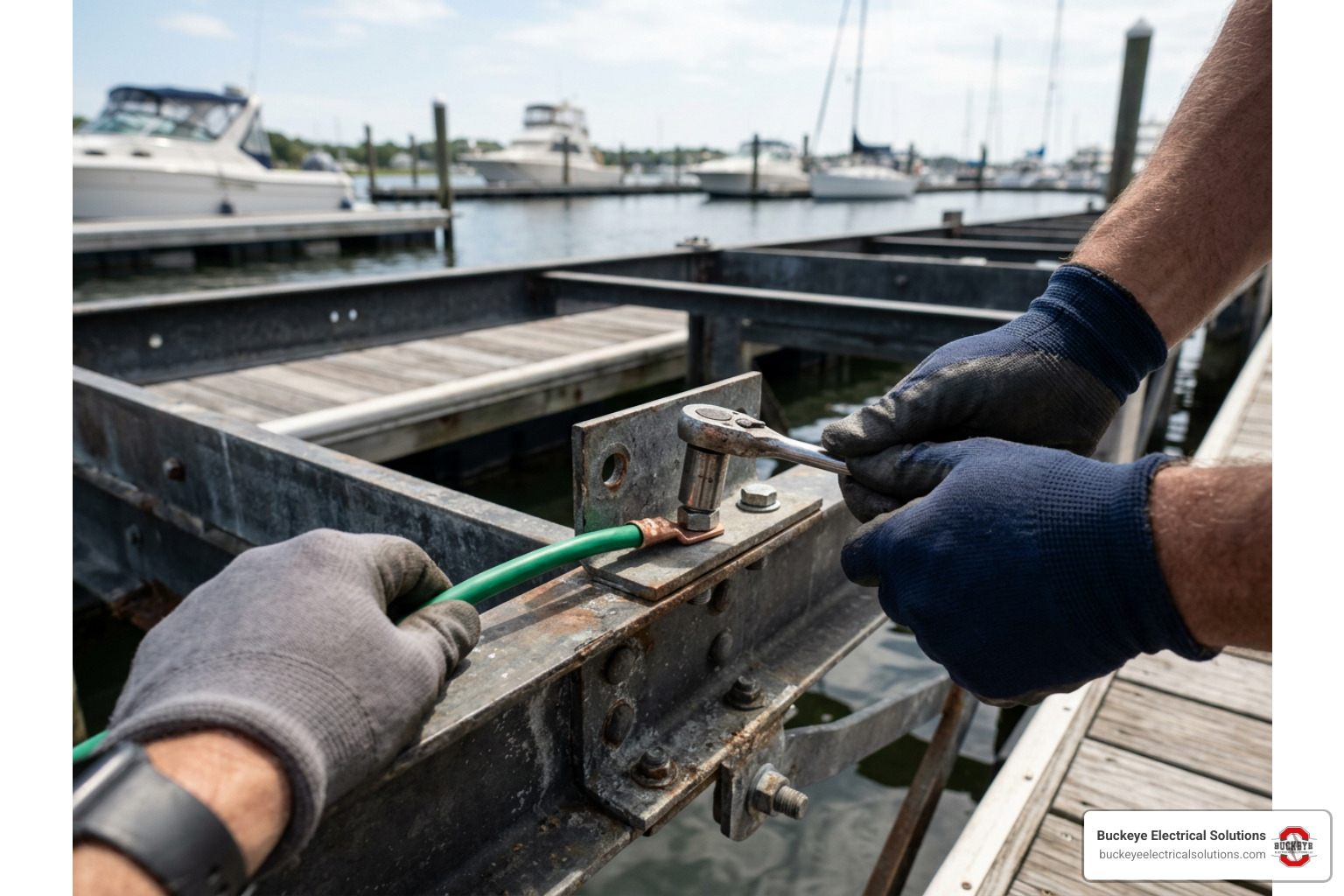
On a dock, a wiring fault can energize metal parts or nearby water if the system is not designed and maintained correctly. Grounding, bonding, and ground-fault protection reduce that risk, but they should be planned as one coordinated system.
For more on safety evaluations, see The Ultimate Guide to Electrical Safety Inspection.
Feeder Protection vs. Receptacle Protection
Ground-fault protection for dock systems should be separated into two concepts:
- Feeder or service-level ground-fault protection: Dock feeders and marina-type supplies may require equipment-level ground-fault protection at a threshold specified by the applicable NEC edition, equipment listing, and AHJ. This is typically evaluated separately from GFCI protection at individual outlets.
- Receptacle-level GFCI protection: Receptacles serving people and portable equipment generally require personnel-protection GFCI. Class A GFCI devices are commonly designed to trip in the 4–6 mA range, but the specific device and application should be verified against current code and listing instructions.
Some older marina guidance and equipment discussions reference higher thresholds, such as 30 mA, for feeder or equipment protection. That number should not be applied universally. The correct protection level depends on the adopted NEC edition, dock configuration, connected equipment, leakage-current conditions, and AHJ direction.
GFCI devices should be tested according to manufacturer instructions. Recurring trips should be treated as a troubleshooting signal, not simply reset and ignored. For outlet safety basics, see Your Complete Guide to Installing Electrical Outlets Safely.
Bonding and Grounding
Bonding and grounding serve different purposes:
- Grounding generally provides an effective fault-current path back to the source and is coordinated with the service or feeder equipment.
- Bonding connects non-current-carrying metal parts so they remain at the same electrical potential.
On many dock projects, bonding may include metal dock frames, ramps, ladders, metal raceways, equipment enclosures, and hinged or floating sections. Conductor size, connection method, and electrode requirements should be selected from the applicable code rules and approved plans.
Because dock structures move and corrode, bonding connections should be mechanically secure, corrosion-resistant, and accessible for inspection. Neutral and equipment-grounding conductors must also be handled correctly; improper neutral-ground connections can create objectionable current paths and shock hazards.
Approved Materials and Wiring Methods for Wet Environments
Dock wiring materials must handle moisture, sunlight, physical damage, temperature changes, and corrosion. Standard indoor wiring methods are generally not appropriate for exposed dock environments.
For broader material-selection guidance, see Upgrade Your Watts: What You Need to Know About Electrical Wiring.
Raceways, Enclosures, and Corrosion Resistance
Commonly used wiring methods may include rigid metal conduit, intermediate metal conduit, Schedule 80 PVC, reinforced thermosetting resin conduit, or other raceways approved for the location. The right choice depends on exposure, physical protection, corrosion risk, support requirements, equipment listing, and inspector approval.
Enclosures should be rated for the actual environment. Damp, wet, splash-prone, and flood-prone areas are not the same, and the enclosure rating must match the conditions. NEMA 3R, NEMA 4, NEMA 4X, or other ratings may apply depending on the location and equipment listing.
Conductors and cables should be listed for wet locations where required. Copper conductors are common in dock work because of their performance and compatibility with many devices, but conductor material should be confirmed against code, equipment listings, terminal ratings, and corrosion conditions.
Flexible Connections for Floating or Seasonal Docks
Floating docks need wiring methods that tolerate movement. Rigid raceway across a hinge or moving ramp can crack, loosen, or pull apart. Depending on the design, electricians may use listed liquidtight flexible conduit, marine-grade flexible cord assemblies, strain reliefs, drip loops, and shore-side disconnects.
Flexible connections should be supported so they do not sag into the water, chafe on dock hardware, or carry mechanical tension. Seasonal docks also need a safe way to disconnect and store equipment without leaving exposed conductors or damaged fittings.
For additional marine electrical background, see the Boater’s Guide to AC Electrical Systems.
Power Feeds, Disconnects, and Shore Power
Getting power from a building to a dock requires careful planning. The electrician must consider service capacity, voltage drop, burial or routing method, overcurrent protection, ground-fault protection, disconnect placement, and inspection access.
For related breaker and panel safety information, see How to Wire a 100 Amp Breaker Box Safely and Effectively.
Equipment Location and Clearances
Dock electrical equipment should be placed to reduce exposure to flooding, splash, impact, and normal dock use. Exact mounting heights and clearance rules vary by structure, equipment type, NEC edition, flood conditions, and AHJ interpretation.
In general, designers try to keep receptacles, junction boxes, disconnects, lighting, and controls above likely water exposure and away from ladders, swim areas, mooring lines, and moving dock components. Overhead and underground feeds also require project-specific clearance or burial-depth review; these details should be verified during design rather than assumed from a generic rule of thumb.
Shore Power Pedestals and Boat Charging
Shore power pedestals and boat charging equipment should be listed for the environment and matched to the intended load. Typical installations may involve locking receptacles, weather-resistant covers, dedicated overcurrent protection, ground-fault protection, corrosion-resistant components, and clear labeling.
Larger boats, lifts, battery chargers, and emerging electric-boat charging equipment can add significant load. Before installing or upgrading shore power, a qualified electrician should calculate the load and confirm that the home’s service, feeder, conductors, and protective devices are properly sized.
Troubleshooting and Maintaining Dock Electrical Systems
Dock electrical systems need regular maintenance because water, sun, wind, movement, and corrosion can damage even well-installed equipment. If a breaker or GFCI trips repeatedly, treat it as a warning sign and have the system checked.
For repair guidance, read Don’t Get Zapped: Navigating Electrical Repair Options in Ohio.
| Symptom | Possible causes | Priority |
|---|---|---|
| Frequent GFCI tripping | Moisture in a box or receptacle, damaged cord, connected boat equipment, cumulative leakage, failing device | High |
| Outlet has no voltage | Tripped breaker, failed GFCI, loose connection, corroded contacts, damaged conductor | Medium to high |
| Flickering dock lights | Loose connection, corrosion, failing fixture, voltage drop, water intrusion | Medium |
| Warm shore power plug | Corroded blades, loose terminals, overload, poor connection, damaged inlet | High |
At the start of each boating season, visually check for cracked conduit, loose fittings, rusted enclosures, worn cords, missing covers, and loose bonding jumpers. Test GFCI devices according to manufacturer instructions. A licensed electrician can also perform a periodic inspection to verify bonding, grounding, enclosure condition, voltage drop, and signs of leakage or corrosion.
Frequently Asked Questions about Dock Electrical Systems
What type of wire is approved for dock electrical wiring?
Dock wiring typically requires conductors or cable assemblies listed for wet locations and suitable for the specific wiring method. Copper is commonly used because it works with many devices and performs well in many installations, but it should not be assumed to be the only permitted conductor. The approved conductor type depends on the NEC edition, equipment terminals, listing instructions, corrosion conditions, and AHJ approval. Flexible or moving sections may require marine-grade cord, liquidtight flexible conduit, or another listed method.
Why does my dock GFCI breaker keep tripping?
Repeated GFCI tripping can be caused by moisture, damaged insulation, a worn shore power cord, connected boat equipment, cumulative leakage current, or a failing device. Long cable runs and multiple loads can complicate troubleshooting. If the device will not reset with loads unplugged, or if it trips again, have the system inspected before using the dock power.
Are solar or 12V systems allowed on Ohio docks?
Low-voltage or solar-powered systems may be useful for limited dock lighting, gate controls, small accessories, or off-grid applications, but they are not automatically exempt from safety requirements. They still need weather-resistant equipment, proper overcurrent protection, secure mounting, battery protection, and wiring methods suitable for wet or corrosive conditions. Any connection to 120V/240V equipment, battery charging systems, inverters, or utility power should be reviewed by a qualified electrician and the AHJ.
Conclusion
Dock electrical wiring should be designed conservatively because water, metal structures, and electrical equipment are close together. A safe installation typically depends on listed wet-location materials, appropriate ground-fault protection, secure bonding and grounding, corrosion-resistant hardware, and AHJ-approved plans.
If you own a dock in Ohio, do not rely on generic mounting-height rules, internet diagrams, or assumptions about conductor type or GFCI thresholds. Start with the code edition adopted locally, confirm requirements with the AHJ, and use a licensed electrician experienced with waterfront installations.
Buckeye Electrical Solutions helps Northeast Ohio property owners evaluate, repair, and install dock electrical systems with safety and code compliance in mind.