A commercial EV charger installation usually starts with a request, not a plan. A tenant asks if they can plug in at work. A fleet manager wants two delivery vans charging overnight. A retail owner in Lorain County notices drivers pulling in, looking for a plug, and leaving.
Each of those sites needs a different EV charger setup. The charger you pick, the power your building already has, and the spot you choose in the lot shape the project. This guide covers those choices in the order an electrician will ask about them.

Match the charger to how long people park
Start with the people who’ll use the chargers and how long their cars sit.
The U.S. Department of Energy’s Alternative Fuels Data Center splits charging equipment into three levels. Level 2 runs on 240 volts in most homes and 208 volts in most commercial buildings. It’s common for workplace and public charging and can operate at 40 to 80 amps. DC fast charging typically takes a three-phase AC input and can deliver up to 500 kW at a station.
| Charger type | Typical power input (AFDC) | Where it fits | Parking time it suits |
| Level 1 | 120 V outlet | Rarely used at businesses | All day or overnight |
| Level 2 | 208 V in commercial buildings, 40 to 80 A | Offices, apartments, hotels, fleet yards | A few hours or longer |
| DC fast | Three-phase AC input, up to 500 kW | Travel stops, retail, fleets that need quick turns | Under an hour |
Charging time depends on the car, the battery, and the equipment. AFDC puts the range at less than 20 minutes on DC fast equipment and 20 hours or more on Level 1.
Level 2 covers most business needs. Employees on a shift, apartment residents, and hotel guests all park long enough for Level 2. DC fast charging makes sense when drivers stop briefly, such as highway-adjacent retail, travel stops, or fleets that need quick turnaround.
Your building’s electrical service sets the limit
Every EV charger installation adds load to a service sized for the building you had. Before anyone orders equipment, a licensed electrician should compare your available capacity to the load the chargers will add.
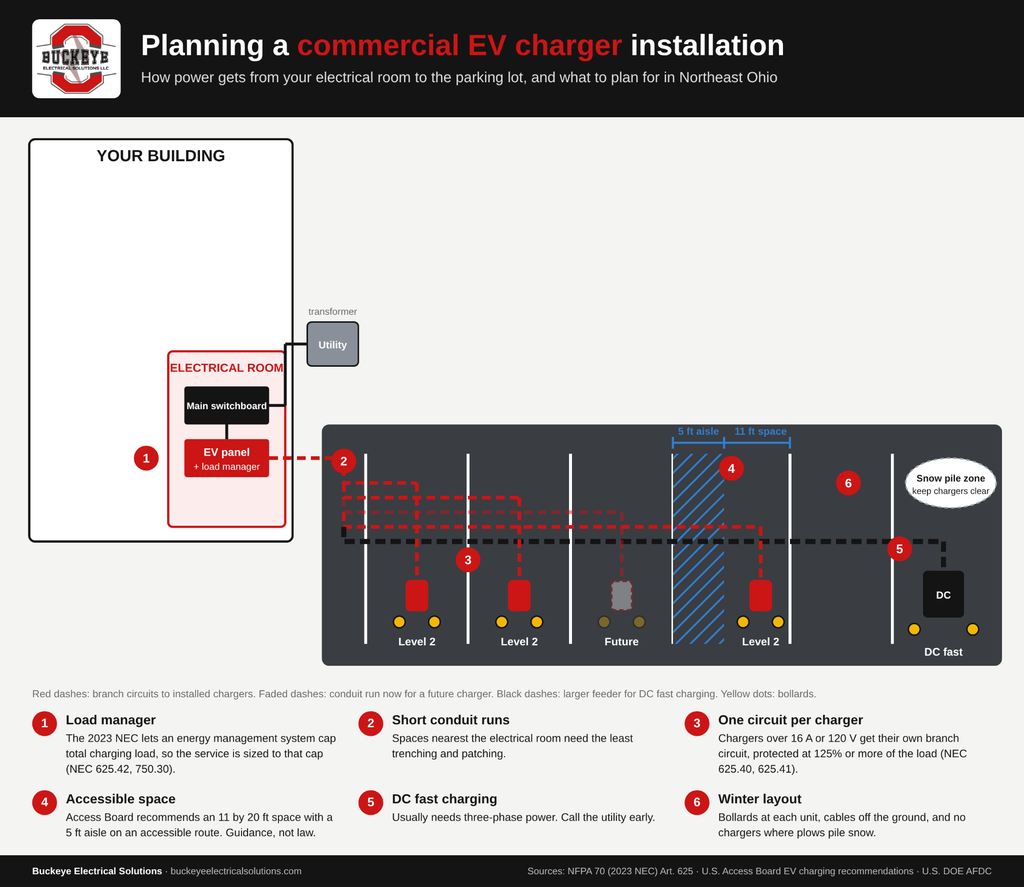
The National Electrical Code (NEC) treats EV charging as a continuous load, because a car can pull full current for hours. That changes how circuits and feeders get sized. Under the 2023 NEC, overcurrent protection for EV supply equipment is sized at no less than 125% of the equipment’s maximum load (NEC 625.41). Each outlet for equipment rated over 16 amps or 120 volts gets its own individual branch circuit (NEC 625.40).
Two things can stretch the capacity you already have:
- Load management. The 2023 NEC lets an energy management system (EMS) control charging so the combined draw stays under a set limit (NEC 625.42 and 750.30). When an EMS is used, the service and feeder can be sized to the maximum load the EMS allows. That can mean more charging ports on the same service.
- Phased buildout. You can run conduit for four spaces now and set equipment on two. Adding the next pair later is simpler when the trench is already dug.
If the numbers still don’t work, the next step is a service upgrade, which brings the utility into the schedule. The Illuminating Company serves portions of Northeast Ohio, including parts of the counties listed in its tariff (FirstEnergy CEI tariff). Confirm the serving utility for the specific address before planning service work. Talk to the utility early if you’re adding DC fast charging, since those units usually need three-phase power.

What Ohio code expects when installing commercial chargers
Commercial buildings in Ohio follow the Ohio Building Code. Its referenced standards list the 2023 edition of NFPA 70, the National Electrical Code, for electrical work (OAC 4101:1-35-01). Article 625 of that code covers EV charging equipment.
Permits, plan review, and installation inspections run through the building department that has jurisdiction over your property. Requirements and timelines can vary from one department to another, so build permit time into your schedule. Unpermitted electrical work can create complications during inspections, insurance reviews, or a future sale of the property.
Your commercial electric contractor should give you a load calculation, a one-line drawing of the new circuits, and the equipment spec sheets. Keep those with your building records.
Site layout, accessibility, and Northeast Ohio winters
Where you put the chargers affects cost as much as which chargers you buy. Shorter runs from the electrical room or service equipment often reduce conduit, trenching, restoration, and labor costs.
Plan the installation for access, too. The U.S. Access Board recommends an accessible EV charging space at least 11 feet wide and 20 feet long, with a 5-foot access aisle and an accessible route to the charger (Access Board EV charging design recommendations). The Access Board’s document includes explanations of applicable ADA/ABA accessibility requirements and additional nonbinding recommendations. Confirm local and project-specific requirements during design.
Winter in Northeast Ohio adds its own planning items for any commercial property:
- Plows and bumpers. Pedestal chargers in open lots sit where plows push snow. Bollards in front of each unit take the hit instead of the charger.
- Cable management. Cords left on the ground get buried, driven over, and frozen into ice. Retractors or holsters keep them up and dry. The Access Board also warns that charging cables should not block accessible routes.
- Snow storage. Don’t put the charging spaces where your plow contractor piles snow every January. The Access Board notes that plowed snow should not obstruct access to the charger.
- Lighting. Drivers plug in after dark for much of the winter. Good lighting over the charging area makes it easier and safer to use.
A planning checklist for your commercial property
Work through these steps before you ask for quotes. Your answers help the electrician write a firm scope.
- Decide who the chargers are for. Employees, tenants, customers, or fleet vehicles. This sets the charger level and how many ports you need.
- Count the ports you need now and in five years. Size conduit and service for the larger number, even if you install fewer units at first.
- Pull your electrical service information. Main breaker size, voltage, and whether the building has three-phase power. Twelve months of utility bills help with the load calculation.
- Pick candidate spaces. Start close to the electrical room and on an accessible route.
- Decide how drivers will pay or sign in. Networked chargers can track use and bill drivers. Simpler units skip that.
- Get a load calculation and a written scope. Ask whether load management would let you add more ports without a service upgrade.
- Schedule around the utility and the weather. Trenching and concrete work goes easier before the ground freezes.
Commercial EV charger installation FAQ
Q: What drives the cost of commercial EV charger installation?
A: It depends on the charger level, the number of ports, the distance from your electrical room, and whether your service needs an upgrade. Ask for a written scope and quote after a load calculation.
Q: Should my business install Level 2 or DC fast chargers?
A: Match the charger to parking time. Level 2 fits offices and apartments where cars sit for hours. DC fast chargers fit short stops and quick fleet turnarounds, and they usually need three-phase power.
Q: Can my existing electrical service handle EV chargers?
A: Sometimes. A load calculation shows how much spare capacity you have. The 2023 NEC also allows an energy management system to limit total charging load, which can let you add ports without a service upgrade.
Q: Do I need a permit for a commercial charging station?
A: Plan on it. Commercial electrical work in Ohio is reviewed and inspected through the building department with jurisdiction over your property, and requirements can vary by department.
Q: Do EV charging spaces have to be accessible?
A: The U.S. Access Board recommends an accessible EV charging space at least 11 feet wide and 20 feet long, with a 5-foot access aisle and an accessible route to the charger. Its document explains applicable ADA/ABA requirements alongside nonbinding recommendations. Confirm local and project-specific requirements during design.
Q: How do chargers hold up in Northeast Ohio winters?
A: Outdoor-rated chargers are designed for weather, but plows, ice, and buried cables can still damage them. Bollards, cable retractors, and a spot away from snow piles protect the equipment.
Plan your EV charging project before the ground freezes
Start with who’ll plug in and how long they park, then let a load calculation show what your building can carry. Sizing conduit for the future and placing chargers near your electrical room keeps today’s project lean and the next phase simple.
Buckeye Electrical Solutions provides commercial electrical services across Northeast Ohio, including EV charger installation, panel upgrades, and new circuits. If your building has a monitored fire alarm, the team can also coordinate any planned shutdown with your fire alarm service. Contact the team to schedule a site visit.
Sources for this article are listed below.
- U.S. Department of Energy, Alternative Fuels Data Center: Electric Vehicle Charging Stations
- Ohio Administrative Code 4101:1-35-01, Ohio Building Code Referenced Standards
- NFPA 70, National Electrical Code, 2023 Edition (Article 625 and Section 750.30)
- U.S. Access Board: Design Recommendations for Accessible Electric Vehicle Charging Stations
- The Cleveland Electric Illuminating Company, P.U.C.O. No. 13 Electric Service Tariff
Protect your equipment budget and your schedule. Call Buckeye Electrical Solutions or contact the team to schedule a commercial EV charger site visit.