What You Need to Know Before Starting Ceiling Fan Fastener Installation
Ceiling fan fastener installation is one of those home projects that looks simple but has real safety stakes if done wrong. Here’s a quick overview of what it involves:
Quick-start summary:
- Turn off power at the circuit breaker before touching anything
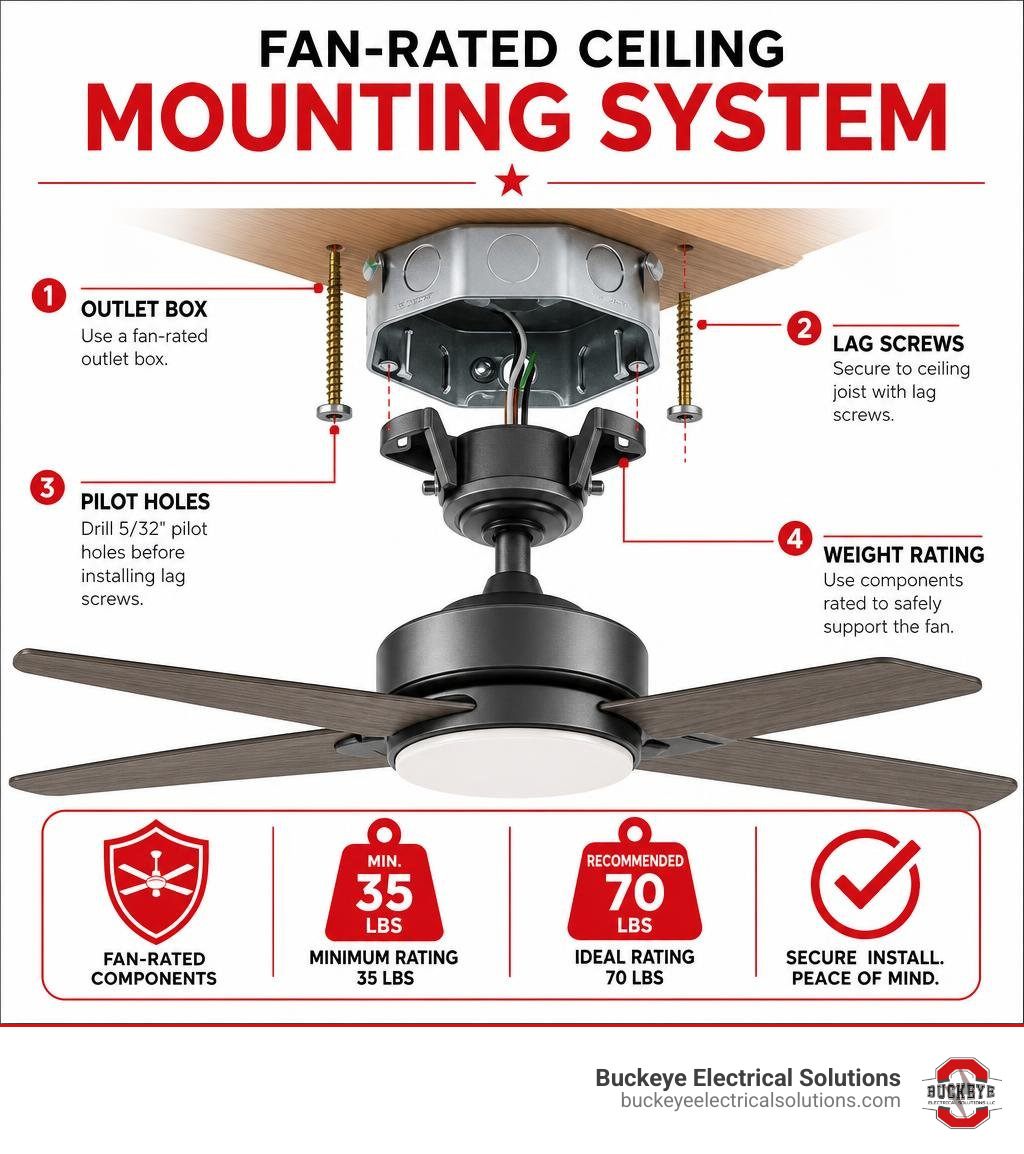
- Confirm your outlet box is rated for fan support (minimum 35 lbs; ideally 70 lbs)
- Drill 5/32″ pilot holes into the ceiling joist before driving lag screws
- Torque mounting screws to 35 in.-lbs using the supplied #10-32 gold screws
- Maintain clearances — at least 7 feet from blade to floor, 30 inches from blade to wall
- Check all fasteners are tight before restoring power and running the fan
Get any one of these steps wrong and you’re looking at a wobbling fan at best — or a falling one at worst.
Ceiling fans are a practical way to stay comfortable year-round in a Northeast Ohio home, especially when paired with your HVAC system. But the fasteners holding that fan to your ceiling are the most critical part of the whole installation. A fan-rated outlet box that can’t handle the load, or mounting screws that aren’t torqued correctly, can lead to serious damage or injury.
This guide walks you through the entire process — from choosing the right hardware to driving the final screw — so your fan stays exactly where it belongs: on the ceiling.
I’m Aaron, owner and master electrician at Buckeye Electrical Solutions LLC, and I’ve overseen ceiling fan fastener installation across dozens of permitted residential projects throughout Northeast Ohio. In the sections below, I’ll share exactly what our crew does on every install to make sure it’s safe, code-compliant, and built to last.
Ceiling fan fastener installation word list:
Understanding Ceiling Fan Fasteners and Safety Ratings
To understand why a specialized ceiling fan fastener is necessary, you have to look at the physics of a ceiling fan. Unlike a stationary light fixture, a ceiling fan is a dynamic load. It rotates, vibrates, and creates continuous aerodynamic torque.
If you hang a fan from a standard electrical junction box using normal drywall screws, the constant vibration will slowly back those screws out, or worse, shear them entirely. When people ask, Is using a fastener for hanging a ceiling fan safe?, the answer is a resounding yes—provided you are using the correct, specialized fasteners and a fan-rated outlet box.
A standard electrical box is only designed to hold static loads up to 50 lbs, and its screw threads are not reinforced for dynamic vibration. A fan-rated outlet box, on the other hand, is specifically engineered and UL-listed to support dynamic loads. To learn more about how these boxes are structured, take a look at our guide on Junction Box Basics: Attaching Your Ceiling Fan Securely.
Structural Support Requirements
When we talk about safety margins, the National Electrical Code (NEC) is very specific.
- Any ceiling fan outlet box must be rated for fan support of at least 35 lbs (15.9 kg).
- For larger or heavier fans, the outlet box and its support structure must be rated to support up to 70 lbs (31.8 kg).
These weight limits aren’t just arbitrary numbers. A standard 20-lb fan can exert much more than 20 lbs of downward force when spinning on its high setting. The safety margin ensures that even if a blade gets slightly out of balance and causes the fan to wobble, the mounting fasteners will not fail. The fasteners must transfer this dynamic energy directly into the home’s wood framing—specifically, the ceiling joists.
Selecting Hardware for Ceiling Fan Fastener Installation
Depending on your ceiling type, different fasteners are required to secure the mounting bracket:
- Wood Screws & Lag Screws: If you are mounting directly to a wooden ceiling joist or a wood cross-member, heavy-duty wood screws or 1/4-inch lag screws are the gold standard. They bite deep into the wood grain, providing exceptional pull-out resistance.
- Metal Expansion Anchors: In commercial settings or homes with concrete ceilings, wood screws won’t work. Instead, heavy-duty steel expansion anchors (such as 10mm or 12mm closed-hook anchors) are used to grip the solid concrete.
- Toggle Bolts: These are generally not recommended for ceiling fan installation because they rely on the strength of the drywall or plaster. Drywall will crumble under the continuous vibration of a spinning fan.
- Heavy-Duty Specialty Anchors: Some advanced fan-rated box kits include proprietary metal bracing systems that wedge between two joists, using sharp steel teeth and locking screws to secure the frame without needing direct access from above.
Always verify your hardware is corrosion-resistant (such as zinc-plated or stainless steel) to prevent rust from moisture, which is especially important if you are installing a damp-rated fan on an outdoor porch or patio.
Step-by-Step Ceiling Fan Fastener Installation Guide
Now that you understand the structural requirements, let’s look at how to execute a proper ceiling fan fastener installation.
Before you begin, refer to the manufacturer’s documentation. Instructions like the Ceiling Fan and Light Fixture Outlet Box Installation Instructions or the Mastering Ceiling Fan Installation: A Homeowner’s Handbook provide excellent context for your specific fan model.
Preparing the Ceiling Structure and Tools
You will need the following tools and safety materials:
- Safety Gear: Safety glasses (plaster and wood dust will fall directly into your eyes) and sturdy work gloves.
- Electrical Tools: A reliable non-contact circuit tester, wire strippers, and electrical tape.
- Hand Tools: A sturdy ladder, a screwdriver set, pliers, and an adjustable wrench.
- Power Tools: A drill with a 5/32″ drill bit (for drilling pilot holes) or a 9/64″ bit depending on the specific lag screw instructions.
- Specialty Tool: A torque wrench or torque screwdriver capable of measuring inch-pounds.
First and foremost: shut off the power at the main breaker panel. Do not rely on the wall switch to keep you safe. Use your non-contact circuit tester inside the ceiling box to verify that all wires are completely dead before proceeding.
Executing the Ceiling Fan Fastener Installation
Follow these steps for a secure, professional-grade installation:
- Locate and Position the Box: If you are retrofitting a box, ensure the face of the outlet box sits completely flush with your finished ceiling. The box must be mounted directly to a ceiling joist or a fan-rated bracing bar.
- Drill Pilot Holes: Never skip this step! Driving heavy lag screws directly into dry wood joists can split the wood, severely compromising its holding power. Use a 5/32″ drill bit to drill pilot holes to a depth of roughly 1-1/4 inches.
- Secure the Box: Drive the supplied 1/4″ lag screws through the mounting holes of your fan-rated box and into the wooden joist. Tighten them down until the box is completely rigid.
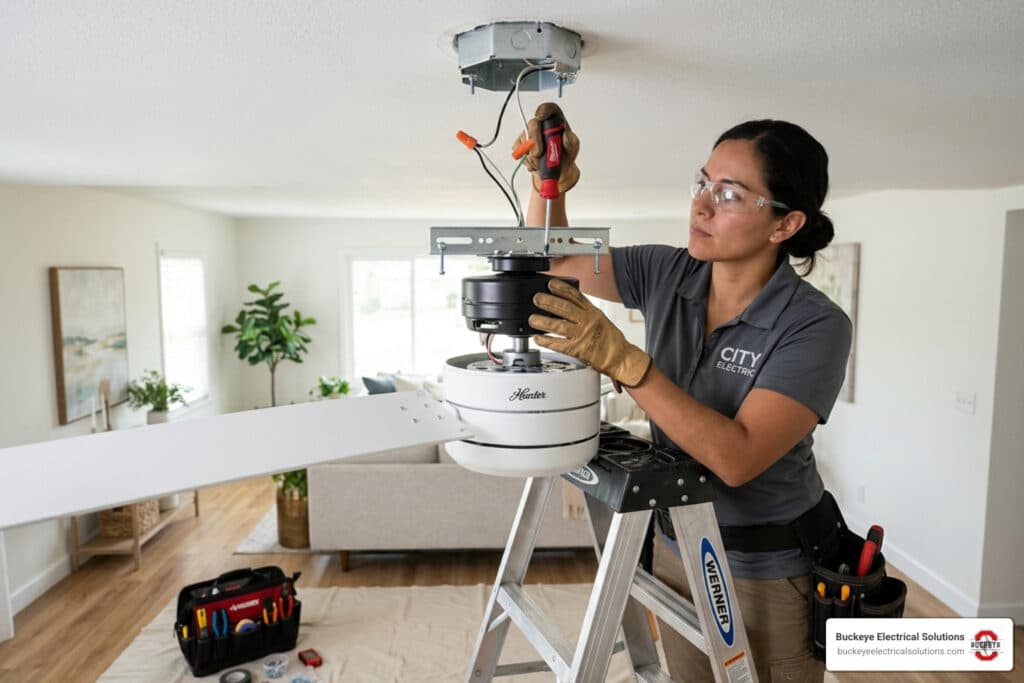
- Install the Mounting Bracket: Attach the fan’s ceiling bracket to the outlet box. Use the supplied #10-32 gold-colored mounting screws, complete with their lock washers and plastic protective sleeves.
- Torque the Screws: To prevent the screws from backing out over time due to vibration, use your torque tool to tighten the #10-32 mounting screws to exactly 35 in.-lbs.
- Hang and Wire the Fan: Many modern brackets feature a convenient Ceiling Fan Hook Discussion or built-in hook to hold the motor assembly while you connect the wires. If you are using a downrod, follow the steps in our guide on ceiling fan downrod installation.
- Secure the Canopy: Tuck the wires neatly into the outlet box, ensuring no wires are pinched, and secure the canopy cover to the mounting bracket.
Common Mistakes to Avoid and Ohio Electrical Codes
Installing a ceiling fan seems straightforward, but a few common mistakes can lead to code violations, electrical hazards, or structural failures.
One major hazard is improper wiring. Some DIYers attempt to bypass grounding by creating a bootleg ground (connecting the neutral wire to the ground screw). This is highly dangerous and a severe violation of the National Electrical Code (NEC).
Furthermore, Ohio’s 2023 NEC adoption includes expanded GFCI (Ground Fault Circuit Interrupter) requirements in several residential locations. While GFCIs are universally known for bathrooms, their application in other areas—like kitchens and outdoor spaces—is highly situational depending on proximity to sinks and moisture. When wiring a fan with an integrated light kit, you must ensure your circuit design matches these modern requirements. For details on proper switch wiring, see our guide on Switch It Up: Your Guide to Wiring a Ceiling Fan Light Switch.
Troubleshooting Common Wiring and Voltage Issues
If you finish your installation, flip the breaker back on, and the fan doesn’t work, you’ll need to troubleshoot systematically.
| Symptom | likely causes | priority level |
|---|---|---|
| Fan hums but won’t spin | Loose wire connection inside canopy | High |
| Fan wobbles excessively | Loose mounting bracket fasteners | High |
| Wall switch does nothing | Outlet has no voltage; could indicate breaker, GFCI, switch, or wiring issue | High |
If your circuit tester reveals that the outlet has no voltage; could indicate breaker, GFCI, switch, or wiring issue, you should start by checking your home’s main panel to see if the breaker tripped during the install. Next, check if the circuit is fed through a tripped GFCI outlet elsewhere in the room. If the voltage issue persists, it’s time to call in a professional to prevent an electrical fire.
Frequently Asked Questions About Ceiling Fan Fasteners
How does proper fastener installation affect the long-term safety of a ceiling fan?
Properly installed fasteners prevent the fan from wobbling. Over months and years, even a tiny, imperceptible wobble can cause metal fatigue in standard screws. Tightening your mounting screws to 35 in.-lbs and using locking washers ensures that the structural integrity of the mount remains solid, preventing wear and tear on the motor and completely eliminating the risk of the fan falling.
When should I consult a professional electrician in Northeast Ohio?
You should call a licensed electrical contractor if:
- Your ceiling has no existing electrical box, requiring a new wire run through your walls and ceiling.
- You have high, vaulted, or angled ceilings (angles greater than 34 degrees require specialized angled mounting kits and extended downrods).
- Your ceiling structure is plaster-and-lath, concrete, or lacks accessible joists for secure mounting.
- You are uncomfortable working on ladders or handling live electrical panel breakers.
What is the maximum weight rating for standard ceiling fan outlet boxes?
Most heavy-duty, UL-listed ceiling fan outlet boxes have a maximum weight rating of 70 lbs for ceiling fans and up to 200 lbs for static light fixtures. Always check the stamp on the inside of the metal or plastic box to verify its specific limits before mounting a heavy, industrial-style fan.
Conclusion
A successful ceiling fan fastener installation keeps your home comfortable, improves energy efficiency, and protects your family from structural hazards. By using the right fan-rated outlet box, drilling accurate pilot holes, and torqueing your fasteners to code specifications, you can enjoy a quiet, wobble-free breeze for years to come.
However, dealing with overhead wiring, heavy motors, and structural bracing can be physically demanding and technically complex. At Buckeye Electrical Solutions, we have served homeowners across Northeast Ohio with dependable, high-quality electrical work for over two decades. Whether you need a simple fan replacement or a brand-new fixture wired from scratch, our licensed professionals are ready to help.
Ready to secure your home’s comfort? Contact Buckeye Electrical Solutions today to schedule our professional residential electrical services! All service estimates and pricing are subject to change depending on local site conditions and AHJ requirements.