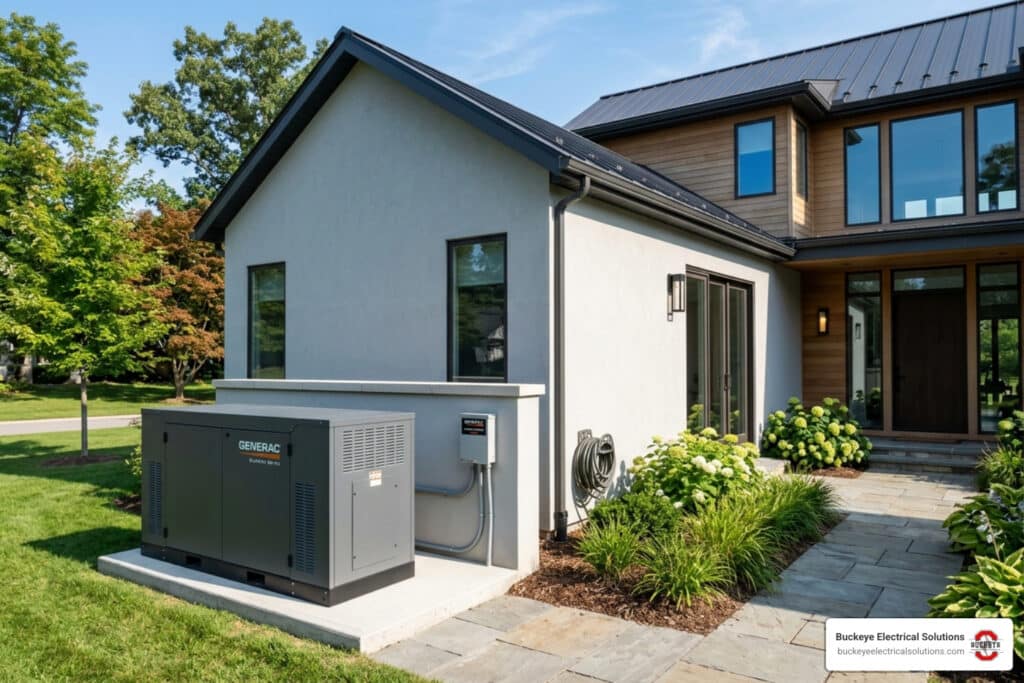

What Does a Home Generator Really Cost in 2026?
Understanding the total cost of home generator systems upfront can save you from some serious sticker shock. Here’s a quick breakdown of what most homeowners can expect to pay in 2026:
| Generator Type | Equipment Cost | Installed Cost (Estimate) |
|---|---|---|
| Portable + interlock kit | $500–$2,000 | $1,500–$3,500 |
| Partial-home standby (10–14 kW) | $3,500–$5,500 | $6,500–$9,000 |
| Whole-house standby (20–22 kW) | $6,000–$7,500 | $9,000–$15,500 |
| Large whole-house (24–48 kW) | $8,500–$12,000+ | $13,000–$20,000+ |
Quick answer: Most Ohio homeowners pay somewhere between $9,000 and $15,000 fully installed for a standard whole-house standby generator. Actual costs vary based on site conditions, local permit requirements, fuel type, and the size of your home’s electrical load.
These numbers are a starting point — not a firm quote. What you’ll actually pay depends on factors like how far your gas line runs, whether your panel needs an upgrade, and your local AHJ (Authority Having Jurisdiction) requirements in Ohio.
Power outages in Northeast Ohio aren’t rare. Ice storms, summer thunderstorms, and aging grid infrastructure can leave homes dark for hours — or days. A whole-house generator keeps your heat, sump pump, refrigerator, and medical equipment running without you lifting a finger. But before you buy, it’s worth understanding exactly what drives the price — because installation costs alone often match or exceed the cost of the unit itself.
I’m Aaron, owner of Buckeye Electrical Solutions LLC and a master electrician with more than 60 permitted projects completed across Northeast Ohio — including standby generator installations where understanding the full cost of home generator ownership made all the difference for our customers. In this guide, I’ll walk you through every cost component so you can make a confident, informed decision.
Further reading on the cost of home generator systems:
Key Factors That Influence the Cost of Home Generator Units
The generator itself is only one piece of the total investment. A safe, code-compliant standby system includes equipment, fuel connection, electrical work, permits, inspections, and often site preparation.
For 2024 through 2026, most national cost guides place a fully installed home standby generator somewhere from the high four figures to the mid five figures, with larger or more complex systems exceeding $20,000. Angi’s 2026 generator cost guide also shows how widely pricing can vary based on size, fuel type, installation labor, transfer switch needs, and site conditions.
Common cost components include:
| Component | Typical 2026 Cost Range | What It Covers |
|---|---|---|
| Generator unit | $3,500–$12,000+ | Air-cooled or liquid-cooled standby generator |
| Automatic transfer switch | $600–$1,500 for equipment; more installed | Safely transfers power from utility to generator |
| Professional installation | $2,000–$6,500+ | Electrical, fuel coordination, placement, startup |
| Concrete or composite pad | $200–$1,000+ | Stable, level base for the generator |
| Permits and inspections | $75–$500+ | AHJ requirements, electrical inspection |
| Propane tank, if needed | $500–$2,500+ for common residential tanks | Fuel storage when natural gas is unavailable |
All prices are subject to change and depend on local labor rates, access, utility requirements, and AHJ rules. In other words, your generator quote is not just “machine plus plug.” If only it were that easy. We would all have fewer gray hairs.
Equipment price is influenced by:
- Capacity in kilowatts
- Air-cooled versus liquid-cooled design
- Manual versus automatic operation
- Warranty length
- Weather-resistant enclosure
- Remote monitoring
- Load management features
- Brand tier and parts availability
Brand can affect the price, too. Mainstream residential brands often offer competitive pricing and strong parts availability, while premium or commercial-grade units may cost more because of heavier-duty engines, quieter enclosures, longer warranty options, or better load-handling features. The best choice is not always the most expensive one; it is the one properly sized and installed for your home.
For another national pricing perspective, you can compare figures from this 2025 whole-house generator cost overview, this 2026 home generator calculator, and this 2026 whole-house generator cost resource. Manufacturer pricing guides, including this 2024 generator cost guide, can also help explain equipment-level costs, though installation still needs a local professional assessment.
How Capacity and Sizing Affect the Cost of Home Generator Installations
Generator size is measured in kilowatts, or kW. One kilowatt equals 1,000 watts. The larger the generator, the more electrical load it can support, but the higher the equipment and installation cost usually becomes.
Here is a practical way to think about sizing:
| Generator Size | Common Use | Typical Fit |
|---|---|---|
| 7–10 kW | Critical loads | Refrigerator, lights, sump pump, selected outlets |
| 10–14 kW | Essential-circuit backup | Furnace blower, fridge, sump pump, some lighting |
| 16–22 kW | Managed whole-home backup | Many average homes with load management |
| 22–26 kW | Larger whole-home systems | Central AC plus more household loads |
| 30 kW+ | Large homes or high-demand loads | Multiple HVAC systems, larger services, complex loads |
Most homes do not need every appliance running at the same time. That is where smart load management helps. It can temporarily pause high-demand equipment, such as an air conditioner or electric water heater, so the generator does not become overloaded.
To estimate the right capacity, we recommend listing:
- Must-run loads: sump pump, furnace, refrigerator, medical equipment, well pump
- Comfort loads: air conditioning, microwave, internet, selected outlets
- High-demand loads: electric range, dryer, electric heat, hot tub, large AC units
- Starting watts: motors often need more power to start than to keep running
- Future needs: EV charger, workshop, home office, or panel upgrade plans
A 13 kW unit may cover essentials. A 20–22 kW unit is often the “sweet spot” for many average homes when paired with load management. A 24 kW or larger unit may be needed when homeowners want broader whole-home coverage.
For a deeper look at the installation process, see our guide to backup generator installation.
Fuel Type Options and the Ongoing Cost of Home Generator Operation
Fuel type affects both installation cost and long-term operating cost. In Ohio, the most common standby generator fuels are natural gas and liquid propane. Diesel may appear in larger residential or commercial-style applications, but it is less common for standard homes.
| Fuel Type | Installation Impact | Operating Cost Notes | Best Fit |
|---|---|---|---|
| Natural gas | Requires proper gas line sizing and connection | Often lower cost per hour if service is already available | Homes with existing gas service |
| Propane | Requires tank purchase or lease, regulator, and fuel line | Cost depends on tank size and propane market pricing | Rural homes without natural gas |
| Diesel | Requires fuel storage and maintenance planning | Efficient for larger units, but fuel storage matters | Larger or specialty systems |
Natural gas is convenient because it does not require a storage tank. If the utility supply is available and properly sized, runtime can be long and refueling is not a homeowner chore.
Propane can be excellent for homes without natural gas, but tank sizing matters. Research pricing commonly places 250-gallon propane tanks around $500 to $1,500 and 500-gallon tanks around $1,000 to $2,500, depending on above-ground versus underground installation, ownership versus lease, and local supplier requirements. Larger 500- to 1,000-gallon setups may cost more.
Operating costs vary widely. A 15–20 kW generator may cost roughly $90 to $220 per day to run under heavier continuous loads, while moderate natural gas operation may be much less depending on local utility rates and actual load. Some 20–22 kW propane systems can consume dozens of gallons per day during continuous operation, especially under high demand.
The big takeaway: do not compare fuel costs by generator size alone. Compare by:
- Actual electrical load
- Local natural gas, propane, or diesel pricing
- Runtime during outages
- Generator efficiency
- Maintenance schedule
- Fuel storage limits
A generator running your refrigerator, furnace blower, sump pump, and a few lights costs far less than one running central AC, electric heat, and every “just in case” appliance in the house.
Comparing Standby, Partial-Home, and Portable Generator Costs
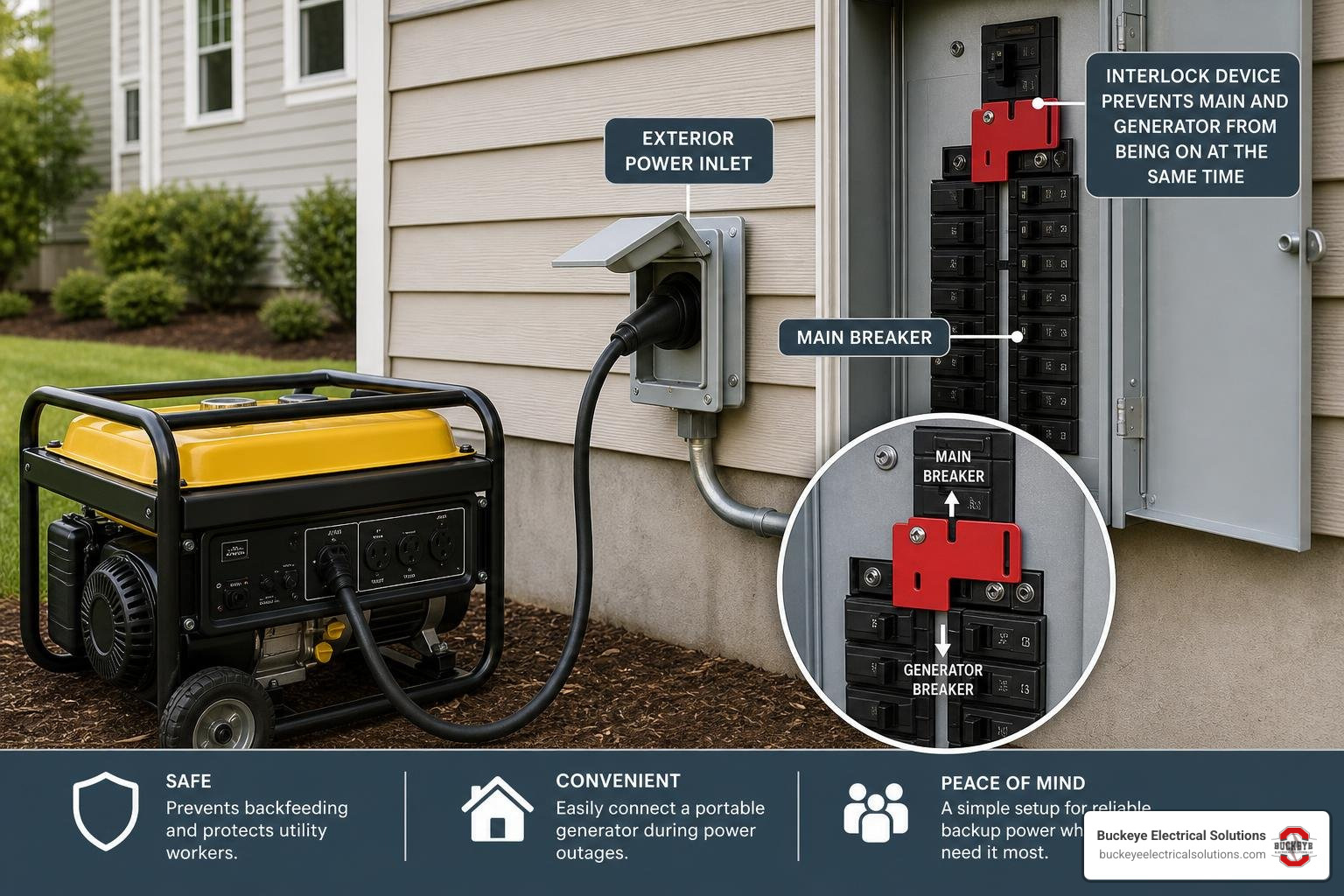
Homeowners generally choose from three backup power approaches: portable, partial-home standby, or whole-house standby. Each has a different cost, convenience level, and installation requirement.
| Generator Type | Average Equipment Cost | Installed Cost Estimate | Likely Causes of Installation Complexity | Priority Level |
|---|---|---|---|---|
| Portable generator with interlock | $500–$2,000 | $1,500–$3,500 | Inlet box location, panel compatibility, UL-listed interlock, safe outdoor placement | Moderate |
| Partial-home standby | $3,500–$6,300 | $6,500–$12,000 | Essential-circuit selection, transfer switch, gas line sizing, load management | High |
| Whole-house standby | $6,000–$12,000+ | $9,000–$20,000+ | Full ATS, service size, larger fuel demand, panel condition, site prep | High |
| Large liquid-cooled system | $10,000+ | $20,000–$35,000+ | Larger service, complex gas/fuel work, heavier equipment, advanced load controls | Very high |
Portable generators are the lowest-cost option, but they require manual setup. You must move the unit outside, connect it safely, start it, refuel it, and manage loads. A portable generator should never run indoors, in a garage, or near windows or doors because of carbon monoxide risk.
A portable system can be much safer and more useful when paired with a proper inlet and interlock. Backfeeding a home through a dryer outlet or homemade cord is dangerous and illegal. For more detail, read our portable generator hookup manual.
Partial-home standby generators are a strong middle ground. They power the most important circuits automatically but do not attempt to run everything. This can reduce equipment size and installation cost.
Whole-house standby generators provide the most convenience. When the power fails, the automatic transfer switch senses the outage, starts the generator, and transfers selected or whole-home loads. You do not need to drag anything through the snow at 2 a.m. That alone is worth something in Northeast Ohio.
For homeowners comparing national cost calculators, Home Depot’s generator installation cost page and this regional generator installation cost example may provide additional context, but a local site visit is still the only way to get a reliable Ohio estimate.
Professional Installation Costs and Ohio Electrical Requirements
Professional installation is where generator projects often become more expensive than expected. That is because a standby generator connects to both the electrical system and the fuel system. It also has to meet clearance, grounding, transfer equipment, and inspection requirements.
Typical installation cost drivers include:
- Generator location and required clearances
- Pad installation or leveling
- Distance from electrical panel
- Distance from gas meter or propane tank
- Trenching or conduit runs
- Automatic transfer switch size
- Existing panel condition
- Permit and inspection requirements
- Utility coordination
- Load calculation and load management
- Cold-weather accessories
A standard air-cooled standby installation may take one to two working days once permits, equipment, fuel coordination, and inspections are lined up. More complex projects can take longer, especially if the electrical service needs upgrades.
Ohio has adopted the 2023 National Electrical Code with state and local enforcement through AHJs. That matters because code requirements can affect the final design and cost. Ohio’s 2023 NEC adoption includes expanded GFCI requirements in several locations, and specific rules, such as kitchen-related GFCI protection, can be situational rather than universal depending on the exact circuit, location, equipment, and AHJ interpretation.
That is one reason we do not recommend DIY standby generator installation. A generator may look like a big outdoor appliance, but electrically it is more like adding a second power source to your home. The transfer equipment must prevent utility backfeed, protect utility workers, and safely serve your home’s loads.
You can compare broad installation pricing with HomeCostCalc’s 2026 installation estimator, but your local conditions will decide the real number.
Electrical Panel Upgrades and Code Compliance
Some generator projects uncover panel issues that need to be corrected before installation. Common examples include overloaded panels, outdated equipment, poor labeling, insufficient space, improper wiring, bootleg ground conditions, or circuits that do not match the homeowner’s intended backup plan.
We may also need to add:
- A generator subpanel
- An automatic transfer switch
- A service-rated transfer switch
- Smart load management modules
- Surge protection
- Dedicated circuits
- Panel replacement or service upgrade
If a panel is too small, damaged, or already crowded, a generator installation can become the right time to modernize it. Learn more about electrical panel upgrade costs and when a larger service may make sense in our guide to a 400 amp electrical panel upgrade.
During an assessment, we also look for warning signs such as:
| Finding | What It May Mean | Priority Level |
|---|---|---|
| Warm breakers or panel discoloration | Possible overload or loose connection | High |
| Frequent breaker trips | Overloaded circuit, equipment fault, or sizing issue | High |
| Improper wiring | Unsafe previous work or code issue | High |
| Bootleg ground | Unsafe grounding condition requiring correction | High |
| Outlet has no voltage; could indicate breaker, GFCI, switch, or wiring issue | Troubleshooting needed before adding backup circuits | Moderate to high |
| Poor panel labeling | Harder emergency operation and maintenance | Moderate |
If your home needs panel work before a generator can be installed, our article on panel upgrade or replacement costs and savings can help you understand the options.
Long-Term Value, Maintenance, and Financial Incentives
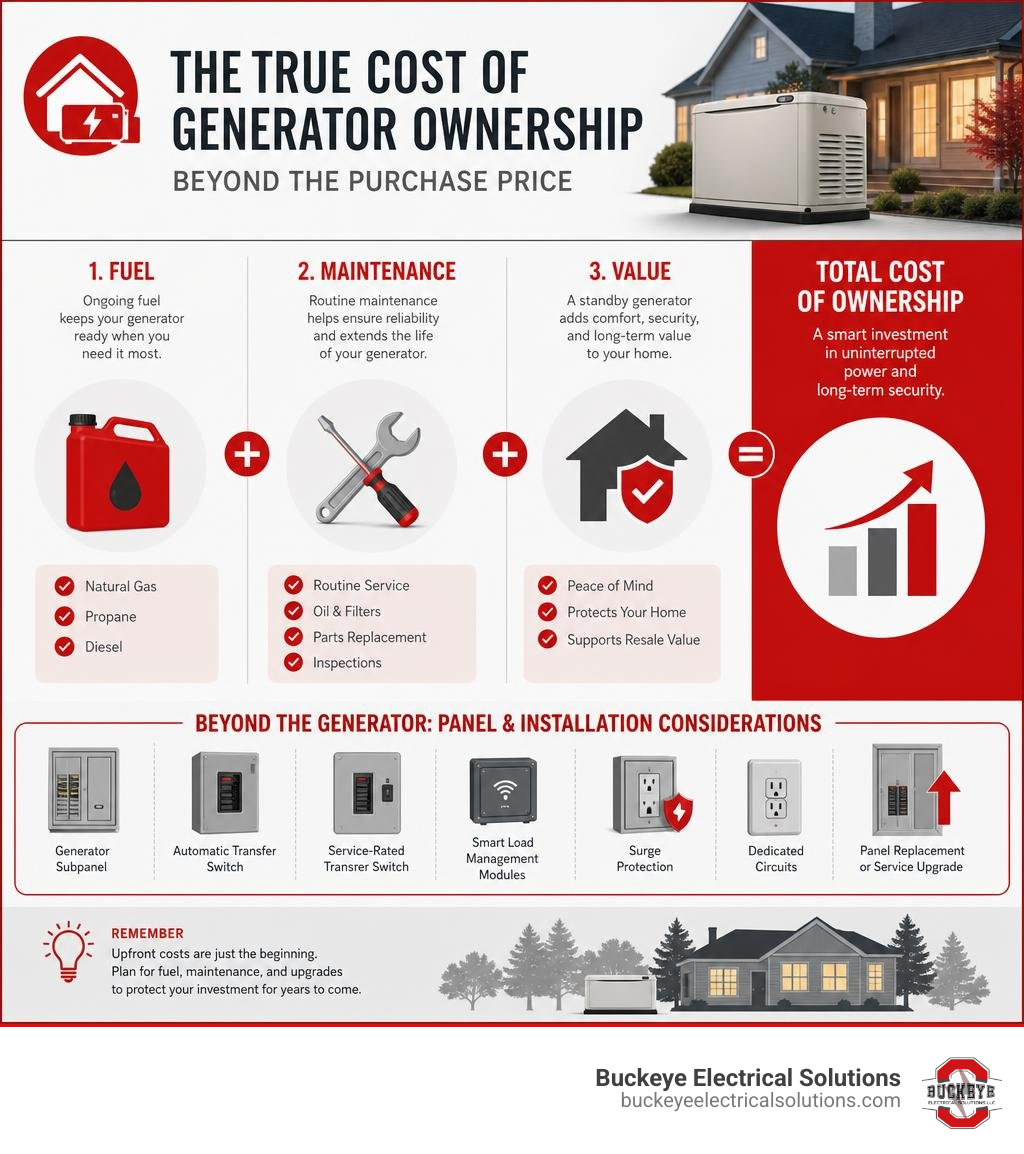
A generator is not just a one-time purchase. It is a long-term home system, much like HVAC equipment.
Typical ongoing costs include:
| Ongoing Item | Common Cost Range | Notes |
|---|---|---|
| Annual maintenance | $200–$500 | Oil, filters, inspection, testing, battery check |
| Fuel for exercise cycles | $50–$150 per year | Varies by generator and fuel pricing |
| Battery replacement | Every 3–5 years commonly | Cost varies by model |
| Extended warranty | $500–$1,200 one-time | Optional, depends on manufacturer |
| Repairs after warranty | Varies | Reduced by regular maintenance |
With proper care, many standby generators can last up to 20 years. The keys are routine exercise cycles, annual service, clean airflow, correct oil and filter changes, battery testing, and keeping snow, leaves, and debris away from the unit. Ohio winters are not gentle, so clearances matter.
A generator can also add long-term value. In outage-prone areas, buyers often see standby power as a practical upgrade, especially when the home has a sump pump, well pump, home office, medical equipment, or finished basement. Some research suggests generators can improve perceived resale value, though exact resale impact depends on the home, neighborhood, and buyer priorities.
Insurance discounts may be available in some cases, but they are not guaranteed. Homeowners should ask their insurance provider whether a permanently installed standby generator qualifies for any property protection discount.
Financing options may include:
- Contractor or dealer financing
- Home equity line of credit
- Personal loan
- Credit union financing
- Manufacturer promotional financing
- Possible utility or local rebate programs, if available
Tax incentives are limited for typical residential fossil-fuel standby generators. In most cases, a personal-use home generator is treated as a home improvement, not a tax deduction. Exceptions may exist for documented medical necessity or business use, but homeowners should consult a tax professional before assuming eligibility.
For commercial facilities, backup power planning can be more complex. We cover that separately in The Business of Backup: What to Expect from Commercial Generator Installation. For maintenance planning, see Power Up: Essential Services for Your Electrical Generator.
Frequently Asked Questions About Home Generator Costs
What is the average total cost to install a standby generator in Ohio?
Most Ohio homeowners should expect a standard whole-house standby generator to land around $9,000 to $15,500 installed, with larger or more complex projects exceeding $20,000. Smaller partial-home systems may cost less, while larger homes, long gas line runs, panel upgrades, trenching, or difficult placement can raise the total.
A reliable estimate requires a site visit, load calculation, fuel review, panel inspection, and AHJ permit review.
How long does a whole-house standby generator typically last?
With proper maintenance, many standby generators can last up to 20 years. Lifespan depends on runtime, maintenance quality, weather exposure, fuel quality, installation conditions, and whether the unit is exercised regularly.
Annual professional maintenance is strongly recommended. Skipping service may save a little now, but it can cost more later when the generator decides to take a nap during the exact storm you bought it for.
Does installing a backup generator increase my home’s resale value?
It can. A standby generator may make a home more attractive to buyers, especially in areas with frequent outages, sump pump concerns, finished basements, rural fuel needs, or work-from-home requirements.
The exact value increase is not guaranteed, but the practical benefits are clear: fewer outage disruptions, better protection for food and appliances, reduced basement flooding risk when sump pumps stay powered, and greater comfort during winter and summer outages.
Conclusion
The real cost of home generator ownership is not just about the generator box. It includes sizing, fuel planning, transfer equipment, electrical work, code compliance, permits, maintenance, and long-term operating costs.
For many Northeast Ohio homeowners, a properly installed standby generator provides more than convenience. It protects heat, refrigeration, sump pumps, medical equipment, home offices, and peace of mind when the weather gets ugly.
At Buckeye Electrical Solutions, we bring more than 20 years of electrical experience to residential and commercial generator projects throughout Ohio. We focus on safe installation, clear communication, code compliance, and prompt project completion.
If you are comparing generator options, we can help you choose between portable backup, essential-circuit coverage, managed whole-house power, or a full standby system.
Schedule a professional generator consultation with Buckeye Electrical Solutions through our electrical services page and let us help you build a backup power plan that fits your home, your budget, and Ohio weather.