Why Hiring the Right Commercial Electricians Can Make or Break Your Next Project
Commercial electricians are licensed professionals who handle the electrical systems in businesses, office buildings, warehouses, restaurants, and other non-residential properties.
If you’re looking to hire one, here’s what you need to know fast:
- What they do: Install, upgrade, repair, and maintain electrical systems in commercial buildings
- Who needs them: Any business doing new construction, renovations, panel upgrades, lighting retrofits, or code corrections
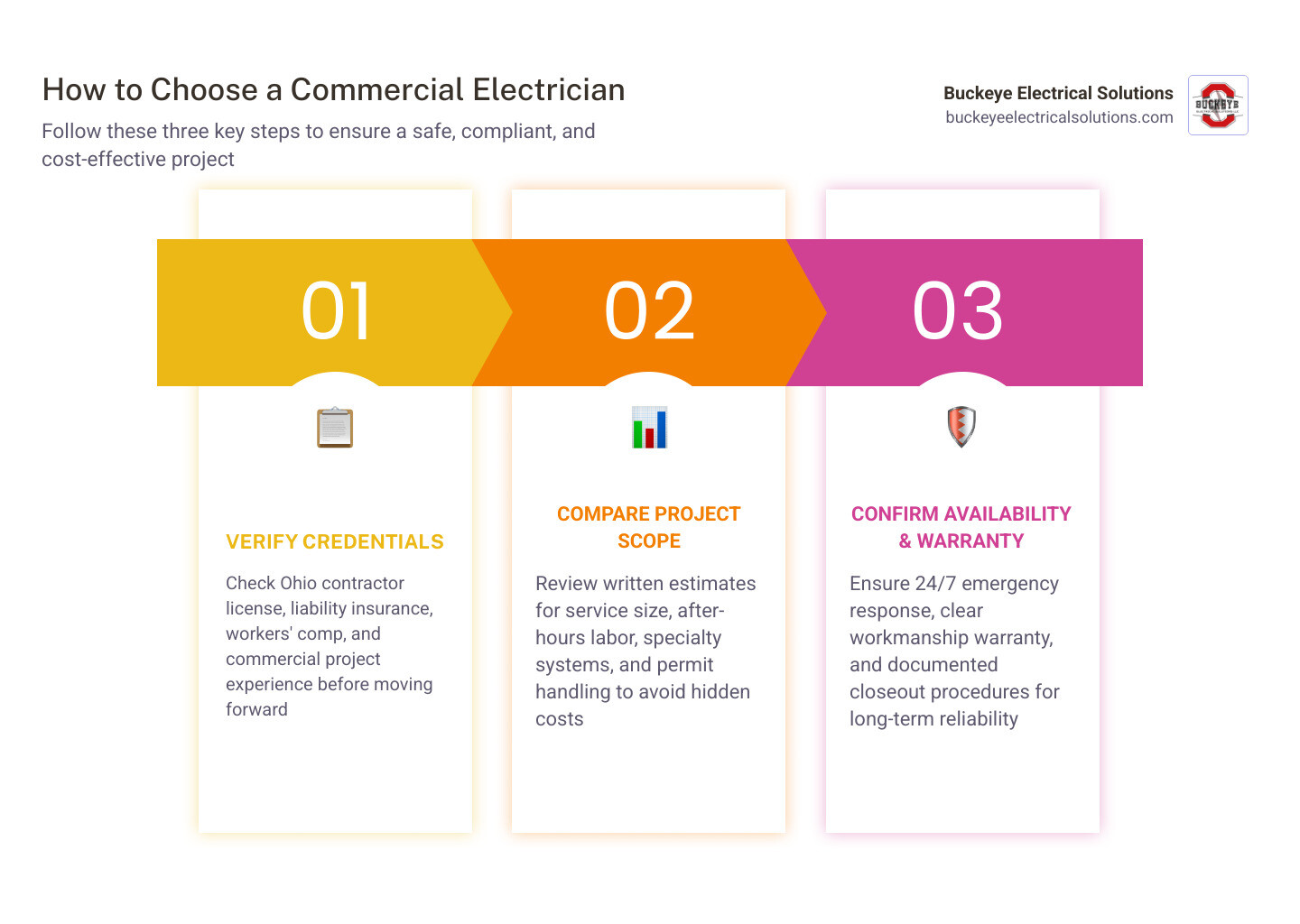
- What to look for: Ohio contractor license, liability insurance, workers’ comp, and commercial project experience
- What it costs: Pricing varies based on project scope, building size, and local AHJ requirements – always get a written estimate
- Emergency help: Many commercial electricians offer 24/7 emergency response to minimize business downtime
Finding the right electrical contractor isn’t just about getting the lights on. A bad hire can mean failed inspections, costly rework, and operational disruptions that hit your bottom line hard. According to the National Electrical Contractors Association, commercial projects account for a major share of electrical contracting activity in the U.S., and demand for qualified contractors remains strong.
The stakes are high. But the good news is that knowing what to look for makes the decision a lot easier.
I’m Aaron, owner of Buckeye Electrical Solutions LLC and a master electrician based in Northeast Ohio, and I’ve led more than 60 permitted electrical projects – including large-scale commercial electrician work like full commercial rewires and tenant build-outs. I’ll walk you through exactly what separates great commercial electrical contractors from the rest.
Related content about commercial electricians:
What the Best Commercial Electricians Actually Do
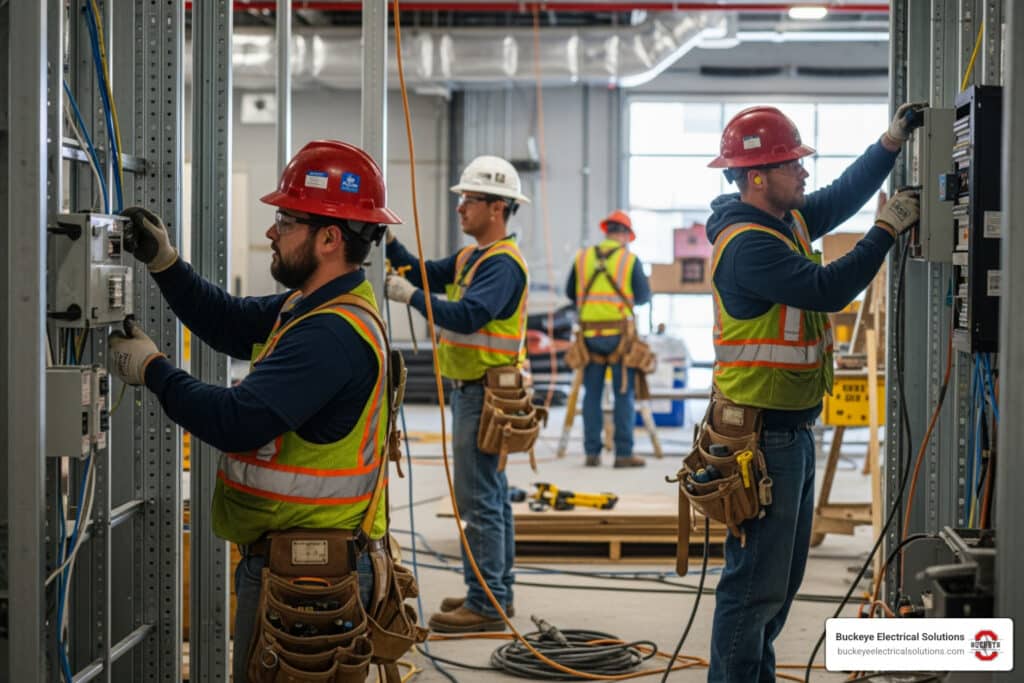
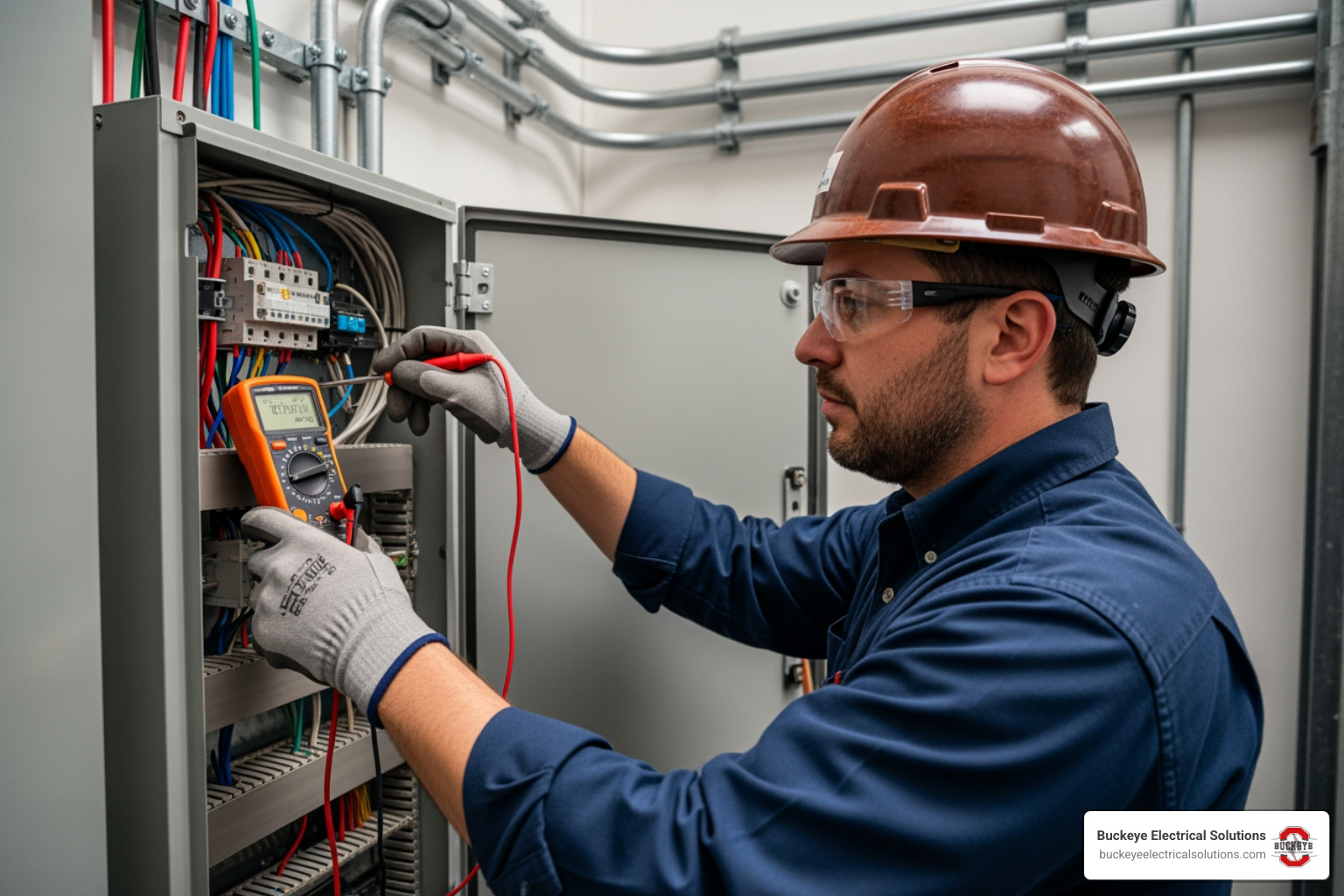
The best commercial electricians do a lot more than swap fixtures and reset breakers. On a commercial project, we often help plan, install, troubleshoot, document, test, and maintain the entire electrical system that keeps a business operating.
That can include new construction, tenant improvements, service upgrades, panel replacements, dedicated circuits for equipment, emergency lighting, code corrections, surge protection, backup power planning, and low-voltage coordination. In many Ohio facilities, it also means working around occupied spaces so employees, customers, tenants, or patients can keep moving while the job gets done.
If you want a deeper overview of service scope, here is more on our commercial electrical services.
Core services commercial electricians provide
Typical commercial electrical work includes:
- New wiring for offices, retail spaces, restaurants, warehouses, and mixed-use buildings
- Tenant build-outs and remodels
- Electrical service upgrades and panel replacements
- Dedicated circuits for HVAC, kitchen equipment, servers, copiers, machinery, and specialty tools
- Interior and exterior lighting installation
- LED retrofit projects
- Emergency egress lighting and exit sign circuits
- Generator connections and backup power planning
- Surge protection and power quality improvements
- Data cabling and low-voltage coordination
- Fire alarm system support and related electrical infrastructure
- Troubleshooting for outages, tripping breakers, flickering lights, and damaged wiring
- Preventive maintenance and inspection programs
Commercial projects usually involve heavier loads, more devices, longer conduit runs, and tighter code coordination than residential work. Translation: more planning, more testing, and fewer opportunities to “just wing it.”
Industries and properties they commonly serve
Commercial electricians commonly work in:
- Office buildings
- Retail stores and shopping centers
- Restaurants and food service spaces
- Warehouses and distribution centers
- Medical and dental offices
- Schools and training facilities
- Apartment complexes and mixed-use properties
- Manufacturing spaces
- Municipal and public buildings
Each environment has its own demands. A restaurant may need circuits for refrigeration, cooking equipment, signage, and emergency lighting. A warehouse may need high-bay lighting, dock power, and stronger service capacity. An office may care most about lighting quality, data support, and minimal downtime. Same trade, very different headaches.
Why regular maintenance pays off for businesses
A lot of expensive electrical problems start small. Loose terminations, overloaded circuits, aging breakers, heat buildup, and outdated panels rarely announce themselves politely.
Regular maintenance helps businesses:
- Catch problems before they become outages
- Extend the life of panels, breakers, and connected equipment
- Improve energy efficiency
- Reduce nuisance tripping
- Support safety and code readiness
- Plan upgrades before a failure forces an emergency decision
Preventive maintenance often includes visual inspections, testing, thermal checks where appropriate, tightening terminations as needed, verifying labeling, and identifying wear or damage before it causes downtime.
For more on this topic, see our guides to business electrical health and facility maintenance.
Commercial Electricians vs. Residential Electricians: Why the Difference Matters
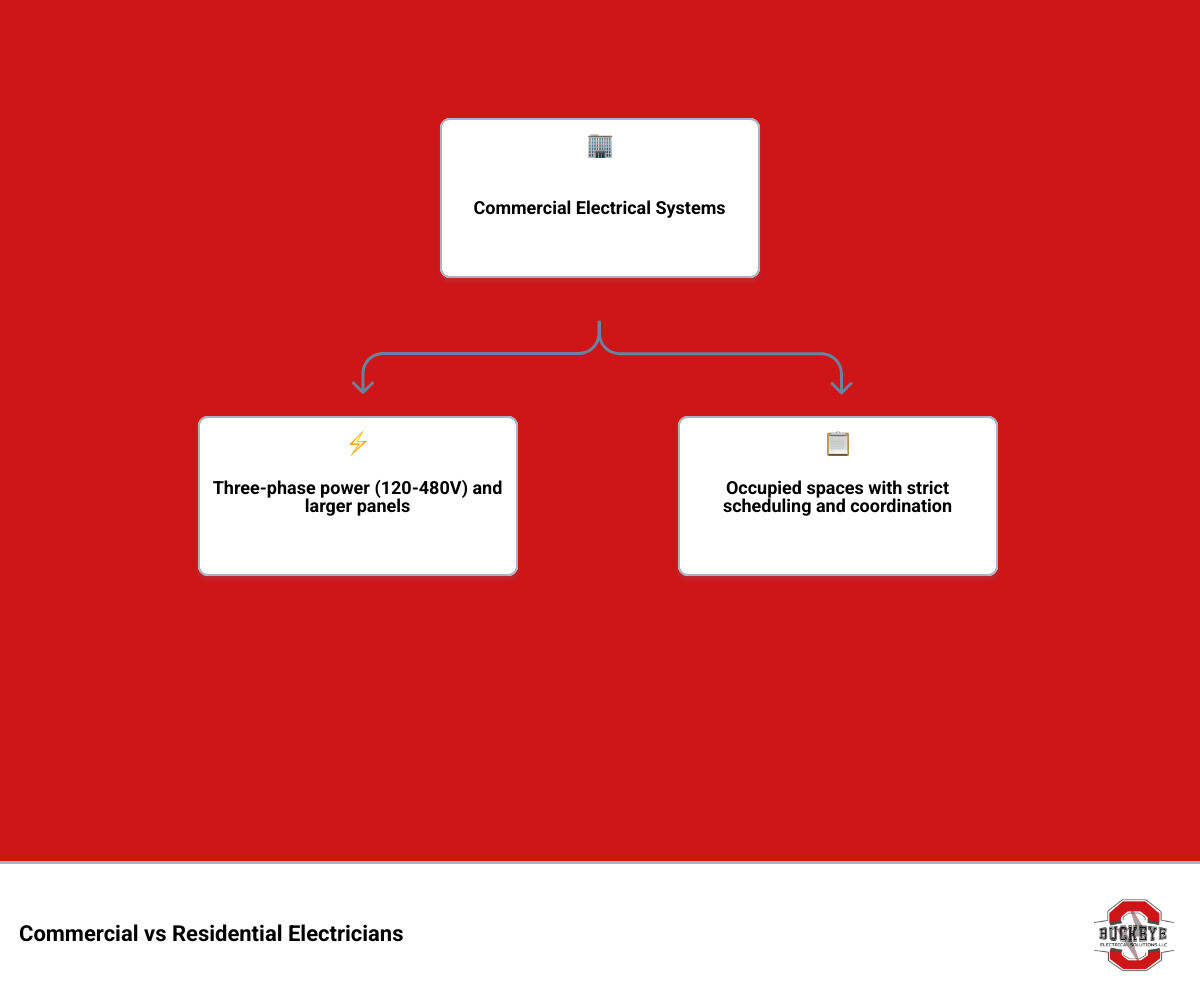
A good residential electrician may be excellent at home wiring and still not be the right fit for a commercial build-out. The difference is not just building size. It is system design, occupancy type, code application, equipment loads, project coordination, and safety requirements.
Commercial work often involves:
- Larger panels and distribution equipment
- Three-phase systems
- Voltage ranges that may extend from 120V up to 480V depending on the facility
- Longer conduit and feeder runs
- Occupied business spaces with strict scheduling needs
- Coordination with inspectors, general contractors, property managers, and other trades
- More documentation, labeling, testing, and closeout requirements
When businesses specifically need commercial electricians
Businesses should hire commercial electricians when the project involves:
- New commercial construction
- Tenant build-outs or interior renovations
- Panel or service upgrades
- Generator or backup power work
- Dedicated circuits for commercial equipment
- Emergency lighting or exit sign systems
- Fire alarm-related electrical work
- Large lighting retrofits
- Code corrections in a business occupancy
- After-hours electrical work to reduce downtime
In short, if the property is used for business, public access, rental occupancy, or heavier operational loads, commercial experience matters.
Ohio-specific code and compliance expectations
In Ohio, commercial electrical work must follow state and local requirements, including permitting and inspection where applicable. The local authority having jurisdiction, or AHJ, may have specific expectations on plan review, labeling, access, and inspection scheduling.
Ohio’s 2023 NEC adoption matters here. One point businesses should know: it includes expanded GFCI requirements in several locations, but those rules are situational and depend on the space, use, and equipment involved. In other words, “it’s a kitchen” does not automatically answer every code question in every commercial setting.
Other common compliance expectations may include:
- Proper panel and circuit labeling
- Emergency egress lighting functionality
- Required disconnect access and working clearances
- Grounding and bonding verification
- Arc flash awareness around applicable equipment
- Lockout/tagout procedures during service work
- Permit and final inspection sign-off when required
If you are comparing contractors, our guide on what to look for in commercial electrical services is a helpful next read.
Common business electrical issues and likely causes
Here is a practical comparison of issues businesses often see:
| Issue | Likely causes | Priority level |
|---|---|---|
| Breakers trip repeatedly | Overloaded circuits, equipment faults, loose connections, undersized circuits | High |
| Flickering lights | Loose connections, failing drivers or ballasts, voltage fluctuation, shared circuit issues | Medium to high |
| Dimming when equipment starts | High inrush load, undersized conductors, service capacity concerns, voltage drop | Medium to high |
| Outdated panel concerns | Aging breakers, obsolete equipment, limited capacity, safety or reliability issues | High |
| Emergency outage in part of building | Tripped breaker, failed connection, damaged equipment, utility or service issue | High |
| Outlet has no voltage; could indicate breaker, GFCI, switch, or wiring issue | Upstream device trip, switched receptacle, open connection, damaged wiring | Medium to high |
| Improper wiring found during inspection | Previous poor-quality work, unsafe modifications, unpermitted changes | High |
| Bootleg ground discovered | Incorrect grounding method in older or altered wiring | High |
| Burnt smell or warm equipment | Overheating connection, failing device, overloaded component | Urgent |
How to Vet the Best Commercial Electricians in Your Area
Not all bids are equal, and not all electricians who “also do commercial” are set up for serious business work. Vetting matters.
Credentials, licenses, and certifications to verify
When hiring in Ohio, ask for proof of:
- Appropriate contractor registration or licensing required for the jurisdiction and project
- Liability insurance
- Workers’ compensation coverage
- Commercial project experience
- Apprenticeship or journeyman/master-level training
- Continuing education
- Safety training, including OSHA-related practices
- Familiarity with NFPA 70E concepts for electrical safety in the workplace
- Manufacturer training where specialized systems are involved
It is also fair to ask about safety record, permitting experience, and who will actually be on site doing the work.
The labor market is tight, too. A 2023 industry survey found that 67% of commercial electrical contractors reported difficulty finding qualified electricians. That makes experienced, organized contractors even more valuable for businesses that need reliable schedules.
Questions to ask before hiring
Before you sign anything, ask these questions:
- Have you handled projects like ours before?
- Who pulls permits and schedules inspections?
- Will the work be done by your team or subcontractors?
- How do you handle change orders?
- What is the expected timeline?
- Can you work nights or weekends if needed?
- How will shutdowns be planned to reduce downtime?
- What testing and closeout documentation will we receive?
- What workmanship warranty do you provide?
- How quickly can you respond if a problem comes up after completion?
For more hiring guidance, check out:
How to compare bids without choosing on price alone
Lowest bid does not always mean lowest total cost. Sometimes it means “surprise, that wasn’t included.”
Compare bids based on:
- Scope clarity
- Materials specified
- Experience level of field crews
- Testing and inspection procedures
- Permit responsibility
- Schedule assumptions
- Exclusions
- Punch-list process
- Warranty coverage
- Emergency response availability
If one quote is much cheaper, ask what has been left out. The missing item may be permit handling, after-hours work, fixture support, patching coordination, or final testing.
More resources:
What Businesses Should Expect: Timelines, Costs, Warranties, and Emergency Service
Commercial electrical work usually follows a predictable path, even when the project itself is complicated.
Typical project timeline from estimate to final inspection
A standard commercial job may include:
- Site walk and discovery
- Scope definition and estimate
- Design coordination if needed
- Permit submission and lead time
- Material procurement
- Rough-in work
- Equipment and device installation
- Testing and troubleshooting
- Final walkthrough
- Punch list and closeout
- Final inspection and turnover
Small jobs may move quickly. Larger projects with custom gear, occupied spaces, or utility coordination naturally take longer. Inspection timing, long-lead materials, and local AHJ requirements can also affect schedule.
Cost factors that shape commercial electrical work
Commercial pricing is never one-size-fits-all. Costs are subject to change and depend on site conditions, project scope, material availability, labor scheduling, and local AHJ requirements.
Common cost drivers include:
- Square footage
- Existing service size and panel capacity
- Length and complexity of conduit runs
- Ceiling height and lift requirements
- Whether the building is occupied
- Need for night or weekend work
- Specialty systems such as fire alarm, generator tie-ins, or low-voltage coordination
- Permit and inspection fees
- Access limitations
- Existing code issues uncovered during the job
As a general industry reference, the average hourly wage for commercial electricians in the U.S. was reported at $32.60, with experienced journeymen in larger metro areas often earning more. That does not equal a project price, but it helps explain why commercial labor quality matters.
Warranties, service agreements, and 24/7 emergency response
Businesses should expect clear warranty terms in writing. Typically, that means:
- A workmanship warranty from the contractor
- Manufacturer warranties on eligible equipment and devices
- Clear communication about what is covered and for how long
- A process for service calls after project completion
For ongoing support, many companies benefit from service agreements or maintenance plans, especially if they operate refrigeration, commercial kitchens, medical spaces, or mission-critical equipment.
Emergency service is another big differentiator. A good commercial electrician should be able to respond to urgent issues like:
- Partial or total power loss
- Burning odors
- Sparking equipment
- Failed panels or breakers
- Emergency lighting failures
- Storm-related electrical damage
- Generator or backup power issues
When emergencies happen, the first goal is often to make the site safe and restore critical operations. Permanent repair may follow once diagnostics, parts, and inspections are lined up.
Related reading:
Specialty Systems That Add Safety, Efficiency, and Future Capacity
The best commercial projects do not just meet today’s load. They leave room for tomorrow’s equipment, tenants, and technology.
Life safety and compliance systems for commercial buildings
Important specialty systems include:
- Fire alarm power and device infrastructure
- Emergency lighting
- Exit signs
- Dedicated life-safety circuits
- Monitoring interface support
- Code corrections related to life-safety deficiencies
These systems need careful installation, testing, and documentation. If they are wrong, it is not just inconvenient – it can delay occupancy or create a serious safety issue.
Learn more here:
Energy-saving upgrades with operational benefits
Energy upgrades are often easier to justify when they also reduce maintenance and improve reliability.
Popular improvements include:
- LED lighting retrofits
- Occupancy sensors
- Daylight-responsive controls
- Smarter lighting layouts
- Panel modernization
- Surge protection and power quality improvements
- Load monitoring for better planning
Benefits can include lower maintenance, better light quality, less wasted energy, and improved support for future growth.
Planning for growth with scalable electrical infrastructure
A smart commercial electrical design considers what comes next:
- Spare capacity in panels where appropriate
- Subpanels for future expansion
- Dedicated circuits for future equipment
- Flexibility for tenant changes
- Structured cabling and data growth
- EV charger readiness
- Generator tie-in planning
- Better documentation for future service work
That kind of planning saves money later because you avoid tearing back into finished spaces every time your business adds equipment, reconfigures workstations, or expands operations.
You can explore more in our commercial electrical services overview.
Frequently Asked Questions about Commercial Electricians
What’s the fastest way to find reliable commercial electricians near me?
Start local and verify everything. Look for an Ohio contractor with documented commercial experience, proof of insurance, project photos, and a written scope. Read reviews carefully, but also ask for examples of similar work, permit familiarity, and emergency availability. If a company cannot clearly explain how it handles inspections, shutdowns, and change orders, keep shopping.
How do commercial electricians keep projects safe and code-compliant?
We keep projects safe through planning, PPE, lockout/tagout procedures, proper testing, permit coordination, and code-based installation practices. Commercial jobs also require careful labeling, working clearance awareness, safe energization procedures, and final inspection follow-through. In Ohio, that means staying current with the 2023 NEC as adopted by the state and any local AHJ requirements.
Do commercial electricians work after hours to reduce business downtime?
Yes, many do. After-hours scheduling is common for occupied offices, restaurants, retail stores, and other businesses that cannot shut down during normal operating hours. Night work, weekend work, phased shutdowns, and tenant coordination are all standard tools for keeping disruption manageable.
Conclusion
Hiring the right commercial electricians is really about protecting your schedule, your budget, and your building’s long-term reliability. The best contractors bring more than tools – they bring planning, code knowledge, safety discipline, and the ability to keep your business moving when electrical work gets complicated.
At Buckeye Electrical Solutions, we serve businesses across Northeast Ohio with over 20 years of experience, prompt project completion, and a practical, safety-first approach to commercial electrical work. Whether you need a tenant build-out, service upgrade, troubleshooting, maintenance, or emergency support, we are here to help.
Ready for next steps? Explore our commercial electrical services and contact us to discuss your next project.