What Is Arc Fault Breaker Installation — and Do You Need It?
Arc fault breaker installation is the process of replacing a standard circuit breaker with an Arc Fault Circuit Interrupter (AFCI) breaker to protect your home’s wiring from dangerous electrical arcs that can cause fires.
Here’s what you need to know at a glance:
- What it does — An AFCI breaker detects unintended electrical arcing in your wiring and shuts the circuit down before a fire can start.
- Who needs it — Most U.S. homes built or renovated under modern code require AFCI protection. Ohio has adopted the 2023 NEC, which expanded these requirements significantly.
- How it’s different from a standard breaker — AFCI breakers include an extra white “pigtail” wire that connects to the neutral bus bar — standard breakers do not.
- Cost to expect — AFCI breakers cost significantly more than standard breakers (sometimes 8–10 times more), and total installation cost varies based on your panel, circuit count, and local permit requirements in Ohio.
- Can you DIY it? — Working inside a live electrical panel carries serious risk of electrocution. A licensed electrician should perform this work.
Electrical arcing can reach temperatures exceeding 9,000°F — hot enough to ignite wood framing and insulation inside your walls long before a standard breaker ever trips. That’s the core problem AFCI technology was designed to solve.
I’m Aaron Estep, owner of Buckeye Electrical Solutions LLC and a master electrician with more than 60 permitted projects completed across Northeast Ohio — including numerous panel upgrades and arc fault breaker installations in both older and newer homes. In this guide, I’ll walk you through exactly how AFCI breakers work, what the code requires in Ohio, and how to install one safely.
What is an Arc Fault and Why Do You Need Protection?
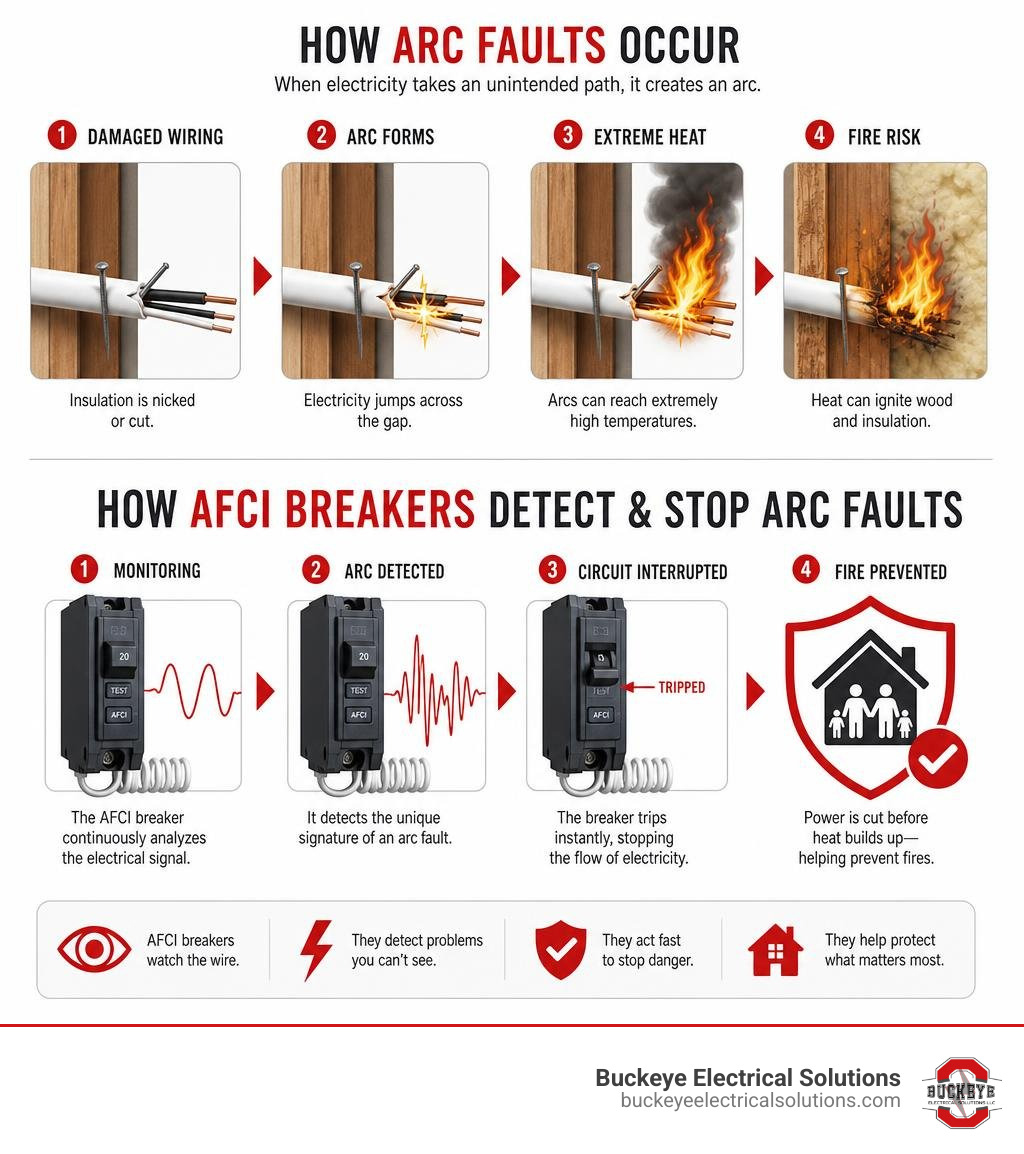
An electrical arc is essentially an unintended discharge of electricity that jumps across an unplanned gap or path in a circuit. Think of it like lightning on a tiny, localized scale inside your walls. When electricity escapes its intended copper pathway, it generates intense localized heat.
Because standard breakers are designed to trip only during short circuits or sustained thermal overloads, they will happily let an arc continue to spark if the overall current draw remains below the breaker’s limit (such as 15 or 20 amps). This is why understanding the mechanics of these faults is so critical to protecting your home. For a deeper look at general system issues, you can review our guide on Short Circuit Explained: Your Guide to Electrical Faults.
Normal Arcing vs. Dangerous Arc Faults
Not all electrical arcing is dangerous. In fact, you probably see normal arcing every day without realizing it. When you turn off a light switch or use an appliance with motor brushes (like a vacuum cleaner or hair dryer), a tiny, controlled arc occurs inside the switch or motor. These are normal operating conditions, and the appliances are designed to handle them safely.
A dangerous arc fault, on the other hand, is an uncontrolled, unintended discharge. Uncontrolled arcs can easily exceed temperatures of 10,000 degrees Fahrenheit. At this level of heat, surrounding materials like wood studs, drywall paper, dust, and wire insulation can ignite instantly. To keep your family safe from these hidden hazards, it is helpful to follow a comprehensive checklist like Don’t Get Shocked: The Ultimate Electrical Safety Checklist for Your Home.
Common Causes of Residential Arc Faults
Arc faults in residential wiring are usually silent and hidden from view. They generally fall into two categories: parallel arcs (arcing between two different conductors, such as hot and neutral) and series arcs (arcing across a break in a single conductor).
The most frequent culprits behind these dangerous faults include:
- Tightly Hammered Staples: During the rough-in wiring phase, if an installer hammers a metal Romex staple too hard into a wooden stud, it can pinch the outer jacket and slowly crush the inner insulation. Over time, the compressed conductors begin to arc.
- Pierced Cables: Hanging a picture frame, mounting a television, or installing shelving can result in a drywall screw or nail piercing through the drywall and directly into a hidden electrical wire.
- Damaged or Pinched Power Cords: Heavy furniture pushed tightly against an outlet can bend power plugs or pinch cords against the wall, damaging the internal copper strands.
- Loose Connections: Outlets and switches that have loose terminal screws or wires that were “back-stabbed” rather than wrapped securely around terminal screws can create gaps where current jumps.
- Worn Insulation and Aging Wire: Over several decades, wire insulation can become brittle, crack, or be chewed away by pests, leaving bare copper exposed to surrounding building materials.
National Electrical Code (NEC) Requirements in Ohio
The National Electrical Code (NEC) has steadily increased requirements for AFCI protection over the last few decades. First introduced as a limited requirement in the 1999 NEC, the mandate expanded significantly in 2008 to cover family rooms, dining rooms, living rooms, parlors, libraries, dens, bedrooms, sunrooms, recreation rooms, closets, hallways, and similar rooms. By the 2017 NEC, virtually every 15-amp and 20-amp branch circuit supplying outlets or devices in residential kitchens and family areas required arc-fault protection.
In Ohio, electrical installations must align with state-specific adoptions of these standards. Ohio’s 2023 NEC adoption includes expanded GFCI requirements in several locations, qualifying specific rules (like kitchens) as situational rather than universal. When performing an arc fault breaker installation, we must carefully cross-reference both AFCI and GFCI requirements to ensure total code compliance and safety. For a thorough understanding of how these national guidelines impact your home, consult The NEC Book Bible.
Step-by-Step Arc Fault Breaker Installation
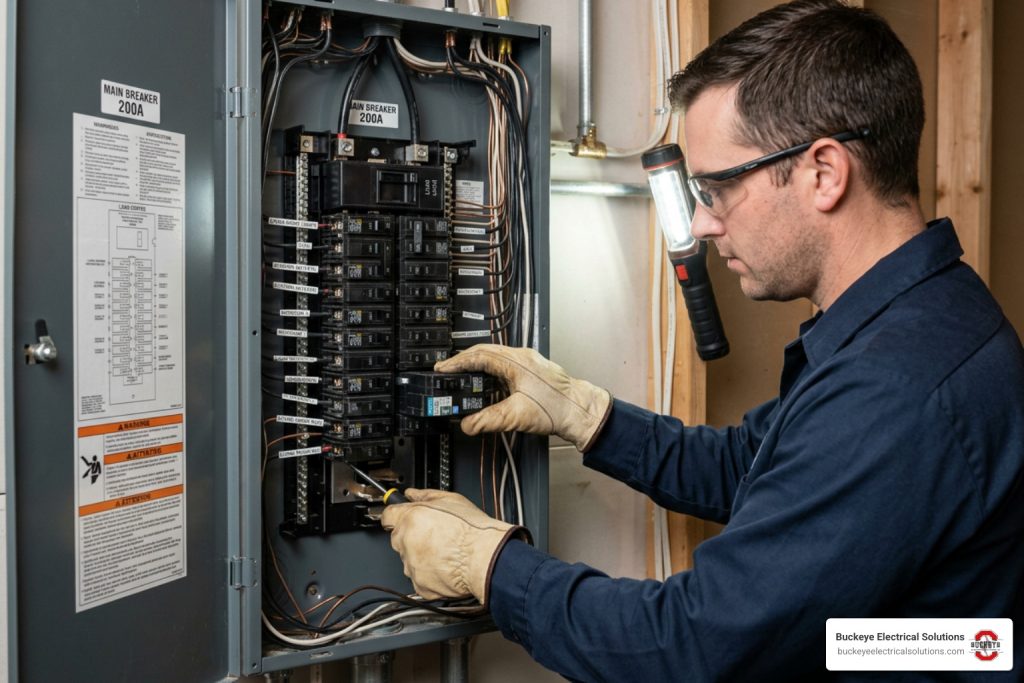
Performing an arc fault breaker installation requires working inside your main electrical panel. If you are comfortable working around electricity and choose to undertake this task, you must follow strict safety protocols. If you are at all uncertain, always hire a licensed professional.
Preparing the Panel and Safety Protocols
Before you remove a single screw from your panel cover, you must establish a safe working environment.
- Wear Safety Gear: Wear rubber-soled shoes, safety glasses, and use tools with properly insulated handles rated for electrical work.
- Clear the Area: Ensure the floor in front of the panel is completely dry. Never stand on a damp floor or work on a panel when moisture is present.
- Shut Off the Main Power: Locate the main circuit breaker (typically at the very top or bottom of the panel, usually rated for 100 to 200 amps) and flip it to the “OFF” position. The lines coming into the panel from the utility meter will still be live, so exercise extreme caution even with the main breaker off.
- Remove the Panel Cover: Carefully remove the screws holding the outer cover in place while supporting it so it doesn’t fall against the internal components.
- Verify the Power is Off: Use a reliable non-contact voltage tester to verify that the individual branch breakers and bus bars are completely de-energized. For detailed steps on utilizing diagnostic equipment, refer to Don’t Get Shocked: Expert Advice for Electrical Troubleshooting.
Wiring the AFCI Breaker
Standard breakers only connect to the hot wire of a circuit. An AFCI breaker, however, must monitor both the hot and neutral currents of the circuit to analyze the electrical waveform for arc signatures. This means the circuit’s neutral wire must connect directly to the breaker rather than the panel’s neutral bus bar.
Here is the step-by-step wiring process:
- Locate and Disconnect the Old Circuit: Identify the circuit you want to protect. Disconnect the black (hot) wire from the old breaker. Next, locate the corresponding white (neutral) wire for that exact same circuit on the panel’s neutral bus bar and disconnect it. Remove the old breaker from the panel.
- Identify the AFCI Terminals: Look closely at your new AFCI breaker. It will feature a gold terminal screw labeled “LOAD” or “LOAD POWER” and a silver terminal screw labeled “LOAD NEUTRAL”. It will also have a coiled white wire (the pigtail) pre-attached to the breaker’s body.
- Connect the Circuit Neutral: Insert the white circuit neutral wire into the silver terminal screw labeled “LOAD NEUTRAL” on the AFCI breaker. Tighten the screw securely to the manufacturer’s torque specifications.
- Connect the Circuit Hot: Insert the black circuit hot wire into the gold terminal screw labeled “LOAD” on the AFCI breaker and tighten securely.
- Connect the Neutral Pigtail: Uncoil the white pigtail wire attached to the breaker. Route it neatly to an open terminal on the panel’s neutral bus bar and secure it tightly.
- Mount the Breaker: Align the breaker with the panel’s mounting rail and push it firmly onto the hot bus bar until it snaps securely into place.
- Re-install and Test: Reattach the panel cover, restore the main power, and flip your new AFCI breaker to the “ON” position. Press the “TEST” button on the face of the breaker to verify that the internal circuitry trips the breaker successfully.
For specific instructions regarding multi-wire or shared neutral circuits, refer to GE’s technical documentation on two-pole AFCI installation and Schneider Electric’s guide on wiring CAFI and DF breakers.
Troubleshooting Nuisance Tripping and Older Wiring Challenges
One of the most common complaints regarding AFCI breakers is “nuisance tripping.” This occurs when a breaker trips despite the absence of an actual wiring hazard. While early generations of AFCI technology were highly sensitive to electronic noise, modern combination AFCI breakers are far more sophisticated at distinguishing between harmless functional arcs and dangerous electrical faults.
Diagnosing Common AFCI Trips
If your newly installed AFCI breaker trips immediately or intermittently, the issue is usually related to shared neutrals, improper wiring, or device incompatibility.
Older homes often utilized shared neutral configurations (where two hot wires share a single white neutral wire to save on materials). Standard AFCI breakers cannot handle shared neutrals because they expect the hot and neutral currents of a single circuit to balance perfectly. If you are dealing with older systems, you can learn more about modern upgrades in Upgrade Your Watts: What You Need to Know About Electrical Wiring.
To help you systematically diagnose issues, use the troubleshooting guide below:
| Symptom / Behavior | likely causes | priority level |
|---|---|---|
| Breaker trips instantly upon turning on with no loads connected | Improper wiring in panel; pinched neutral contacting ground; bootleg ground | High |
| Breaker trips immediately when a specific appliance is turned on | Damaged power cord; motor winding arc fault; appliance internal short | High |
| Breaker trips intermittently when various electronics or LED dimmers are active | Incompatible solid-state dimmer; excessive electronic noise; loose wire nut | Medium |
| Outlet has no voltage; could indicate breaker, GFCI, switch, or wiring issue | Tripped AFCI or GFCI upstream; loose terminal connection; broken line conductor | High |
Modern AFCI breakers from manufacturers like Siemens or Square D include onboard LED trip indicators. When the breaker trips, turning it back on will trigger a diagnostic light pattern for a few seconds. This pattern tells you whether the trip was caused by an overcurrent event, a parallel arc, or a ground fault, significantly speeding up the troubleshooting process.
AFCI vs. GFCI: Key Differences and Dual-Function Protection
It is common for homeowners to confuse AFCI breakers with Ground Fault Circuit Interrupter (GFCI) devices. While both are essential safety components, they serve entirely different protective roles.

- GFCI Protection: Designed to prevent severe electrical shock. GFCIs monitor the balance of current between hot and neutral wires. If current leaks to an unintended path (like water or a human body), the GFCI cuts power within milliseconds.
- AFCI Protection: Designed to prevent electrical fires. AFCIs monitor the wave signature of the electricity. If they detect the erratic, high-frequency signature of an electrical arc, they trip the circuit before the heat can ignite surrounding materials.
Today, you can purchase “Dual-Function” (DF) breakers that combine both AFCI and GFCI protection into a single unit. This is highly convenient for areas like kitchens and laundry rooms where modern codes require both shock and fire prevention. If you are considering upgrading your panel to accommodate these modern safety components, check out our resource on Panel Upgrade or Replacement: Your Guide to Costs and Savings.
Frequently Asked Questions about AFCI Breakers
What is the difference between a pigtail and a plug-on neutral arc fault breaker installation?
A standard pigtail AFCI breaker has a coiled white wire that you must manually run and secure to the panel’s neutral bus bar. A plug-on neutral (PON) breaker is designed for modern panels that feature a built-in neutral bar running along the breaker mounting rail. When you snap a plug-on neutral breaker into place, it automatically connects to both the hot bus bar and the neutral bar, eliminating the need for a coiled white wire and creating a much cleaner, faster installation.
Can I perform an arc fault breaker installation in an older home with knob-and-tube wiring?
Yes, but it requires careful evaluation. Knob-and-tube wiring is an ungrounded, open-air system that often features shared neutrals and improper handyman splices hidden behind walls. While AFCI breakers are highly recommended for knob-and-tube systems because they can detect dangerous carbon buildup and loose splices, installing them on these older systems often leads to immediate tripping due to shared neutrals. Resolving these issues may require rewiring sections of your home. To understand the broader costs and benefits of upgrading older electrical panels, read Amp Up Your Home: Benefits and Costs of an Electrical Panel Upgrade.
Why does my newly installed AFCI breaker keep tripping?
If your new breaker keeps tripping, it is doing its job. It is either detecting a genuine arc fault (such as a loose connection in an outlet or a damaged cord), a wiring error (like a neutral wire touching a ground wire inside a junction box), or electrical noise from an incompatible or poorly designed electronic device. To isolate the problem, unplug all appliances on the circuit, reset the breaker, and plug devices back in one at a time to see which one triggers the trip.
Conclusion
Upgrading your home with AFCI protection is one of the most effective steps you can take to prevent electrical fires before they start. While the cost of an AFCI breaker is higher than a standard breaker—with single-pole options typically around $65 compared to under $8 for a standard breaker—the peace of mind and safety benefits are invaluable. Please note that all service pricing and material estimates are subject to change and dependent on local site conditions or local Authority Having Jurisdiction (AHJ) requirements.
Because working inside an active breaker panel presents severe safety risks, we strongly recommend leaving these upgrades to licensed professionals. At Buckeye Electrical Solutions, we have served homeowners across Northeast Ohio for over 20 years with reliable, high-quality residential electrical installations, panel replacements, and safety inspections.
If you are ready to secure your home against electrical hazards, contact us today to schedule a comprehensive system inspection or professional installation. Schedule emergency electrical service in Northeast Ohio with our trusted team and ensure your electrical system is fully compliant, safe, and reliable.