
What Does It Cost to Add an Outlet in a Bathroom?
The cost to add outlet in a bathroom typically ranges from around $140 to $700 or more, depending on your specific situation. Here’s a quick snapshot to help you budget:
| Scenario | Estimated Cost Range |
|---|---|
| Simple GFCI outlet replacement | $140 – $210 |
| New GFCI outlet, existing wiring | $210 – $350 |
| New outlet with new circuit or wiring | $350 – $700+ |
| New outlet with panel upgrade or drywall repair | $700 – $1,500+ |
Note: All cost estimates are subject to change based on local site conditions, material costs, and your local Authority Having Jurisdiction (AHJ) requirements in Ohio.
These numbers reflect a few realities. Bathroom outlets aren’t like standard outlets elsewhere in your home. Ohio electrical code — aligned with the 2023 National Electrical Code (NEC), adopted in April 2024 — requires GFCI protection on all bathroom outlets. That adds a small but real cost to every bathroom outlet project. And if your home needs new wiring, a circuit extension, or drywall repair, costs can climb quickly.
There’s also the labor factor. Licensed electricians in Ohio typically charge $50 to $100 per hour, and most projects carry a minimum call-out fee even for straightforward jobs.
The bottom line: a simple swap costs relatively little. A full new outlet installation — especially in an older home — can cost significantly more once you account for wiring, permits, and code compliance.
I’m Aaron, owner of Buckeye Electrical Solutions LLC and a master electrician who has directed more than 60 permitted electrical projects across Northeast Ohio, including numerous bathroom outlet installations that required navigating Ohio’s updated GFCI requirements. Understanding the cost to add outlet in a bathroom is something I help homeowners work through every week, and this guide will walk you through every factor that affects your final price.
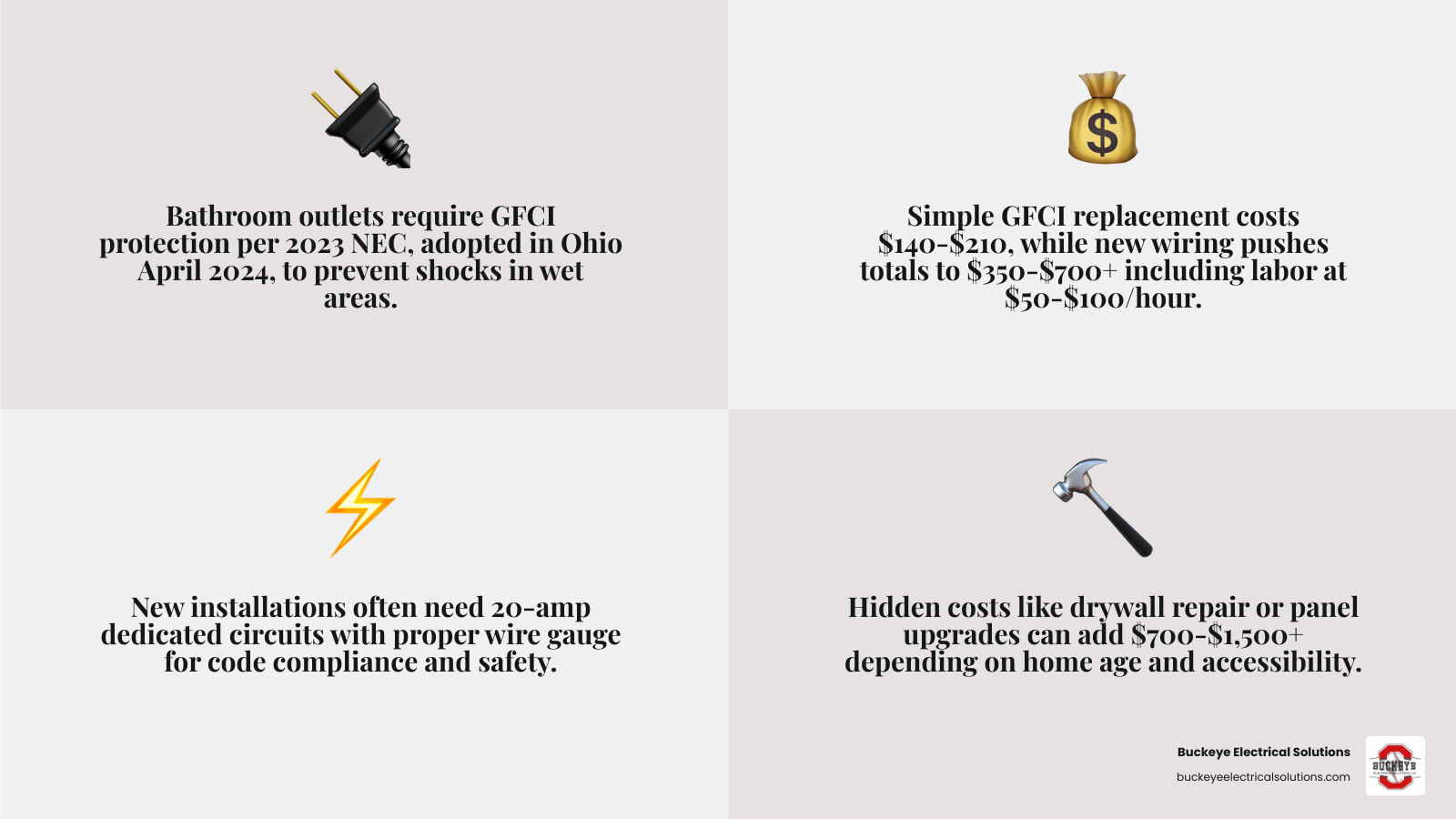
Quick look at cost to add outlet in a bathroom:
Factors Influencing the Cost to Add Outlet in Bathroom
When we walk into a home in Akron or Cleveland to provide an estimate, we aren’t just looking at the wall where the outlet goes. We are looking at the entire electrical “ecosystem” of your bathroom. Several variables dictate whether your project sits at the $200 mark or climbs toward $700.
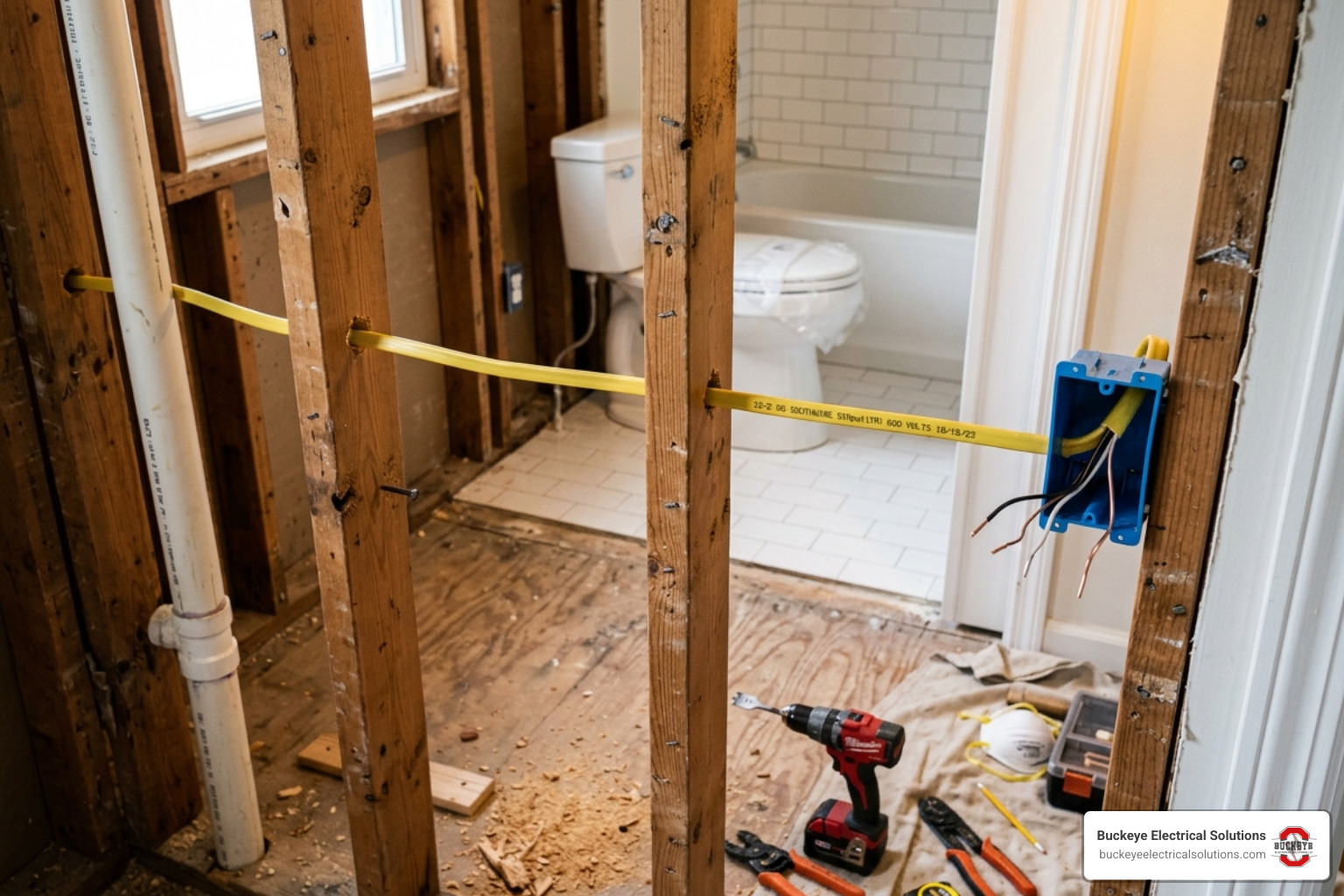
The most significant driver is the complexity of the installation. If we are simply replacing an old, non-GFCI outlet with a modern one, the labor is minimal. However, if you need an outlet on the opposite side of the room where no wiring exists, we have to “fish” wires through finished walls. This often requires cutting into drywall, which adds both time and repair costs.
According to the Cost to Install Electrical Outlet – 2026 Cost Calculator, the basic unit cost for an outlet installation includes material delivery, worksite preparation, and labor setup. However, this base price often excludes the specific requirements of a damp environment like a bathroom, where specialized boxes and moisture-resistant components are often necessary.
Labor Rates and Professional Electrician Fees
In Northeast Ohio, labor is the largest component of your bill. Most licensed electricians charge between $50 and $100 per hour, though master electricians may charge closer to $150 for complex troubleshooting.
It is important to understand the “minimum call-out fee.” Because of the costs associated with gas, insurance, and travel time, most pros charge a minimum of 1 to 2 hours of labor (typically $100 to $200) regardless of how fast the job is. This is why we often recommend that homeowners bundle projects. If you need a bathroom outlet but also have a flickering light in the hallway, having us fix both during one visit can significantly lower the “per-task” cost.
Our Residential Electrical Services team focuses on efficiency, but safety never takes a backseat to speed. A proper installation involves testing the circuit load and ensuring the grounding is sufficient—steps that take time but prevent house fires.
Material Costs for GFCI and Specialty Receptacles
The physical hardware for a bathroom outlet is more expensive than a standard bedroom outlet.
- Standard GFCI Outlets: These typically cost $15 to $40 for the unit alone. They feature the “Test” and “Reset” buttons you’re likely familiar with.
- USB-Integrated GFCI: If you want to charge your phone or electric toothbrush without taking up a plug, these units can cost $40 to $60.
- Smart GFCI Outlets: For those integrating home automation, smart outlets that monitor power usage or can be shut off remotely add a $25 to $50 premium over standard units.
- Faceplates: While a basic plastic faceplate is under $2, premium finishes like brushed nickel or matte black to match your bathroom fixtures can cost $10 to $20.

Ohio Electrical Codes and GFCI Requirements
Ohio takes electrical safety seriously. In April 2024, the state officially adopted the 2023 National Electrical Code (NEC). This update expanded where and how GFCI (Ground Fault Circuit Interrupter) protection must be used.
For bathrooms, the rules are clear: every single 125-volt, single-phase, 15- and 20-ampere receptacle must have GFCI protection. It doesn’t matter if the outlet is right next to the sink or on the far wall by the door; if it’s in the bathroom, it needs protection. This is a non-negotiable safety standard designed to prevent electrocution in areas where water is present.
As noted in the Cost to Install Gfci Outlet in Bathroom 2026, regional variations in labor markets can cause price differences of 15% to 25%, but the code requirements remain a constant baseline for any legal installation.
Mandatory GFCI Protection in Wet Areas
Why are these outlets so important? A GFCI outlet is essentially a fast-acting circuit breaker built into the plug. It constantly monitors the flow of electricity. If it detects that the current is “leaking” (perhaps through a person’s body because they touched a hair dryer with wet hands), it snaps the power off in as little as 1/40th of a second.
This life-saving technology has reduced residential electrocutions by over 80% since it was first introduced. We discuss these mechanics in detail in Your Complete Guide to Installing Electrical Outlets Safely. In a bathroom, moisture from showers and proximity to sinks makes the risk of a “ground fault” much higher than in a dry bedroom or living room.
Impact of the 2023 NEC on Bathroom Wiring
The 2023 NEC update didn’t just change the outlets; it reinforced the need for dedicated circuits. Modern bathrooms are full of high-wattage devices. A single high-end hair dryer can draw 1,875 watts, which is nearly the entire capacity of a 20-amp circuit.
If we are adding a new outlet, we must ensure it isn’t “tapping” into a circuit that is already overloaded by a nearby bedroom or a vacuum cleaner in the hall. Often, code requires a dedicated 20-amp circuit for bathroom receptacles. This ensures that when you turn on the curling iron, you don’t plunge the rest of the house into darkness.
Hidden Expenses: Wiring, Panels, and Drywall Repairs
The “sticker shock” some homeowners experience usually comes from the “hidden” work required to make the new outlet functional and safe. If your home was built before 1970, you might have ungrounded wiring (two-prong outlets). Adding a GFCI to an ungrounded system is possible and actually recommended for safety, but it requires specific labeling and testing to meet Ohio code.
Cost to Add Outlet in Bathroom with New Circuitry
If your current bathroom circuit is already at capacity, we have to run a brand-new wire from your main electrical panel to the bathroom. This is known as a “home run.”
- Wire Costs: Copper prices fluctuate, but running 50 feet of 12/2 Romex (standard for 20-amp circuits) adds to the material bill.
- Routing: If the bathroom is on the second floor and the panel is in the basement, we have to find a path through the walls. If there is no “chase” or attic access, we may have to cut small holes in the drywall to pull the wire through.
Planning for these additions is similar to the prep work we recommend in our guide on Bright Ideas for Your Kitchen Electrical Remodel Planning, where circuit loads are equally critical.
Electrical Panel Capacity and Potential Upgrades
Before we can add a new circuit, we have to check your electrical panel. Do you have an open slot for a new breaker?
- Breaker Space: If the panel is full, we might be able to use “tandem” breakers to save space, but some older panels don’t allow this.
- Amperage: If your home still has a 60-amp or 100-amp service, adding modern bathroom appliances and extra outlets might push the system to its limit.
In some cases, the cost to add outlet in a bathroom might trigger the need for a panel upgrade. While a new outlet is a few hundred dollars, a panel upgrade can range from $1,000 to $2,500. You can learn more about this in our article Amp Up Your Home: Benefits and Costs of an Electrical Panel Upgrade.
Professional Installation vs. DIY Risks in Ohio Homes
We understand the temptation to watch a YouTube video and try to save $200 by installing the outlet yourself. However, the bathroom is the most dangerous place in the house for DIY electrical work.
The Risks of DIY Bathroom Wiring:
- Fire Hazards: Loose connections are the leading cause of electrical fires. In a bathroom, moisture can accelerate the corrosion of poorly joined wires.
- Insurance Issues: If a fire occurs and the cause is traced back to non-permitted, uncertified electrical work, your insurance company may deny the claim.
- Code Violations: If you sell your home, a home inspector will check for GFCI protection. If the wiring isn’t up to 2023 NEC standards, it could hold up the sale of your house.
- Personal Safety: Working in a bathroom often means standing on tile or near metal plumbing—both of which are excellent conductors. A mistake during installation can be fatal.
For more on why professional help is vital for system-wide changes, see our Panel Upgrade or Replacement: Your Guide to Costs and Savings.
Estimating the Total Cost to Add Outlet in Bathroom
To give you a clearer picture of what to expect in the Northeast Ohio market, we’ve broken down the typical project costs based on the scope of work.
| Project Type | Labor (Avg) | Materials (Avg) | Total Estimated Cost |
|---|---|---|---|
| Simple Replacement | $125 – $175 | $15 – $35 | $140 – $210 |
| Add Outlet (Existing Circuit) | $175 – $300 | $35 – $50 | $210 – $350 |
| Add Outlet (New Circuit) | $300 – $600 | $50 – $100 | $350 – $700 |
| Premium Installation | $600+ | $100+ | $700+ |
Note: These are estimates for a single outlet. Adding multiple outlets during the same visit typically reduces the cost per outlet because the call-out fee and setup time are shared.
Frequently Asked Questions about Bathroom Outlet Costs
Do I need a permit to add an outlet in my bathroom?
In most Ohio municipalities, yes. Adding a new circuit or modifying existing wiring typically requires a permit from your local building department. This ensures that a third-party inspector verifies the work meets safety codes. At Buckeye Electrical Solutions, we handle the permitting process for our clients to ensure everything is “above board.”
How long does it typically take to install a new bathroom outlet?
A straightforward replacement takes about 30 to 45 minutes. However, adding a brand-new outlet in a finished wall usually takes 2 to 4 hours, depending on the distance to the power source and the ease of routing the wire.
Will adding a GFCI outlet increase my home’s resale value?
While adding a single outlet won’t dramatically spike your home’s price, it significantly increases “resale appeal” and safety. Home buyers in Ohio expect modern, code-compliant bathrooms. If an inspector finds non-GFCI outlets in a bathroom, it becomes a “red flag” that often results in the buyer asking for a repair credit during negotiations.
Can one GFCI outlet protect other outlets in the bathroom?
Yes! One GFCI outlet can be wired to protect “downstream” standard outlets on the same circuit. This is a great way to save on material costs while still ensuring the entire bathroom is safe. However, this requires precise wiring of the “Line” and “Load” terminals, which is best left to a pro.
Why does my bathroom GFCI keep tripping?
If your outlet trips frequently, it’s doing its job. It could be due to moisture inside the box, a faulty appliance (like an old hair dryer), or a “nuisance trip” caused by a motor. If it won’t reset, the internal circuitry has likely failed, and the unit needs replacement.
Conclusion
Budgeting for the cost to add outlet in your bathroom is an investment in both convenience and the safety of your family. Whether you are tired of sharing a single plug or you are bringing an older Ohio home up to modern safety standards, understanding the variables—from labor rates to the 2023 NEC requirements—helps you plan effectively.
At Buckeye Electrical Solutions, we pride ourselves on transparent pricing and expert craftsmanship. We’ve spent over 20 years serving the Northeast Ohio community, ensuring that every wire we pull and every outlet we install meets the highest standards of safety.
Don’t leave your bathroom safety to chance or uncertified “handyman” fixes. If you’re ready to upgrade your space, we are here to help with professional consultations and prompt service.
Ready to get started? Contact Us today for an estimate tailored to your home, or explore Our Services to see how we can brighten your next home improvement project.