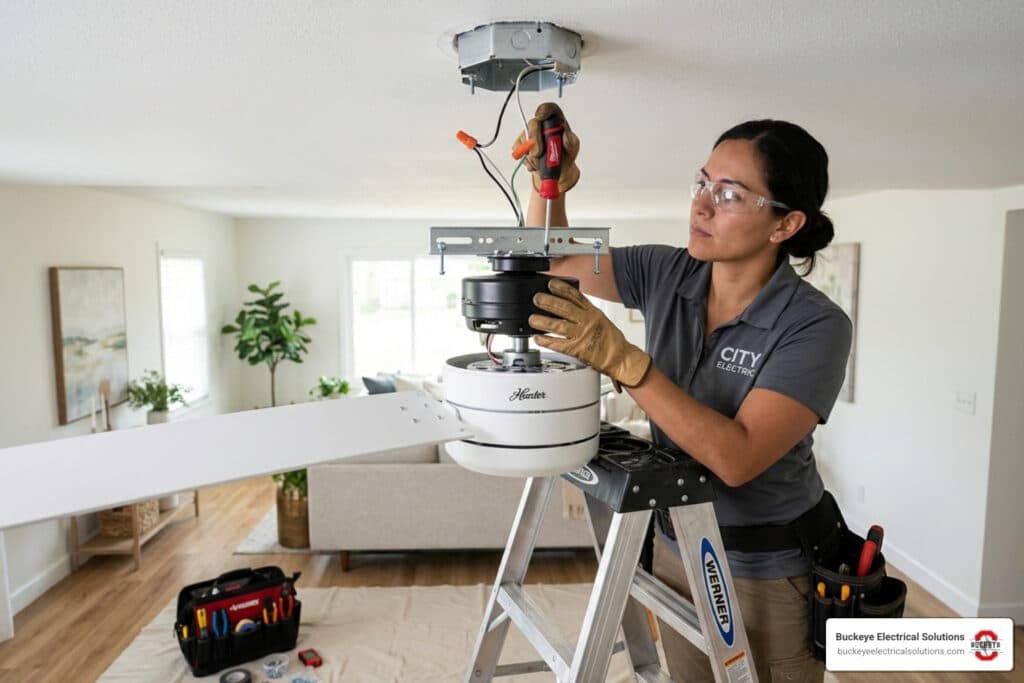

Essential Requirements for Attaching a Ceiling Fan
Attaching a ceiling fan is one of the most rewarding home upgrades you can make — it improves airflow, cuts energy costs, and adds a polished look to any room. However, the process is a complex electrical and structural undertaking that requires adherence to strict safety codes and professional standards.
Successful installation involves several critical technical phases:
- Structural Verification: Ensuring the electrical box is UL-listed and fan-rated to support dynamic loads of at least 70 lbs.
- Electrical Safety: Complete circuit isolation and professional voltage testing to prevent hazards.
- Precision Mounting: Securely anchoring the mounting bracket to a ceiling joist or specialized brace.
- Advanced Wiring: Configuring complex connections for specific switch, remote, or smart-home requirements.
- Component Calibration: Precision assembly of the motor, blades, and light kit to ensure balanced operation.
What may seem like a simple swap can get complicated fast — especially in older homes, on vaulted ceilings, or when existing wiring isn’t up to modern standards.
Ceiling fans can weigh up to 50 pounds and run continuously for hours. A poor installation isn’t just annoying — it’s a genuine safety risk. Fans that aren’t properly anchored have been known to crash down without warning, and faulty wiring can create fire hazards.
I’m Aaron, a master electrician and owner of Buckeye Electrical Solutions LLC, and I’ve overseen dozens of electrical installations across Northeast Ohio — including attaching a ceiling fan in everything from standard living rooms to large commercial spaces. In this educational overview, I’ll explain the critical standards and safety protocols required to ensure a safe and efficient installation.
Key technical concepts for attaching a ceiling fan:
When we talk about attaching a ceiling fan, the most critical factor isn’t the style of the blades or the brightness of the light kit—it is the structural integrity of the connection to your home. Many homeowners assume they can simply swap a lightweight hallway light for a heavy ceiling fan, but this is a common misconception that can lead to dangerous results.
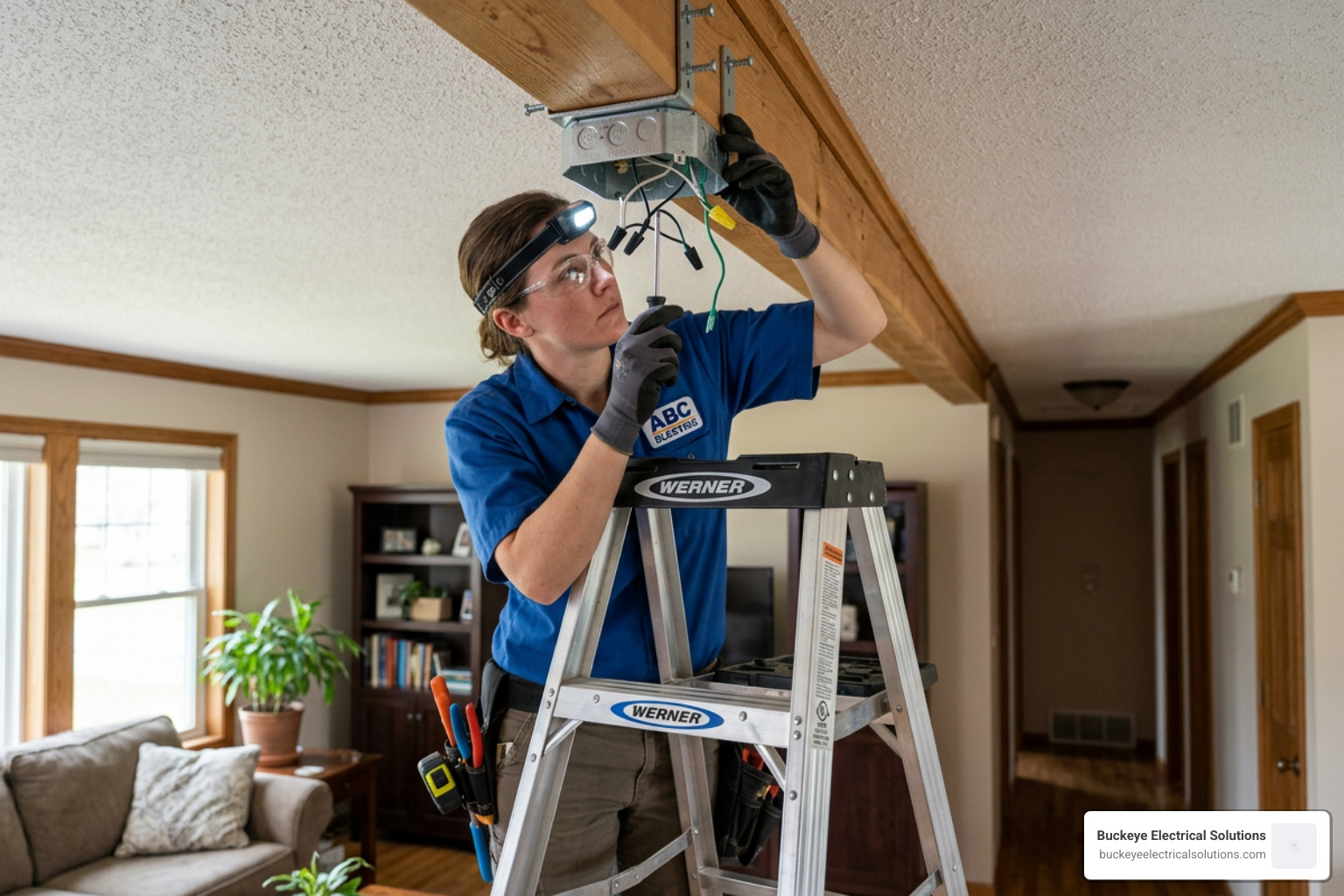
The Role of the Fan-Rated Electrical Box
Standard electrical boxes are designed to hold the weight of a static light fixture, usually up to 35 pounds. However, attaching a ceiling fan requires a specialized, UL-listed fan-rated electrical box. These boxes are engineered to support at least 70 pounds. This extra capacity is necessary because a fan isn’t just heavy; it creates dynamic loads. As the motor spins and the blades move air, the unit produces vibrations and torque that can pull a standard box right out of the ceiling.
These fan-rated boxes must be mounted directly to a ceiling joist or a specialized adjustable brace that spans the gap between two joists. At Buckeye Electrical Solutions, we ensure every installation adheres to Industrial & Commercial Fan Standards and the ANSI/NFPA 70 codes, which dictate the safety requirements for electrical wiring in the United States.
Voltage Testing and Circuit Integrity
Safety starts at the breaker panel. Before any work begins, the power must be completely severed to the circuit. Professionals don’t just rely on the wall switch; we use professional-grade voltage testers to confirm that no “ghost” currents or shared neutrals are present. Ensuring circuit integrity is vital, especially in older Northeast Ohio homes where wiring may have been modified by previous owners over the decades.
Proper Clearance and Sizing Guidelines
A fan that is too large for a room can feel overwhelming, while one that is too small won’t move enough air to be effective. Additionally, safety codes require specific clearances to prevent accidents.
- Floor Clearance: The blades must maintain a minimum of 7 feet of clearance from the floor. For optimal airflow, 8 to 9 feet is the “sweet spot.”
- Wall Clearance: To prevent the “buffeting” effect (where the air bounces off the walls and creates noise), blade tips should be at least 30 inches from the nearest wall or obstruction.
- Blade Span: Choosing the right size ensures efficiency.
| Room Size (Sq. Ft.) | Recommended Blade Span (Inches) |
|---|---|
| Up to 75 sq. ft. | 29 – 36 inches |
| 76 – 144 sq. ft. | 36 – 44 inches |
| 145 – 225 sq. ft. | 44 – 50 inches |
| 226 – 400 sq. ft. | 50 – 54 inches |
| Over 400 sq. ft. | 56+ inches or multiple fans |
Understanding Mounting Options and Room Placement
Not every ceiling is flat, and not every room has the same height. Choosing the right mounting method is essential for both performance and aesthetics when attaching a ceiling fan.
Standard Downrod vs. Flush-Mount
For rooms with ceilings 9 feet or higher, a downrod assembly is used to bring the fan closer to the occupants. This ensures the “wind-chill effect” is felt where it matters most. Conversely, for rooms with low ceilings (8 feet or less), a flush-mount or “hugger” fan is the way to go. These fans sit tight against the ceiling to maximize vertical space and safety.
Sloped and Vaulted Ceilings
If you have a beautiful vaulted ceiling in your Northeast Ohio home, you’ll need a specialized approach. Standard mounting brackets typically only handle slopes up to 34 degrees. For steeper pitches, an angled mounting kit and an extended downrod are required to ensure the blades don’t strike the ceiling. You can refer to this angled ceiling mount guide for more technical details on compatibility.
Optimizing airflow in these large spaces often requires strategic placement to ensure the air circulates effectively throughout the entire volume of the room. For more specialized advice on your specific layout, you can explore more info about residential electrical services.
Technical Considerations for Attaching a Ceiling Fan
Modern fans are much more than just motors and blades. They are now integrated parts of a smart home ecosystem.
Control Systems and Smart Integration
When attaching a ceiling fan, we look at how you want to control it. Options include:
- Remote Receivers: These allow you to control fan speed and lighting from anywhere in the room. They are particularly useful if your ceiling box only has a single power wire but you want independent control of the fan and the light.
- Wall Controls: Hardwired switches are often more reliable and won’t get lost in the couch cushions.
- Smart Home Integration: Many new models connect to Wi-Fi, allowing you to set schedules or use voice commands via Alexa or Google Home.
Wiring Configurations
The complexity of the wiring depends on your existing setup. A single-switch configuration usually means the fan and light turn on together, while a dual-switch setup allows for separate operation. If you’re upgrading from a simple light fixture, we often recommend adding a remote receiver or smart control to avoid the need for pulling new wires through your walls and ceilings. You can learn more about these options through our professional electrical services.
Component Assembly and Structural Integrity
The actual assembly of the fan involves several precision parts. The motor housing protects the core of the unit, while the canopy trim hides the wiring and bracket.
- Blade Irons: These are the brackets that connect the blades to the motor. They must be tightened uniformly to prevent wobbling.
- Vibration Reduction: High-quality fans include rubber gaskets or dampeners to minimize noise.
- Hardware Tightening: We use specialized tools to ensure every set screw and locknut is torqued to manufacturer specifications. Loose hardware is the leading cause of “clicking” sounds and eventual mechanical failure.
Safety Standards and Professional Installation Benefits
While the “DIY” spirit is strong in Ohio, electrical work is one area where professional expertise pays for itself in peace of mind.
National Electric Code (NEC) Compliance
Every installation we perform at Buckeye Electrical Solutions meets or exceeds the National Electric Code. This ensures that your home’s electrical system isn’t overloaded and that the grounding is sufficient to prevent shocks.
Professional Advantages
- Warranty Protection: Many fan manufacturers will only honor warranties if the unit was installed by a licensed professional.
- Liability Reduction: In the rare event of a fire or structural failure, having a record of professional installation is vital for insurance purposes.
- Complex Wiring: If your home has “knob and tube” wiring or aluminum wiring, attaching a ceiling fan becomes significantly more complex and dangerous for an amateur.
- High-Ceiling Hazards: Working on a 12-foot or 20-foot ladder while holding a 50-pound motor housing is a recipe for injury without the proper scaffolding and safety gear. For business owners, we also offer commercial electrical safety evaluations to ensure your workplace remains compliant.
When is a professional needed for attaching a ceiling fan?
You should definitely call us if you encounter any of the following:
- The existing electrical box is plastic or loose.
- There are no wires in the ceiling where you want the fan.
- The ceiling is higher than 10 feet.
- The fan wobbles even after you’ve tried a balancing kit.
- You are dealing with an older home with brittle or mystery wiring.
Post-Installation Optimization and Maintenance
Once a fan is securely attached, professional calibration ensures it runs perfectly for years.
Wobble Correction and Balancing
Even high-end fans require precision alignment. Professionals use specialized measuring tools to ensure each blade is equidistant from the ceiling. If a wobble persists, balancing kits—small weights applied to the blades—are used to offset manufacturing inconsistencies and ensure smooth operation.
Seasonal Direction Reversal
Optimizing energy bills in Northeast Ohio involves utilizing the fan’s directional settings year-round:
- Summer (Counter-Clockwise): Creates a direct breeze and a wind-chill effect.
- Winter (Clockwise): Pushes warm air trapped at the ceiling back down into the living space, potentially reducing heating costs.
Professional Maintenance Standards
To maintain peak performance:
- Debris Removal: Preventing dust buildup on blades avoids imbalances.
- Hardware Inspection: Periodic checks of mounting and blade screws prevent mechanical failure.
- Acoustic Monitoring: New humming or clicking sounds often indicate a component has vibrated loose and requires professional attention.
Frequently Asked Questions about Ceiling Fan Installation
What is a ceiling fan-rated electrical box?
A ceiling fan-rated box is a heavy-duty metal or reinforced plastic junction box that is UL-listed to support the weight and motion of a fan. Unlike standard boxes, these are secured with heavy-duty screws and are designed to be mounted directly to structural lumber (joists) or a reinforced brace. They are typically rated to support 70 pounds or more to ensure the fan doesn’t vibrate loose over time.
How is the right mounting style determined for different ceiling heights?
To ensure safety and optimal airflow, the blades should remain at least 7 feet above the floor. For 8-foot ceilings, a “hugger” or flush-mount fan is the standard choice. Rooms with 9-foot ceilings typically utilize a 3-to-6-inch downrod, while ceilings 10 feet or higher require extended downrods to ensure the airflow effectively reaches the living space.
Why does my ceiling fan wobble after installation?
Wobbling is typically the result of mechanical imbalances or structural deficiencies. Common causes include loose mounting hardware, the use of a standard electrical box instead of a fan-rated one, or misaligned blade irons. Professional technicians use precision balancing kits and structural reinforcements to eliminate these issues and ensure the fan operates safely and quietly.
Conclusion
Attaching a ceiling fan is a smart investment in your home’s comfort and efficiency, but it requires more than just a screwdriver and a ladder. From ensuring your electrical box can handle the 70-pound dynamic load to navigating the complexities of smart home wiring, the details matter.
At Buckeye Electrical Solutions, we take pride in serving our neighbors across Northeast Ohio. With over 20 years of experience, our certified electricians bring quality craftsmanship and safety assurance to every project. Whether you’re looking to upgrade a single bedroom or outfit an entire commercial office, we ensure the job is done promptly and correctly the first time.
Don’t risk a wobbly fan or a DIY electrical mishap. Let our experts handle the heavy lifting and technical details so you can sit back and enjoy the breeze. Contact Buckeye Electrical Solutions for professional installation today and experience the difference that professional service makes.