Understanding 100 Amp Breaker Box Wiring Requirements
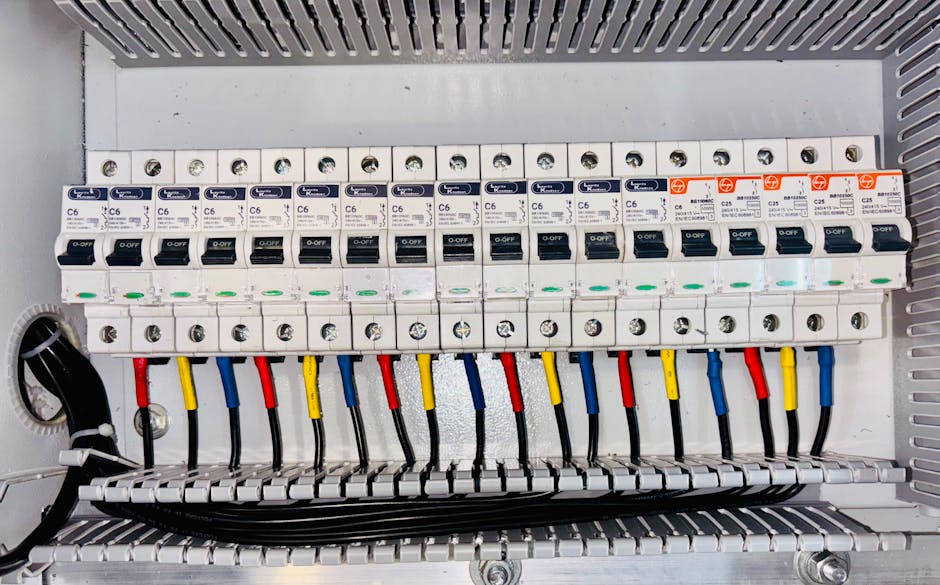
100 amp breaker box wiring is one of the most common electrical projects in residential homes — whether you’re adding a subpanel to a detached garage, upgrading an outdated system, or feeding a new living space.
Here’s a quick overview of what’s involved:
| Topic | Key Fact |
|---|---|
| Minimum wire size (copper) | #3 AWG THHN at 75°C per NEC Table 310.16 |
| Minimum wire size (aluminum) | #1 AWG for a full 100A feeder |
| Feeder breaker must match | Wire ampacity — never oversize the breaker for the wire |
| Subpanel grounding | Separate neutral and ground bars required by NEC |
| Permits and inspection | Required by law in virtually every jurisdiction |
| Voltage drop | Must be calculated for runs over 80–100 feet |
This is not a simple swap-out job. Mistakes here — like using undersized wire, skipping a ground, or mismatching a breaker to the conductor — can cause overheating, fires, or failed inspections. One forum user shared how a 100-amp fuse blew on a #6 AWG wire that was already running too hot, nearly causing a serious fire. That’s the kind of real-world risk that makes this work best left to a licensed professional.
I’m Aaron, owner of Buckeye Electrical Solutions LLC and a master electrician with decades of hands-on experience in 100 amp breaker box wiring across dozens of permitted residential and commercial projects throughout Northeast Ohio. In this guide, I’ll outline the standards for safe, code-compliant installation — so you know exactly what to expect when you hire a professional.
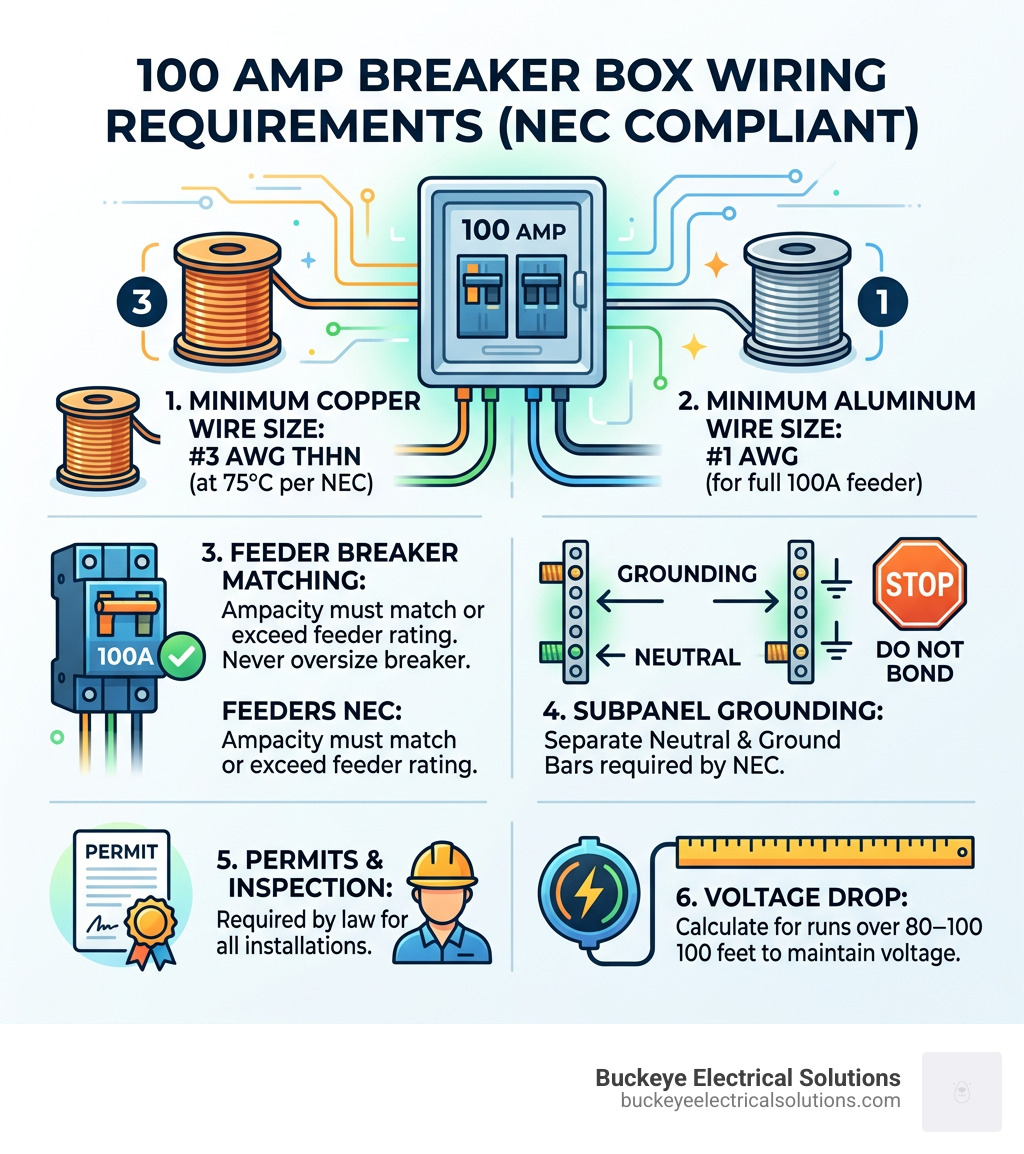
When we talk about 100 amp breaker box wiring, we aren’t just looking at a metal box on a wall; we are looking at a carefully balanced system governed by the National Electrical Code (NEC). The primary goal of these regulations is to prevent electrical fires and ensure that the system can handle the intended load without overheating.
A critical starting point for any installation is NEC Table 310.16, which dictates the allowable ampacity of insulated conductors. For a 100-amp service or feeder, the wire must be rated to carry at least 100 amperes under specific conditions. However, it isn’t as simple as picking a wire off a shelf. Rigorous ampacity calculations are performed to account for variables like ambient temperature and the number of conductors in a single conduit.
In Northeast Ohio, 100-amp panels are often used as the primary service for smaller homes, condos, or apartments. In larger modern homes, they frequently serve as subpanels for workshops, finished basements, or ADU (Accessory Dwelling Unit) conversions. Before any wire is pulled, the “calculated load” must be determined. This ensures the main service has enough “headroom” to support an additional 100-amp draw without tripping the main house breaker every time the air conditioner kicks on.
Material Specifications and Conductor Sizing
The choice between copper and aluminum is one of the first decisions made during the planning phase. Both materials are safe when installed correctly, but they require different sizing to achieve the same 100-amp rating. Copper is a superior conductor, meaning it can be smaller in diameter, but it is significantly more expensive. Aluminum is lightweight and cost-effective, but it requires larger gauges and specific terminal treatments to prevent oxidation.
| Conductor Material | Wire Size (AWG) | Ampacity (at 75°C) |
|---|---|---|
| Copper (THHN/THWN-2) | #3 AWG | 100 Amps |
| Copper (THHN/THWN-2) | #2 AWG | 115 Amps |
| Aluminum (THHN/THWN-2) | #1 AWG | 100 Amps |
| Aluminum (URD/Mobile Home) | #2 AWG | 90 Amps (Requires 90A Breaker) |
As shown in the table above, #3 AWG copper is the standard for a 100-amp circuit. Interestingly, many professionals in the field choose to upsize to #2 AWG copper for added peace of mind and availability. If aluminum is chosen, the gauge must step up to #1 AWG to reach a full 100-amp capacity. A common mistake is the use of #2 AWG aluminum (often found in “2-2-2-4” cable assemblies), which is only rated for 90 amps. In such cases, the feeder breaker in the main panel must be downsized to 90 amps to protect the wire.
Conduit fill is another major factor. When individual THHN wires are pulled through PVC or EM conduit, there must be enough air space to prevent heat buildup. For example, a 1-1/4″ PVC conduit is generally required to comfortably house three #3 AWG conductors and a dedicated ground wire while staying under the NEC 40% fill limit.
Selecting Conductors for 100 Amp Breaker Box Wiring
When selecting conductors for Residential Electrical Services, THHN/THWN-2 wire is prioritized for its durability and heat resistance. However, distance changes the math. If a subpanel is located 150 feet away in a detached garage, “voltage drop” becomes a concern.
Electricity loses “pressure” as it travels over long distances. To ensure power tools or appliances run efficiently, the drop is calculated and the wire may be upsized to #1 AWG copper or 1/0 aluminum for long runs. Furthermore, all terminals and lugs must be rated for 75°C. Even if the wire is rated for 90°C, the system is only as strong as its weakest link—the connection points.
Critical Safety and Grounding Protocols
Grounding is the most misunderstood aspect of 100 amp breaker box wiring, yet it is the most vital for life safety. In a main service panel, the neutral (white) wires and the ground (bare or green) wires are bonded together. However, in a subpanel, these two systems must be kept entirely separate.
This is known as “neutral isolation.” This is achieved through the use of a this bar and ensuring the neutral bar is not bonded to the metal enclosure. If the neutrals and grounds are mixed in a subpanel, it can create “objectionable current,” where the metal casing of the panel—and potentially your appliances—becomes electrified.
Code Compliance for 100 Amp Breaker Box Wiring
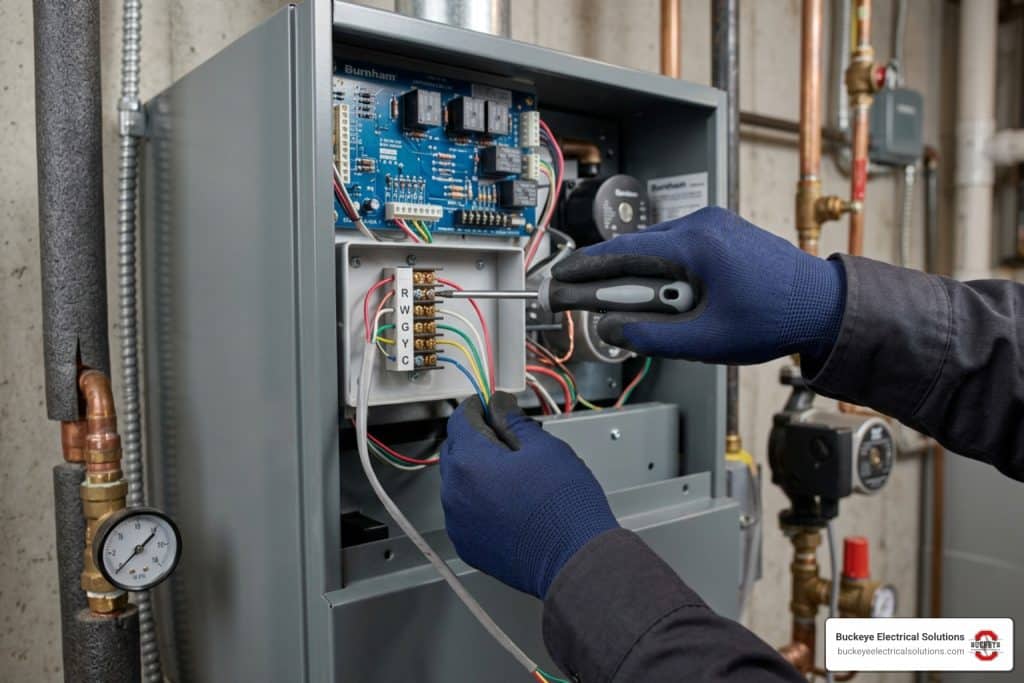
To meet current NEC standards, a 100-amp feeder must be a “4-wire” system: two hot wires (usually black and red), one neutral wire (white), and one dedicated equipment grounding conductor (green or bare).
In Northeast Ohio, inspectors look specifically for:
- Separate Grounding: A dedicated ground wire sized per NEC Table 250.122 (typically #8 copper for a 100A circuit).
- Main Lug Kits: If a standard breaker panel is being used as a subpanel, a main lug kit is installed to provide a secure landing spot for the large feeder wires.
- Local Grounding: For detached structures like a garage or shed, the NEC requires the installation of local grounding electrodes (ground rods) bonded to the subpanel’s ground bar.
Professional Installation vs. DIY Risks
We understand the appeal of the DIY approach. There are countless forums where people debate whether #4 or #6 wire is “good enough.” But electrical work isn’t about what you can get away with; it’s about what will hold up during a fault or a lightning strike.
Wiring a 100-amp panel involves working inside the main service box, often near “live” lugs that cannot be turned off without the utility company’s help. The risk of an arc flash—a massive release of energy that can cause severe burns or blindness—is very real.
Beyond the immediate physical danger, there are long-term liabilities:
- Permit Requirements: Most cities in Northeast Ohio require a building permit for a 100-amp installation. Unpermitted work can lead to fines and must often be ripped out and redone when you try to sell your home.
- Insurance Denials: If an electrical fire occurs and the insurance adjuster finds unpermitted or non-code-compliant 100 amp breaker box wiring, they may deny the claim entirely.
- Fire Hazards: Undersized wire or loose lugs create heat. Over time, this heat degrades insulation until a short circuit occurs.
At Buckeye Electrical Solutions, we handle the permits, the utility coordination, and the precision torqueing of every lug to ensure your home stays safe.
Frequently Asked Questions about 100 Amp Panels
What is the correct wire size for a 100 amp subpanel?
For a standard run (under 80 feet), the most common choice is #3 AWG copper THHN or #1 AWG aluminum. If the subpanel is for a dwelling feeder (like an apartment), the NEC sometimes allows #4 copper under the “83% rule,” but for most subpanels and workshops, #3 copper is the safest, code-compliant choice. Always consider upsizing if the distance exceeds 100 feet to prevent voltage drop.
Do I need to separate neutrals and grounds in a 100 amp box?
Yes, if it is a subpanel. Per NEC 250.24, the neutral and ground systems are maintained as separate entities downstream of the main service disconnect. This ensures that in the event of a fault, the electricity has a clear, safe path back to the source without energizing the panel’s exterior.
When is a 100 amp panel upgrade necessary?
You likely need an upgrade or a new 100-amp subpanel if:
- You are installing a Level 2 EV charger (which can pull 40-60 amps alone).
- You are adding a hot tub, central air conditioning, or an inground pool.
- Your current panel is a “Federal Pacific” or “Zinsco” brand, which are known fire hazards.
- You notice flickering lights or breakers that trip when you use a hair dryer and a microwave at the same time.
Conclusion
Successfully executing 100 amp breaker box wiring requires more than just connecting wires to terminals. It requires a deep understanding of ampacity, grounding physics, and local Ohio building codes. Whether you are powering a new workshop in Akron or upgrading a condo in Cleveland, the safety of your family and your property depends on a professional installation.
At Buckeye Electrical Solutions, we take pride in our 20-year history of serving Northeast Ohio. We don’t just “hook things up”—we engineer systems that are built to last and designed to keep you safe. If you’re planning a project that requires a new panel or a service upgrade, we invite you to explore Our Services and see how we can help.
Don’t leave your home’s safety to guesswork or forum advice. Contact us today for a professional consultation, and let’s make sure your 100-amp project is done right the first time.