Why Commercial Generator Installation Matters for Business Continuity
Generator installation is a critical investment for businesses that can’t afford downtime. When you’re planning a commercial generator installation, here’s what you need to know:
Quick Overview:
- Timeline: Expect 2–6 weeks from consultation to final testing, depending on permitting and site prep
- Cost Range: $8,000–$22,000+ for most installations, varying by generator size and complexity
- Key Steps: Site assessment → Permitting → Generator placement → Fuel connection → Electrical wiring → Transfer switch integration → Testing
- Fuel Options: Natural gas, liquid propane, or diesel (each with distinct pros and cons)
- Professional Installation Required: Licensed electricians must handle complex electrical work, gas connections, and code compliance
Power outages have become more frequent and unpredictable. Weather-related events cause 80% of major U.S. outages, and the frequency has nearly doubled in the last decade compared to the early 2000s. For businesses, every minute without power means lost revenue, disrupted operations, and potentially spoiled inventory.
A standby generator automatically kicks in within seconds of a power loss, keeping your critical systems running. Unlike portable generators that require manual setup and can only power a few circuits, a professionally installed standby generator integrates seamlessly with your building’s electrical system through an automatic transfer switch.
I’m Aaron, and I’ve overseen dozens of permitted electrical projects across Northeast Ohio, including complex commercial installations and full building rewires. Through Buckeye Electrical Solutions, I’ve seen how proper generator installation protects businesses from costly downtime and keeps operations running smoothly when the grid fails.
Sizing and Selecting the Right Commercial Generator
Choosing the right commercial generator is like picking the perfect superhero for your business – it needs to be strong enough to handle any challenge, but also efficient and reliable. Our goal is to ensure your business in Northeast Ohio stays powered, no matter what Mother Nature throws our way.
Determining Your Power Needs
The first step in any successful generator installation is accurately determining your power needs. This isn’t just about saying “we need power for everything!” It’s a detailed load calculation and power needs assessment. We look at your essential loads (what absolutely must stay on), and then consider what it would take to power your whole building.
We’ll talk in terms of kilowatts (kW), which is the unit of power your generator will produce. It’s crucial to distinguish between a device’s running wattage (what it uses consistently) and its starting wattage (the brief, higher surge it needs to kick on). For example, your HVAC system or large industrial motors will have a much higher starting wattage than a light fixture. Undersizing a generator can lead to frustrating brownouts or even damage, while oversizing can mean unnecessary costs.
For a typical home, a 2,500 square foot space might need a 20kW to 25kW generator, and a 1,500 square foot home might need 15kW to 20kW. Commercial needs are far more complex, potentially requiring hundreds of kilowatts. This is why a professional load analysis is non-negotiable. We’ll help you assess every critical system—from lighting and security to refrigeration, data servers, and manufacturing equipment—to ensure your generator can handle the demand, including those tricky “surge watts” needed to start motors.
Comparing Fuel Sources for Your Business
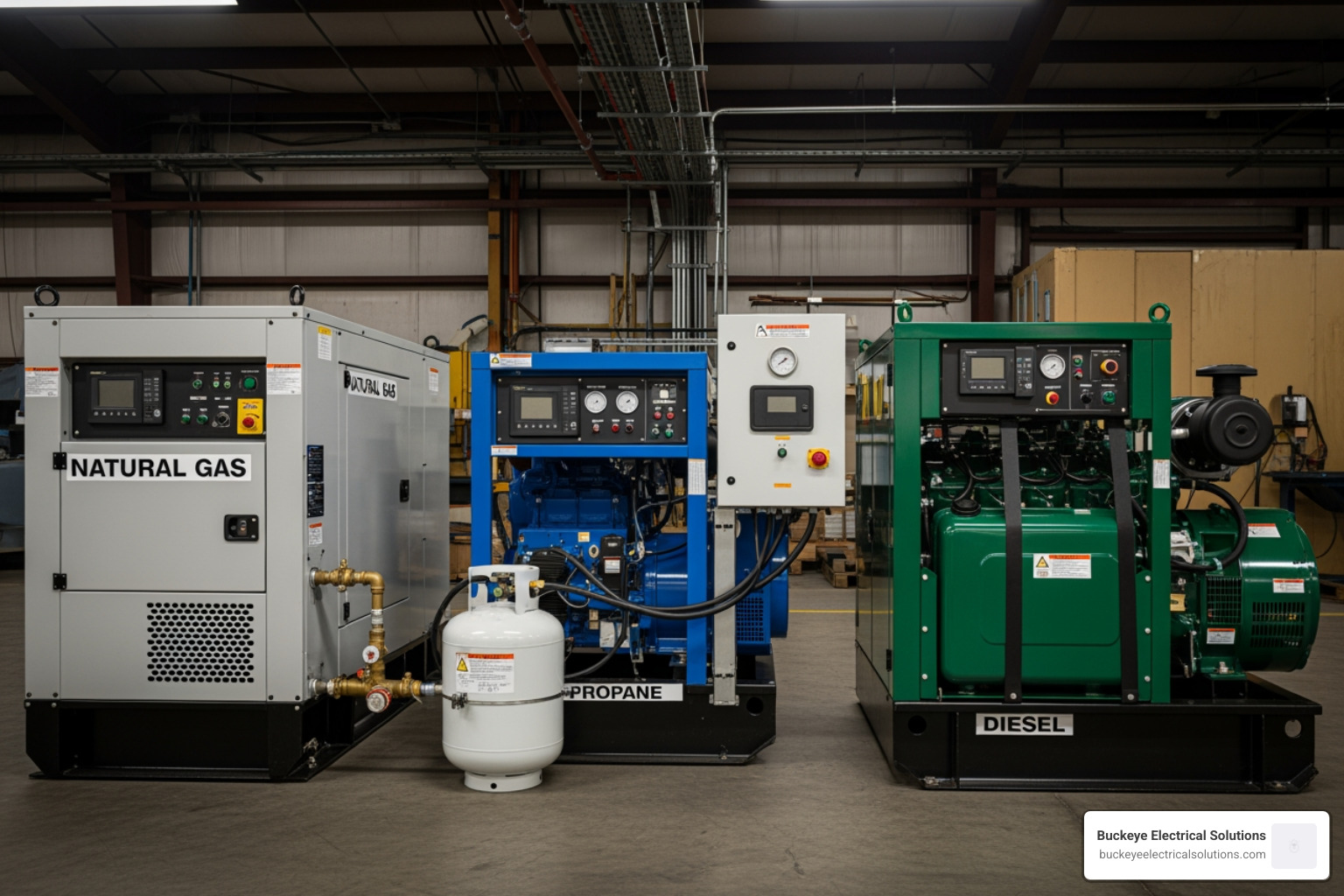
The heart of your generator runs on fuel, and choosing the right type is a major decision for your Northeast Ohio business. We generally consider three main types for commercial generator installation: Natural Gas, Liquid Propane, and Diesel. Each has its own personality, pros, and cons.
| Feature | Natural Gas (NG) | Liquid Propane (LP) | Diesel |
|---|---|---|---|
| Pros | Continuous supply, no refueling, cleaner burning | Clean-burning, long shelf life, portable tanks | Highly efficient, long-lasting, readily available |
| Cons | Requires pipeline infrastructure, pressure-dependent | Needs storage tanks, more expensive than NG, heavier than air (settles low) | Requires on-site storage, higher emissions, can “wet stack” if underloaded |
| Availability | Plentiful via existing utility lines | Delivered and stored in tanks | Delivered and stored in tanks |
| Storage | No on-site storage needed | Requires large, dedicated tanks | Requires large, dedicated tanks |
| Maintenance | Generally lower | Moderate | Higher (e.g., fuel polishing, filter changes) |
| Cost | Generally most affordable | More expensive per BTU than NG | Can fluctuate with market |
Natural gas generators offer a continuous fuel supply directly from your utility line, meaning no refueling worries. They’re typically the most affordable to operate and burn cleaner. However, you need to be connected to a natural gas line, and the pressure needs to be consistent (typically 3.5-7 inches water column for some units).
Liquid propane generators are also clean-burning and have an indefinite shelf life, making them great for long-term storage. The fuel comes in tanks, so you’ll need space for on-site storage. LP gas is heavier than air, so safety considerations for placement are important to prevent it from settling in low areas.
Diesel generators are workhorses, known for their efficiency and power, especially in larger commercial applications. Diesel fuel is energy-packed and offers long run times. The downside is the need for on-site fuel storage, which requires careful management and maintenance (like fuel polishing to prevent contamination). Diesel exhaust also has higher emissions, and if continuously run under light load, diesel generators can experience “wet stacking” (accumulation of unburned fuel and oil in the exhaust).
Choosing between these often comes down to your building’s existing infrastructure, budget, and specific operational needs. We’ll help you weigh these factors to make an informed decision.
Budgeting for Your Investment
Let’s talk numbers. A commercial generator installation is a significant investment, but one that often pays for itself many times over by preventing costly business interruptions. While the research primarily quotes residential costs, we can use these as a baseline understanding for the components involved.
For most homeowners, the cost to install a whole-house generator is between $1,600 and $8,900, with larger units going up to $21,000 or more. A general breakdown for residential units shows the generator unit itself costing $3,000–$10,000+, and installation ranging from $5,000–$12,000, leading to a total of $8,000–$22,000+. For commercial applications, these figures represent a starting point, with larger, more powerful units and complex installations often pushing costs considerably higher.
The total budget for your generator installation will include:
- Generator Unit Cost: This varies significantly based on power output (kW), brand, and fuel type.
- Installation Costs: This is where our expertise comes in. It covers the labor for site preparation, pouring concrete pads, running fuel lines, electrical wiring, and connecting the automatic transfer switch.
- Transfer Switch Cost: An automatic transfer switch (ATS) is essential for seamless operation and safety. Its cost is integrated into the overall installation.
- Permit Fees: Nearly all commercial generator installations require permits. These can include electrical, plumbing/gas, and building permits. While residential permits might add $50 to $100, commercial permits in Northeast Ohio are typically more involved and thus more expensive. We handle the entire permitting process for you, ensuring compliance with all local regulations.
- Long-Term Operational Costs: Don’t forget ongoing expenses like fuel, routine maintenance, and potential service contracts.
We provide transparent pricing and detailed estimates before any work begins. You can get a general breakdown of costs by checking resources like here’s a general breakdown, but for a precise commercial quote, a professional consultation is essential.
The Professional Commercial Generator Installation Process
Undertaking a commercial generator installation is a complex project, far beyond the scope of a DIY weekend warrior. It requires specialized knowledge, licensed professionals, and adherence to strict safety and building codes. We approach every installation with meticulous planning and execution, ensuring your business receives a reliable, safe, and code-compliant backup power system.
Step 1: Site Assessment and Preparation
Before we even think about placing a generator, we conduct a thorough site assessment. This is where we play detective, examining your property in Northeast Ohio to find the perfect spot.
Key considerations for site selection include:
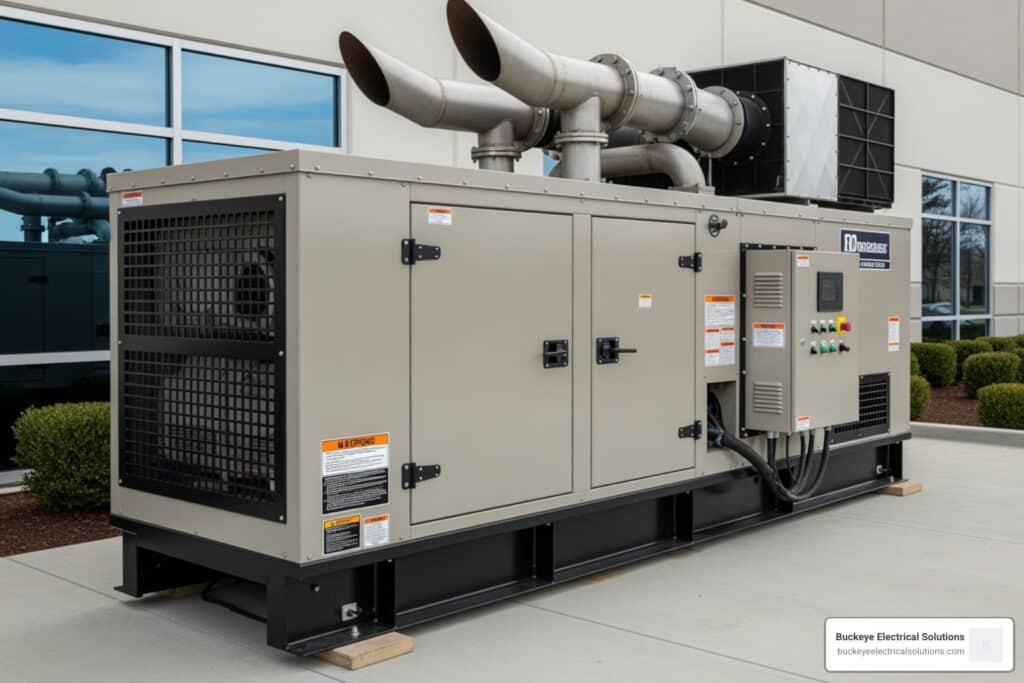
- Clearance Requirements: Generators generate heat and exhaust, and they need space for ventilation, maintenance, and safety. We adhere to stringent NFPA standards and manufacturer guidelines (like Generac’s recommendation of 18 inches minimum from the rear to a stationary wall, 3 feet from the front and ends, and 5 feet overhead). Crucially, no operable windows, doors, or openings should be within 5 feet of the generator to prevent deadly carbon monoxide from entering your building. We also ensure it’s at least 4 feet from exterior walls and 3 feet from flammable materials.
- Proximity to Electrical and Fuel Lines: The closer the generator is to your existing electrical panel and fuel source (natural gas line or propane/diesel tanks), the more efficient and less costly the installation will be.
- Foundation: Commercial generators are heavy. They require a robust, level concrete pad capable of supporting 125% of the unit’s wet weight. This pad must be flat, level to within 1/2 inch, and extend at least 18 inches beyond the unit’s frame.
- Drainage: The site must be high ground, with provisions for water drainage, away from potential flooding sources like sprinklers or downspouts, to protect the unit from water damage.
- Permit Acquisition: This is a crucial, often underestimated, part of the process. Due to the electrical and fuel work involved, commercial generator installation in Northeast Ohio almost always requires multiple permits—electrical, plumbing/gas, and sometimes a building permit for the pad. We handle all the necessary paperwork and inspections, ensuring your installation meets all local building codes and regulations.
Step 2: The Installation and Connection
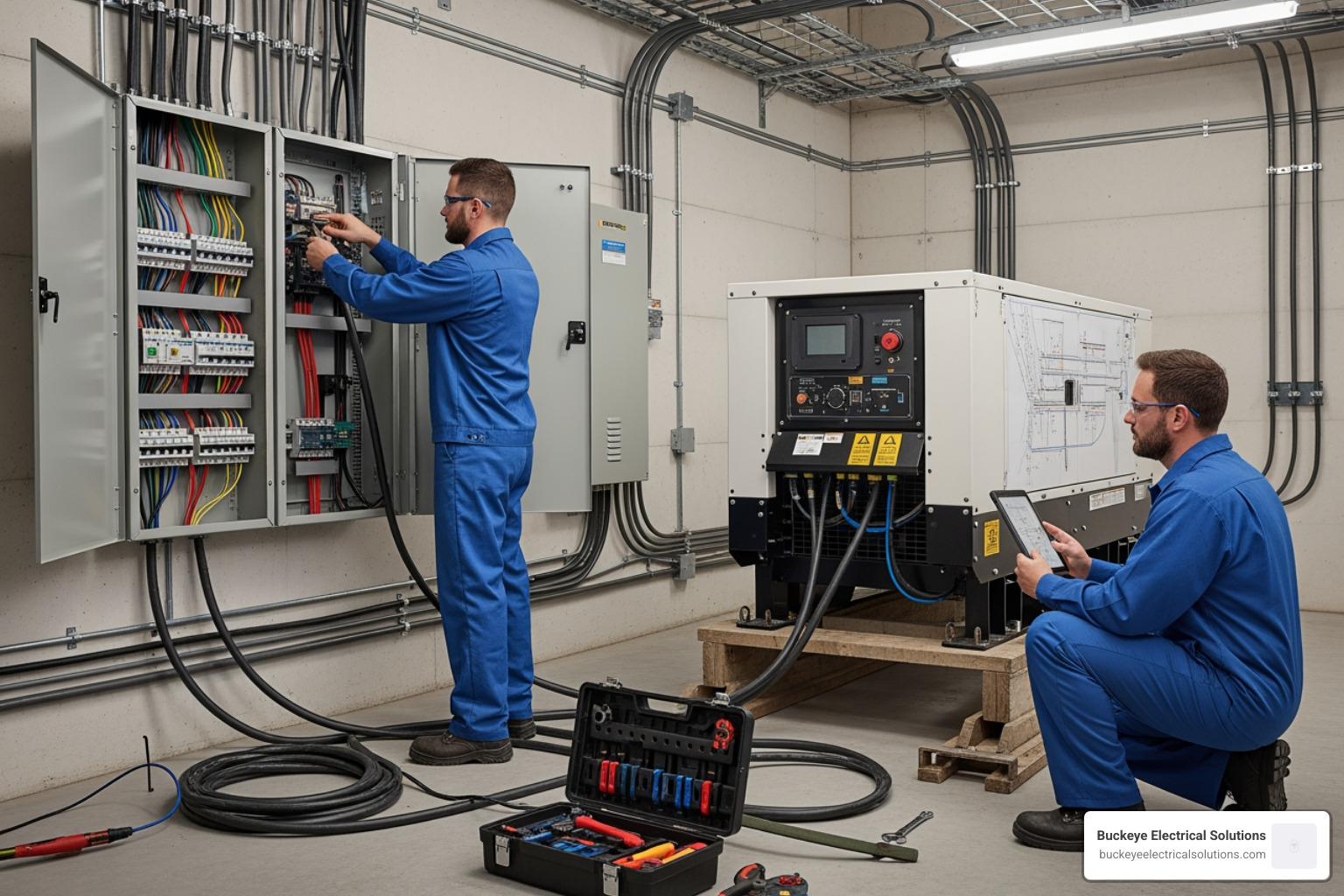
With site preparation complete and permits in hand, our team of licensed electricians and technicians moves to the physical generator installation.
- Generator Placement: The generator is carefully moved and secured onto its prepared concrete pad. Proper placement also considers exhaust discharge, ensuring it’s directed away from occupied buildings and structures, and that airflow for cooling is unobstructed.
- Fuel Line Installation: For natural gas or liquid propane units, we run and connect the fuel lines. This involves precise measurements, proper pipe sizing (sized for 100% load BTU rating, regardless of actual load), and the installation of full-flow rated shut-off valves. For natural gas, regulators must be installed at a specific distance (e.g., 10 feet) from the generator to ensure proper operation and code compliance. All fuel lines are rigorously purged and leak-tested to prevent dangerous explosions or leaks.
- Electrical Connections: This is the core of our expertise. We carefully wire the generator to your main electrical panel, integrating it seamlessly with your building’s existing system. This includes both the main AC wiring (carrying the power) and control wiring (for communication between the generator and ATS). We ensure all connections are torqued to precise specifications and that wiring meets all NEC requirements.
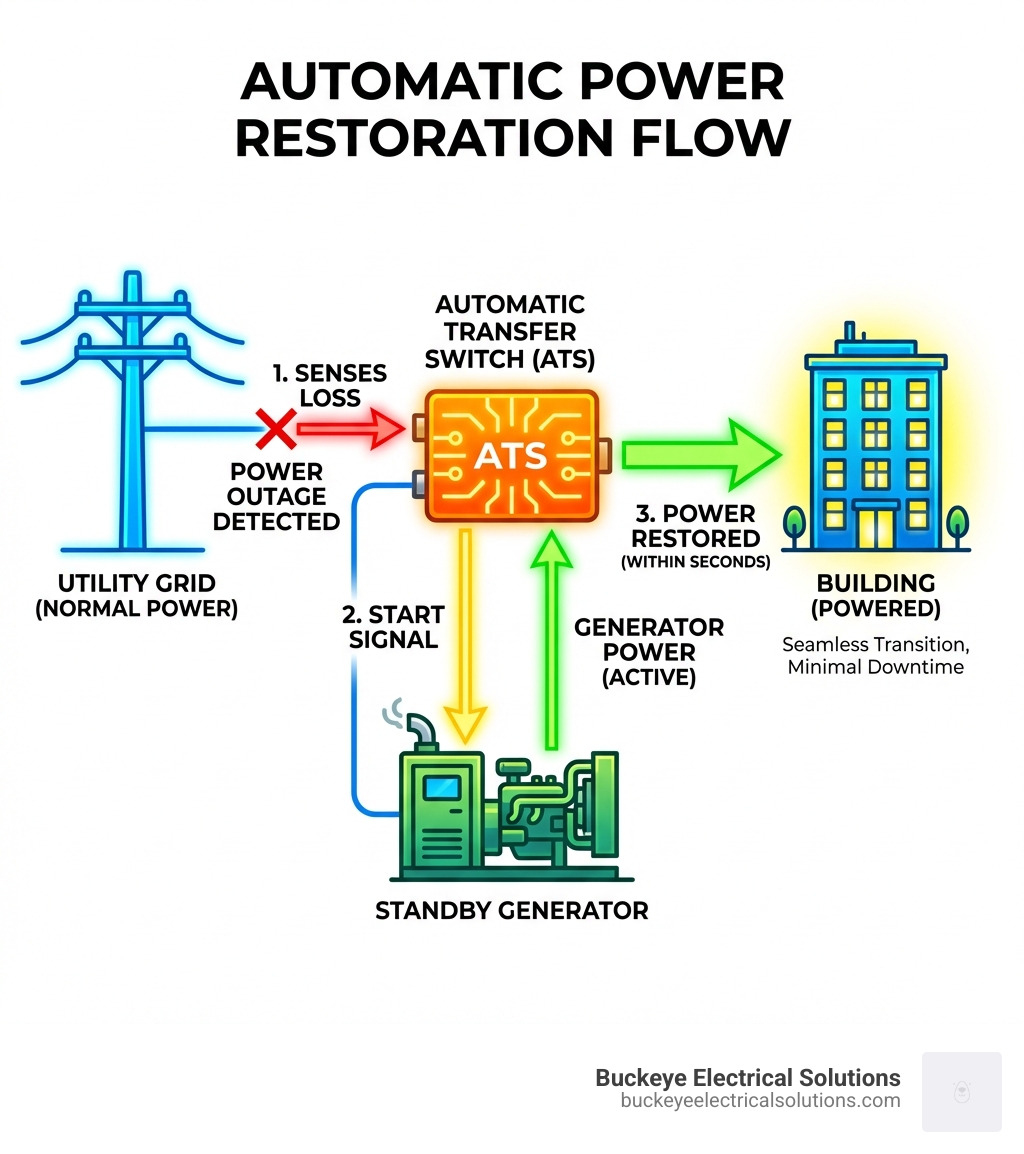
- Automatic Transfer Switch (ATS) Integration: The ATS is the brain of your backup system. We install and integrate it near your main electrical panel. This device constantly monitors utility power and, upon an outage, safely disconnects your building from the grid before signaling the generator to start. This prevents dangerous “backfeeding” of electricity into the utility lines, which could harm utility workers.
- Main Electrical Panel Wiring: Our commercial electrical services extend to ensuring your entire electrical system is ready to handle generator power. More info about our commercial electrical services.
Step 3: Testing, Commissioning, and Handoff
Once the physical generator installation is complete, we enter the testing and commissioning phase. This is where we prove that your new backup system is ready to perform when it matters most.
- System Self-Test: We initiate the generator’s internal self-test functions, confirming all components are communicating correctly. Many generators are equipped with exercise timers that allow for weekly, bi-weekly, or monthly self-tests to ensure readiness.
- Load Bank Testing: For commercial installations, we often perform load bank testing. This involves connecting a temporary resistive load to the generator to simulate your building’s power demand. This allows us to verify the generator’s output voltage, frequency, and overall performance under real-world conditions, ensuring it can handle your critical loads.
- Simulating a Power Outage: We’ll simulate a utility power outage to demonstrate the seamless transition to generator power and back to utility power, ensuring your ATS functions perfectly.
- User Training and Documentation: We don’t just install and leave. We provide comprehensive training to your staff on the generator’s operation, control panel interface, and how to interpret any alerts. We’ll also explain the maintenance schedule and provide all warranty documentation.
- Maintenance Schedule Explanation: We review the recommended maintenance schedule (e.g., oil and filter changes, battery checks) and discuss professional service contracts to ensure the longevity and reliability of your investment.
Safety, Compliance, and Long-Term Reliability
Safety isn’t just a buzzword for us; it’s the foundation of every commercial generator installation we undertake in Northeast Ohio. Given the power involved, ensuring everything is installed correctly and safely is paramount.
Critical Safety Considerations for Generator Installation
Working with generators involves inherent risks if not handled by professionals. We prioritize these critical safety aspects:
- Carbon Monoxide (CO) Poisoning: Generators produce deadly carbon monoxide gas. It’s odorless, colorless, and tasteless, making it incredibly dangerous. This is why outdoor installation only is an absolute rule. We ensure the generator is placed at least five feet from any windows, doors, or vents to prevent exhaust fumes from entering your building. Never run a generator in an enclosed space like a garage, basement, or shed. We also strongly recommend installing battery-operated CO detectors inside your facility.
- Electrical Shock Hazards: Utility power and generator power both carry potentially lethal voltages. Improper wiring can lead to severe electrical shocks, fires, or damage to your electrical systems. Our licensed electricians are trained to handle these high voltages safely.
- Backfeeding Prevention: The automatic transfer switch is your first line of defense against backfeeding—sending electricity from your generator back into the utility grid. This is extremely dangerous for utility workers who might be repairing lines, assuming they are dead. Our ATS installations strictly comply with NEC requirements to prevent this.
- Fuel Storage Safety: Natural gas and liquid propane are highly explosive. LP gas is heavier than air and settles in low areas, while natural gas is lighter and collects in high areas. We adhere to strict guidelines for fuel line installation, leak testing, and on-site storage for propane and diesel, ensuring approved containers and safe distances from heat sources.
- Fire Prevention: Generators operate at high temperatures. We ensure proper clearance from flammable materials and integrate fire prevention measures into the installation, including recommending a fire extinguisher nearby.
Why Professional Generator Installation is Non-Negotiable
You might be handy, but commercial generator installation is not a DIY project. It’s a complex, multi-faceted job that demands professional expertise for several critical reasons:
- Licensed Electricians: Our team consists of licensed electricians with over 20 years of experience. We understand the intricacies of commercial electrical systems and the unique demands of integrating a powerful generator safely.
- Code Compliance (NEC, NFPA): In Northeast Ohio, as everywhere else, generator installations must comply with the National Electrical Code (NEC), NFPA 37 (Standard for the Installation and Use of Stationary Combustion Engines), and NFPA 70 (National Electrical Code), along with all local building codes. Navigating these complex regulations and ensuring full compliance is our job, not yours.
- Complex Electrical Work: From sizing wires and setting proper torque on connections to integrating the ATS and ensuring proper grounding of the generator frame, the electrical work is extensive and requires specialized skills to avoid hazards.
- Gas Line Plumbing: Installing or modifying gas lines for a natural gas or propane generator requires certified plumbing expertise to prevent dangerous leaks or explosions.
- Protecting Your Warranty: Many generator manufacturers require professional installation for their product warranties to remain valid. Attempting a DIY installation could void your warranty, leaving you without coverage if issues arise.
- Avoiding Safety Hazards: As discussed, the risks of carbon monoxide poisoning, electrical shock, and fire are very real with improper generator installation. Hiring professionals eliminates these dangers, providing peace of mind.
Maintenance, Lifespan, and Warranty
A commercial generator is a long-term investment, and like any critical asset, it requires ongoing care. With proper maintenance, a quality standby generator can last for 20 to 30 years, or between 10,000 and 30,000 hours of use. Its lifespan greatly depends on the engine quality, usage frequency, and adherence to recommended maintenance schedules.
Routine maintenance tasks typically include:
- Oil and Filter Changes: Just like your car, the generator’s engine needs fresh oil and filters to run efficiently and prolong its life.
- Battery Checks: The battery is crucial for starting. We regularly check its charge and condition.
- Coolant Levels: For liquid-cooled units, maintaining proper coolant levels is essential to prevent overheating.
- Spark Plug Inspection: Ensuring spark plugs are clean and properly gapped promotes efficient combustion.
- General Inspection: Regularly checking for leaks, wear and tear, and debris accumulation.
We recommend professional service every six months to a year, depending on usage. We offer professional service contracts to ensure your generator receives the care it needs, proactively addressing potential issues before they become costly problems.
Generators typically come with a manufacturer’s warranty (e.g., some residential units offer a five-year limited warranty). Our professional generator installation services also include a labor warranty, providing you with comprehensive protection for your investment. We ensure all necessary documentation is provided at the time of handoff.
Frequently Asked Questions about Commercial Generator Installation
How does an automatic transfer switch (ATS) work?
An ATS is the brain of your backup power system. It constantly monitors incoming utility power. When it detects an interruption, it automatically disconnects your building from the grid and signals the generator to start. Once the generator is ready, the ATS switches your building’s electrical system over to generator power. The entire process happens in seconds, ensuring a seamless transition.
How long does a whole-house or commercial generator last?
With proper maintenance, a quality standby generator can last for 20 to 30 years, or between 10,000 and 30,000 hours of use. The lifespan depends on the engine quality, usage frequency, and adherence to the recommended maintenance schedule.
What permits are required for a generator installation?
Nearly all standby generator installations require permits. These typically include an electrical permit for the wiring and transfer switch, and often a plumbing or gas permit for the fuel connection. A building permit may also be needed for the concrete pad. A qualified installer will handle the entire permitting process to ensure compliance with local codes.
Conclusion
In today’s unpredictable world, investing in a commercial generator installation is more than just a luxury; it’s a strategic move for business preparedness. For businesses in Northeast Ohio, a reliable backup power solution provides uninterrupted operations, protects valuable assets, and ensures the safety of your employees and customers.
We believe in empowering businesses with power security. Our professional expertise, backed by over 20 years of experience in Northeast Ohio, ensures your commercial generator is sized, installed, and maintained to the highest standards. This commitment to quality provides you with invaluable peace of mind, knowing that when the grid goes down, your business will continue to thrive.
Ready to secure your business against power outages? Explore our comprehensive electrical services to learn more about how Buckeye Electrical Solutions can help.