Why Commercial Fire Alarm Inspection Is Critical for Your Business
Commercial fire alarm inspection is the process of professionally testing, evaluating, and documenting every component of your building’s fire detection and warning system to ensure it works when it matters most.
Here’s what you need to know at a glance:
| What | Details |
|---|---|
| Who needs it | All non-domestic commercial premises |
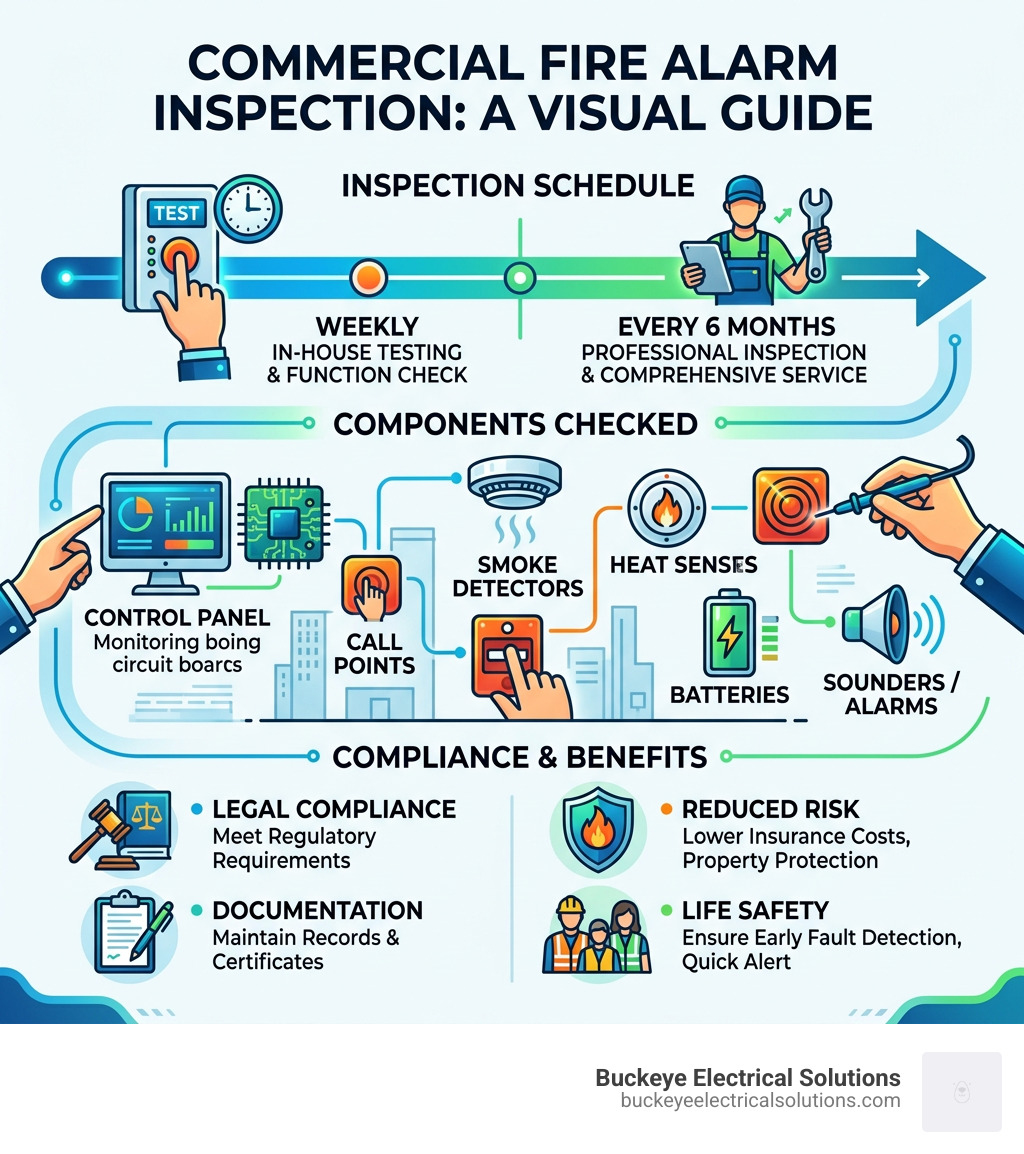
| How often | Weekly in-house tests + professional inspection every 6 months |
| Who performs it | A trained, competent fire safety technician |
| Key standard | NFPA 72 (US) / BS 5839-1:2017 (UK) |
| What’s checked | Control panels, smoke detectors, heat sensors, call points, batteries, sounders |
| Why it matters | Legal compliance, early fault detection, life and property protection |
Fire is fast. According to industry data, there were over 2,700 fire callouts to businesses in a single year — and more than 5% resulted in injuries. A system that fails silently is just as dangerous as no system at all.
Regular inspections catch faults before they become tragedies. They also keep you compliant with fire safety regulations, protect your insurance coverage, and give you documented proof that you’ve met your duty of care.
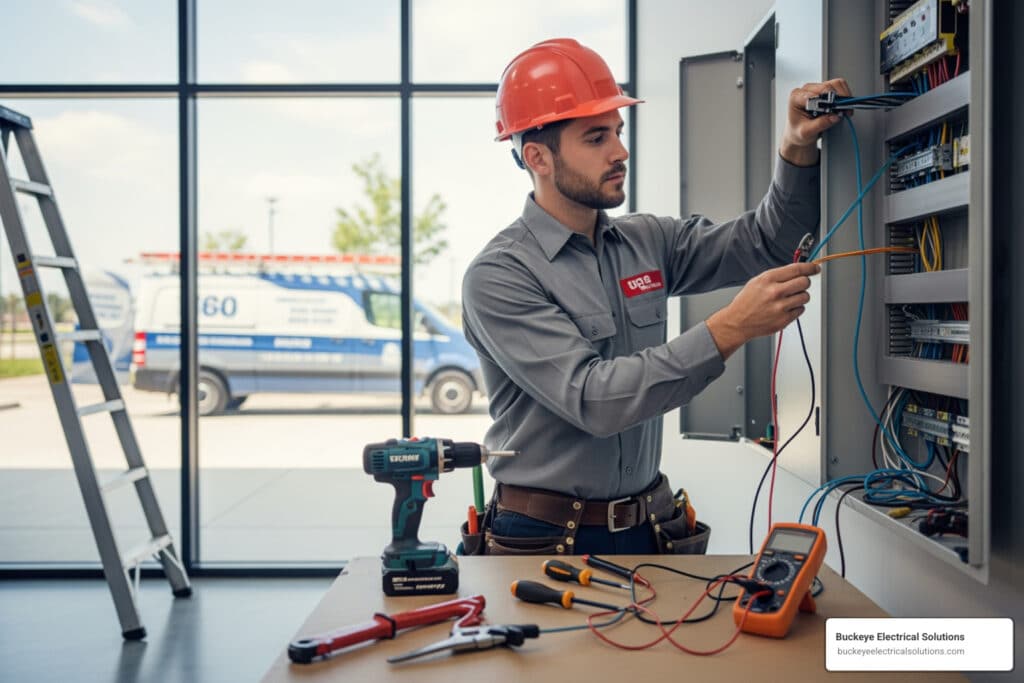
I’m Aaron, owner of Buckeye Electrical Solutions and a licensed master electrician with hands-on experience overseeing commercial electrical and safety projects across Northeast Ohio — including commercial fire alarm inspection work as part of larger commercial builds and rewires. In the sections below, I’ll walk you through everything you need to know to keep your business protected and compliant.
Commercial fire alarm inspection vocab explained:
Legal Requirements and Standards for Commercial Fire Alarm Inspection
Navigating fire safety laws can feel like trying to read a map in a dark room. However, for business owners in Northeast Ohio, the requirements are quite clear once you strip away the jargon. The primary benchmark we follow in the United States is the National Fire Protection Association Standards, specifically NFPA 72. This “National Fire Alarm and Signaling Code” dictates how systems must be designed, installed, and, most importantly, maintained.
While our friends across the pond look to The Regulatory Reform (Fire Safety) Order 2005 and the British Standard BS 5839-1:2017, the core philosophy remains the same: the “Responsible Person” (usually the building owner or manager) has a legal duty of care to ensure the fire alarm system is in good working order.
In Ohio, local fire codes often adopt NFPA standards by reference. If you fail to meet these, you aren’t just looking at a stern talking-to from the fire marshal; you could face the revocation of your certificate of occupancy, hefty fines, or even criminal liability if a fire occurs and your system was found to be neglected. Beyond the law, your insurance company likely requires proof of regular commercial fire alarm inspection to keep your policy valid. If you need a hand understanding how these codes apply to your specific building, you can find More info about Fire Alarm Services on our dedicated service page.
The Inspection Schedule: How Often Should You Test?
One of the most common questions we get at Buckeye Electrical Solutions is, “How often do I actually need to do this?” The answer is a blend of frequent “common sense” checks and deep-dive technical audits. Think of it like your car: you check your mirrors every time you drive (weekly test), but you still take it to a mechanic for a multi-point inspection every few months (professional service).
| Frequency | Responsibility | Key Actions |
|---|---|---|
| Daily | Facility Staff | Visual check of the control panel for “fault” lights. |
| Weekly | Facility Staff | Test one manual pull station (on rotation) to ensure sirens sound. |
| Monthly | Facility Staff | Visual inspection of batteries and extinguishers. |
| 6 Months | Professional Tech | Thorough testing of detectors, wiring, and signal transmission. |
| Annual | Professional Tech | Full system “stress test,” including battery load and sensitivity. |
Weekly In-House Testing vs. Professional Commercial fire alarm inspection
The weekly test is your frontline defense. A “competent person” on your staff should activate a different manual call point or pull station each week. This ensures that the signal reaches the panel and the sounders actually fire off. It’s vital to rotate these points so that over a year, every single pull station has been physically pulled at least once. Always record these results in your fire logbook—if it isn’t written down, as far as an inspector is concerned, it never happened.
A professional commercial fire alarm inspection, however, goes much deeper. We don’t just pull a handle; we use specialized equipment to simulate smoke and heat, check the voltage of backup batteries, and ensure the communication path to the monitoring center is lightning-fast.
When to Schedule an Additional Commercial fire alarm inspection
Sometimes, the “standard” schedule isn’t enough. You should call us for an extra inspection if:
- Structural Renovations: If you’ve moved walls or added rooms, your smoke detectors might now be in “dead air” spaces where smoke won’t reach them.
- Environmental Wear: In Ohio, we deal with high humidity in the summer and extreme cold in the winter. This can lead to corroded connections or battery drain.
- System Faults: If your panel is chirping or showing a “trouble” light, don’t just press “silence” and hope for the best.
- Post-Occupancy Changes: If a quiet office space is converted into a warehouse with high-piled storage, your fire risk profile has changed, and your system needs to be re-evaluated.
What Happens During a Professional Commercial Fire Alarm Inspection?
When our team arrives for a professional commercial fire alarm inspection, we aren’t just walking around with a clipboard. It is a methodical, component-by-component “health check” of your entire life safety ecosystem.
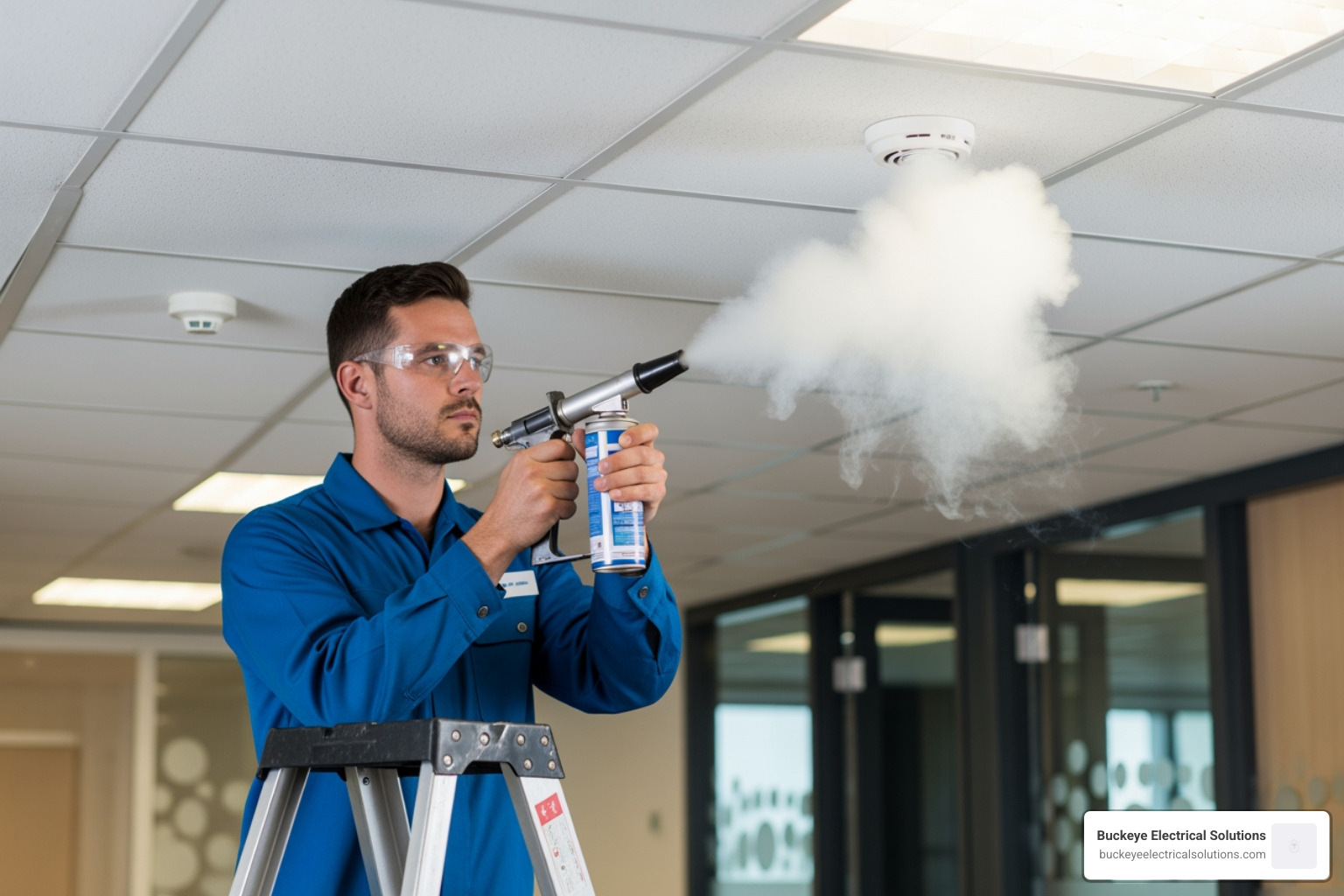
We start at the brain of the system: the Fire Alarm Control Panel (FACP). We check for any latent faults, test the fuses, and ensure the primary power supply is stable. From there, we move into the field.
Key Components of a Commercial fire alarm inspection
- Testing smoke detectors: We use canned smoke or smoke generators to ensure the sensors trigger within the required timeframe. We also perform sensitivity testing to make sure they aren’t so “jumpy” that they cause false alarms, but not so “lazy” that they miss a real fire.
- Heat Sensors: Especially in kitchens or mechanical rooms, we test these to ensure they react to rapid temperature rises or fixed temperature limits.
- Manual Pull Stations: We physically activate them to ensure the mechanical components haven’t seized up over time.
- Audible and Visual Notification: We verify that sirens are loud enough to be heard over ambient noise and that strobe lights are synchronized to prevent seizures while remaining visible to everyone.
- Backup Batteries: This is a big one. We perform a load test to ensure that if the power goes out during a storm, your fire alarm will still run for the required 24 or 60 hours.
- Communication Paths: We confirm that the “DACT” (Digital Alarm Communicator Transmitter) is successfully sending signals to the monitoring station.
Whether you have a Conventional system (which tells you a fire is in a general “zone”) or a modern Addressable system (which tells you exactly which smoke detector in room 402 is alarming), our inspection covers the specific nuances of your hardware.
Why Professional Maintenance is Essential for Compliance
It might be tempting to think that as long as the “power” light is green, everything is fine. But fire alarm components deteriorate. Dust accumulates in sensors, batteries lose their chemical charge, and wiring can be chewed by pests or damaged by moisture.
Professional maintenance is about early fault detection. Catching a failing battery during a Tuesday morning inspection is a minor fix; having the system fail during a Friday night fire is a catastrophe. Furthermore, regular professional checks drastically reduce false alarms. False alarms aren’t just annoying; in many Ohio municipalities, the fire department will start charging you significant “nuisance” fees if they keep showing up for no reason.
Staying on top of your inspections also ensures Insurance validity. If you ever have to file a claim for fire damage, the first thing the adjuster will ask for is your maintenance records. If you can’t provide them, they may have grounds to deny the claim, leaving you with the full bill for repairs. For more on how we support businesses, check out More info about Commercial Electrical Services.
Consequences of Failing to Maintain Fire Systems
The risks of skipping your commercial fire alarm inspection are steep:
- Legal Fines: Fire marshals have the authority to issue heavy fines for non-compliance.
- Occupancy Revocation: They can literally “padlock” your doors and force you to close until the system is repaired.
- Safety Risks: This is the most important. Without a working alarm, your employees and customers lose those precious seconds needed to evacuate.
- Criminal Liability: In cases of gross negligence, building owners have faced criminal charges following fatal fires.
Frequently Asked Questions about Commercial Fire Alarm Inspection
Who is considered a ‘competent person’ for fire alarm servicing?
A “competent person” isn’t just someone who is handy with a screwdriver. For professional servicing, this means a technician with specific fire alarm training, years of experience, and access to the right diagnostic tools. They should have a deep understanding of NFPA 72 and local Ohio building codes. At Buckeye Electrical Solutions, our 20+ years of experience ensures that we bring that high-level expertise to every job.
How should I keep records of my fire alarm tests?
You should maintain a dedicated Fire Alarm Logbook. This can be a physical binder kept near the control panel or a digital audit trail. It must include the date of the test, which devices were tested, any faults found, and the date/details of the repairs made. This logbook is your “get out of jail free card” during a fire marshal audit.
What should I do before a scheduled fire alarm test to avoid false alarms?
Preparation is key to avoiding a “whoops” moment.
- Notify Occupants: Let everyone in the building know when the bells will ring so they don’t panic.
- Alert the Monitoring Center: Call your alarm monitoring company and tell them to put the system on “Test” mode so they don’t dispatch the fire department.
- System Isolation: If your alarm is tied to a sprinkler system or kitchen hood suppression, ensure those are isolated so you don’t accidentally get everyone wet or covered in chemicals!
Is a weekly test required by law?
While NFPA 72 focuses heavily on professional annual inspections, local fire marshals and “Duty of Care” standards almost always require weekly user tests to ensure the system is functional between professional visits.
How long does a professional inspection take?
It depends on the size of the building. A small retail shop might take 2 hours, while a large industrial facility or high-rise office could take a full day or more.
Can any electrician do a fire alarm inspection?
No. It requires specific knowledge of fire alarm circuitry and life safety codes. Always ensure your contractor is licensed and experienced in fire safety systems specifically.
Conclusion
At the end of the day, your fire alarm system is a silent guardian. You hope you never need it, but you need to be 100% certain it will work if you do. For over 20 years, Buckeye Electrical Solutions has been the trusted partner for Northeast Ohio businesses, providing quality electrical repair, installation, and maintenance.
We pride ourselves on exceptional service and prompt project completion. Don’t leave your safety to chance or wait for a “fault” light to appear. You can find More info about Our Services on our website, or better yet, give us a call.
Secure your professional commercial fire inspection today. Let us handle the technical details so you can focus on running your business with total peace of mind.