

Why Hot Tub Electrical Installation Safety Matters
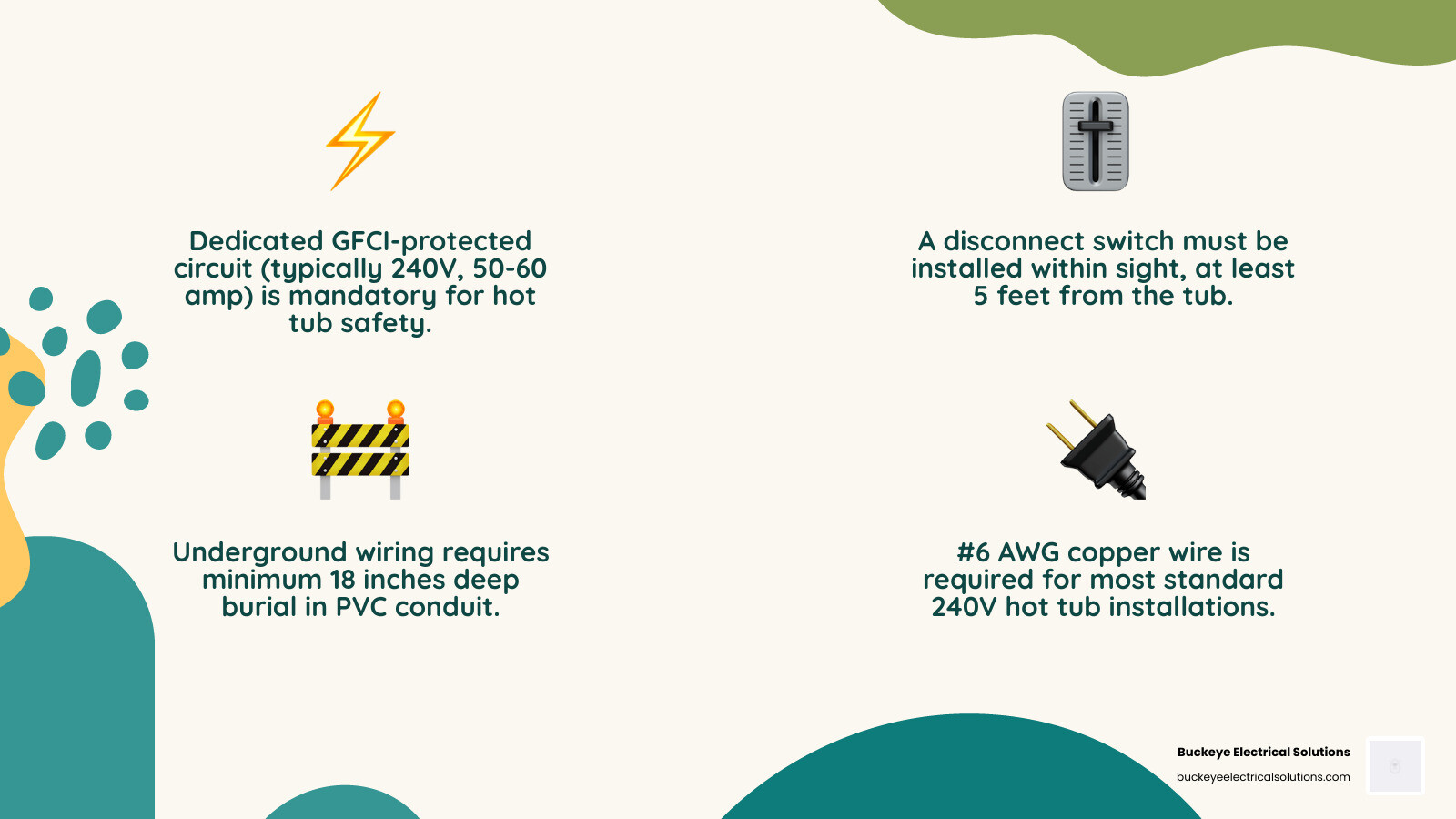
Hot tub electrical installation is a critical—and dangerous—home improvement project. Proper installation is not just a recommendation; it’s a requirement under the National Electrical Code (NEC) to prevent serious risks. Key NEC requirements include:
- A dedicated GFCI-protected circuit (typically 240V, 50-60 amp)
- A disconnect switch within sight, at least 5 feet from the tub
- Buried wiring at a minimum of 18 inches deep in PVC conduit
- #6 AWG copper wire for most standard 240V installations
- No extension cords under any circumstances
Water and electricity are a lethal combination. The primary goal of NEC Article 680 is to keep people and electricity safely separated. A single mistake in hot tub wiring can lead to electrocution, fire, costly equipment damage, or a voided warranty.
This guide covers everything from your spa’s power requirements to the professional installation process. You’ll learn about non-negotiable safety components like GFCI breakers, disconnect switches, and burial depth requirements for wiring.
Important: While this guide helps you understand the process, hot tub electrical work is complex and potentially deadly if done incorrectly. Most homeowners in Northeast Ohio should hire a licensed professional to ensure safety and code compliance.
Pre-Installation Prep: Understanding Your Hot Tub’s Electrical Needs
Before any work begins, the first step in a hot tub electrical installation is understanding your spa’s specific electrical needs. This planning phase ensures your home’s electrical system can safely support it.
Plug-and-Play (120V) vs. Hardwired (240V) Tubs
Hot tubs fall into two electrical categories: 120-volt (120V) “plug-and-play” models and 240-volt (240V) “hardwired” models. This difference affects heating speed, installation complexity, and your overall experience.
120V “Plug-and-Play” Hot Tubs:
These smaller, portable tubs use a standard 120V outlet but still require a dedicated 15-20 amp GFCI-protected circuit. Their convenience comes with a trade-off: the heater and jets often can’t run simultaneously, leading to slower heating, especially in cold Ohio weather.
240V Hardwired Hot Tubs:
These are the most common type, offering a superior experience. They need a dedicated 240V circuit, typically 50-amp, but some require 30, 40, or 60 amps. This higher voltage allows the heater and jets to run at full power simultaneously for faster heating and stronger hydrotherapy. For example, most Master Spas hot tubs require a 50-amp/240V connection. The higher power draw makes them more efficient and safer long-term.
Here’s a quick comparison:
| Feature | 120V Plug-and-Play Hot Tubs | 240V Hardwired Hot Tubs |
|---|---|---|
| Voltage | 120 Volts | 240 Volts |
| Amperage | Dedicated 15-20 Amps | Dedicated 30-60 Amps (often 50A) |
| Heating Speed | Slower (heater and jets often can’t run together) | Faster (heater and jets can run simultaneously) |
| Jet Power | Moderate | Powerful and consistent |
| Installation | Simpler, but still needs dedicated GFCI outlet | More complex, requires hardwiring to a dedicated circuit |
| Typical Cost | Generally lower initial cost | Higher initial electrical installation cost |
Decoding Your Hot Tub’s Data Plate and Manual
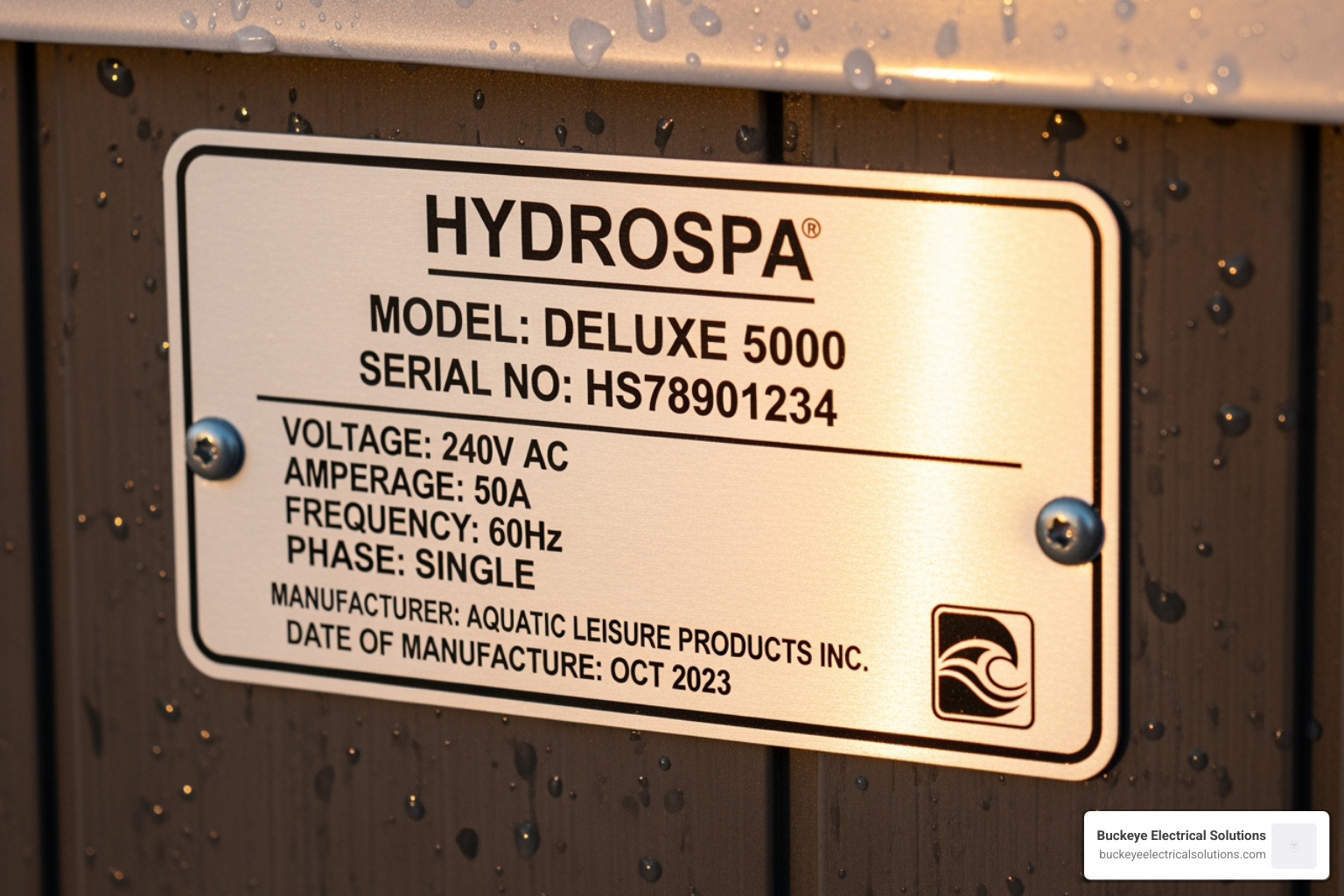
Every hot tub has a data plate near the electrical hookup that lists its specific requirements. This plate is essential for a safe installation and will state:
- Voltage (V): 120V or 240V.
- Amperage (A): The maximum current draw (e.g., 50 amps).
- Required Wire Gauge (AWG): The minimum wire size needed. A standard 240V, 50A installation typically uses No. 6 gauge copper wire.
- Horsepower (HP) and Motor Data: Information about the pumps.
Always consult the owner’s manual for detailed diagrams. Manufacturers like Master Spas often provide this information online. Keep this documentation for your electrician and contact your dealer if you have questions.
Essential Components for a Safe Installation
Regardless of your hot tub type, several electrical components are required for a safe and code-compliant hot tub electrical installation in Northeast Ohio.
-
Dedicated Circuit: A hot tub must have its own dedicated circuit. Sharing a circuit can cause frequent breaker trips, damage the spa’s components, and create a fire hazard.
-
GFCI Breaker: A Ground Fault Circuit Interrupter (GFCI) is mandatory. This safety device detects ground faults and immediately shuts off power to prevent electrocution. It’s your primary defense against the dangers of mixing electricity and water.
-
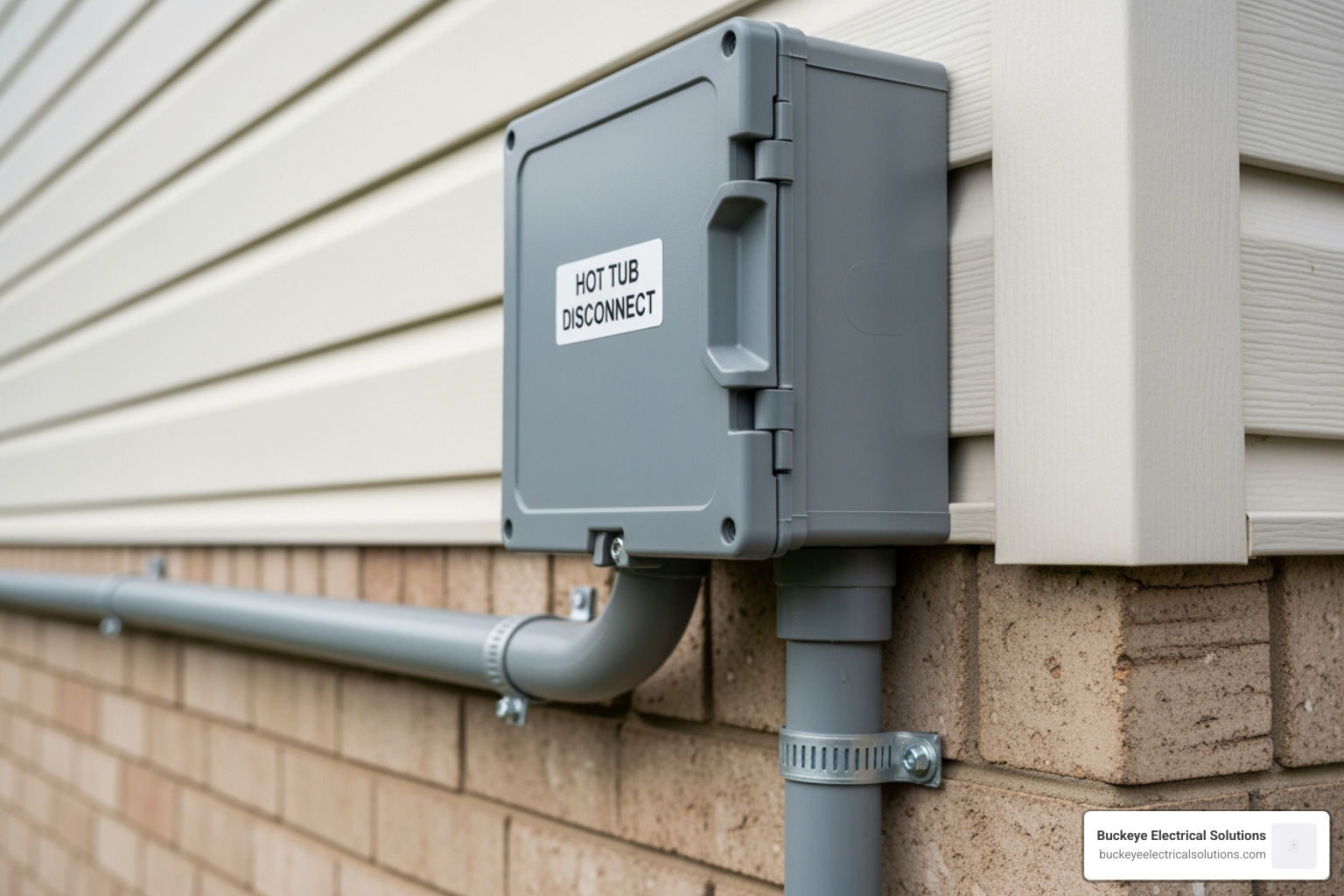
Manual Disconnect Switch: The NEC requires a manual disconnect switch to quickly cut power for emergencies or maintenance. It must be located within sight of the hot tub but at least 5 feet from the water’s edge.
-
Correct Wire Gauge: Using the correct wire size is critical to prevent overheating and fire. Most 240V, 50-amp tubs require No. 6 AWG copper wire (two hot, one neutral, one ground). Always confirm the required gauge on the data plate.
-
Weatherproof Conduit: Outdoor wiring must be protected from weather and physical damage by running it through weatherproof conduit (typically Schedule 80 PVC for underground burial). This ensures a safe, long-lasting connection.
The Core of a Safe Hot Tub Electrical Installation: NEC and Safety Codes
Adhering to electrical codes isn’t just a suggestion; it’s a legal requirement for your safety. In Northeast Ohio, hot tub electrical installation must comply with the National Electrical Code (NEC). Our team at Buckeye Electrical Solutions ensures every installation meets these stringent standards.
GFCI Protection: Your Non-Negotiable Safety Net
GFCI protection is mandatory for all hot tub circuits and is your most important safety device. A Ground Fault Circuit Interrupter (GFCI) constantly monitors electrical current. If it detects a small leak (a ground fault), it cuts power in a fraction of a second, preventing electrocution. Without a GFCI, your hot tub could become a deadly hazard. Test your GFCI monthly by pressing the “Test” button; if it fails to trip, it must be replaced immediately. For more details, refer to OSHA’s eTool on GFCI protection.
The Role and Rules of the Disconnect Switch
The disconnect switch is another critical safety component, providing a way to shut off power for emergencies or maintenance. The NEC has specific location rules for this switch:
- It must be within sight of the hot tub.
- It must be located at least 5 feet from the inside walls of the tub to prevent contact from within the water.
- It must be no more than 50 feet away to ensure it’s accessible.
A properly installed, weatherproof disconnect switch is an indispensable part of a safe system.
Clearance and Placement: NEC Distance Requirements
The NEC governs the placement of your hot tub and its electrical components to prevent hazards. These clearance rules are designed for your safety.
- Distance from House and Structures: Hot tubs must be at least 5 feet away from the house and other structures unless specific bonding and clearance rules are followed.
- Overhead Power Line Clearance: Never install a hot tub under power lines. The NEC requires a minimum clearance of 22.5 feet for overhead power conductors from the water level.
- Outdoor Receptacle Placement: Any general-purpose GFCI-protected receptacle must be located between 6 and 20 feet from the inside wall of the tub. Other receptacles within 20 feet must also be GFCI protected.
- Light Switch Distance: Light switches must be at least 5 feet, measured horizontally, from the inside walls of the hot tub.
These regulations are part of the National Electrical Code (NEC), which electrical contractors in Northeast Ohio adhere to diligently.
Underground Wiring: Conduit and Burial Depth
For most outdoor installations, wiring must be buried to protect it from damage and weather. The NEC specifies burial depths and conduit types:
- Why Bury Wiring? Buried wiring in conduit is protected from lawnmowers, shovels, and pests, preventing tripping hazards and dangerous electrical situations.
- PVC Conduit Burial Depth: When using Schedule 80 PVC conduit, wiring must be buried at least 18 inches deep.
- Rigid Metal Conduit (RMC) Depth: With the greater protection of RMC, the burial depth is reduced to 6 inches.
- Local Code Variations: Local Ohio codes may have additional requirements. Our electricians are versed in both NEC and local codes. Wiring under a deck may sometimes be run above ground in conduit, but always check with your local building department first.
Step-by-Step Guide to a 240V Hot Tub Electrical Installation
Safety Disclaimer: This is a complex and dangerous project. This guide is for informational purposes to help you understand the process. We strongly recommend hiring a licensed professional for your safety and to ensure code compliance. For professional help, see our Residential Electrical Services.
A 240V hot tub electrical installation is a significant undertaking that should only be performed by a qualified electrician. Understanding the steps can help you communicate effectively with your chosen professional.
Step 1: Planning the Route and Gathering Materials
Meticulous planning is the first step. This involves mapping the most efficient, code-compliant wire path from the main panel to the disconnect, and then to the hot tub, considering distance and obstacles to minimize trenching. A professional will use a 2-pole GFCI breaker (e.g., 50-amp), a weatherproof disconnect box, Schedule 80 PVC conduit, #6 AWG copper wire, a multimeter, trenching tools, fish tape, and other essential tools and safety gear.
Step 2: Installing the Dedicated Circuit and GFCI Breaker
This dangerous step requires an expert to work inside your main electrical panel.
- Turn Off Main Power: The electrician first shuts off the main breaker to the entire home, often using a lockout/tagout procedure for safety.
- Install GFCI Breaker: The correctly sized 2-pole GFCI breaker is installed in an open slot in the main panel.
- Run Feeder Cable: A feeder cable is run from the new breaker through the wall to the exterior location for the disconnect switch.
Step 3: Mounting the Disconnect and Running Conduit
The focus now moves to the outdoor components.
- Mount the Disconnect Box: A weatherproof disconnect box is mounted securely, meeting NEC distance requirements (within sight, 5-50 feet away, and at least 5 feet from the tub). The enclosure is caulked to protect it from Ohio weather.
- Trench and Lay Conduit: A trench is dug along the planned route to the required depth (e.g., 18 inches for PVC). Schedule 80 PVC conduit is then assembled, glued, and laid in the trench to create a watertight path for the wires.
Step 4: Pulling Wires and Making Final Connections
This is the final stage of wiring.
- Pull Wires: Fish tape is used to pull the four copper wires (two hot, one neutral, one ground) through the conduit.
- Make Connections: Wires are connected inside the disconnect switch (panel feed to input, tub feed to output) and then at the hot tub’s control panel, following the manufacturer’s diagram.
- Secure and Test: All connections are torqued to the proper specification to prevent loose connections, a common fire hazard. Finally, the circuit is energized, and a multimeter is used to verify correct voltage at the tub before its first test run.
Frequently Asked Questions about Hot Tub Electrical Installation
We understand that hot tub electrical installation can be a maze of questions. Here, we address some of the most common inquiries we receive in Northeast Ohio.
Why is my new hot tub’s breaker tripping?
A tripping breaker indicates a problem. Here are the most common culprits for a new hot tub:
- Incorrect Wiring or Loose Connections: This is the most frequent cause. A licensed electrician can find and fix issues like miswired neutrals or loose connections at the breaker, disconnect, or control panel.
- Faulty GFCI Breaker: The GFCI breaker itself could be faulty. If it trips instantly with the hot tub disconnected, the breaker likely needs replacement.
- Water Moisture: Moisture in the control box, conduit, or other electrical parts can cause a ground fault and trip the breaker, especially after rain.
- Heater Malfunction: A faulty heating element or a short in the heater assembly can trip the breaker, often when the tub tries to heat the water.
- Pump Issues: A seized motor, damaged impeller, or short in a pump motor can draw too much current and trip the breaker.
- Undersized Wire: Wire that is too small for the amperage or distance can cause voltage drop and overheating, tripping the breaker.
If your hot tub breaker trips, call a licensed electrician to diagnose the cause safely.
Can I use an extension cord for my hot tub?
NO, NEVER! Using an extension cord for a hot tub is an extreme fire hazard and creates a serious risk of electrocution. Here’s why:
- Fire Hazard: Standard extension cords can’t handle a hot tub’s high, continuous current draw. They can overheat, melt, and cause a fire.
- Component Damage: Most cords aren’t rated for the required amperage (e.g., 50A). This leads to voltage drop, which strains the pumps and heater, shortening their lifespan and causing costly repairs.
- Voids Warranty: Using an extension cord will void your manufacturer’s warranty.
- Electrocution Risk: Cords are not meant for wet environments and lack the robust GFCI protection needed for hot tubs, significantly increasing the risk of electrocution.
Hot tubs must always be hardwired directly into a properly rated, grounded, and GFCI-protected dedicated circuit by a qualified electrician.
What factors influence the cost of a professional hot tub electrical installation?
The cost of a professional hot tub electrical installation varies. Key factors include:
- Distance from Panel to Tub: Longer distances require more materials (wire, conduit) and labor (trenching), increasing the cost.
- Trenching Difficulty: Trenching through difficult terrain like concrete, asphalt, or rock is more labor-intensive and costly than digging in soft soil.
- Main Panel Capacity: If your main panel is full or lacks capacity for a new 50-amp circuit, an upgrade or sub-panel may be needed, adding significant cost.
- Local Permit Fees: Permit fees from your local municipality are required for hot tub installations and vary by location.
- Electrician’s Labor Rates: Labor rates depend on the electrician’s experience and job complexity. Hiring a licensed, insured professional ensures a safe, code-compliant installation.
- Type of Hot Tub: A 120V plug-and-play tub typically has a lower electrical setup cost than a 240V hardwired unit.
Conclusion: Ensuring a Safe and Enjoyable Hot Tub Experience
A hot tub electrical installation is not a DIY project. As we’ve covered, the risks of improper wiring—from electrocution and fire to equipment damage—are far too great. Peace of mind comes from knowing the installation is safe. This means adhering to the National Electrical Code by using mandatory GFCI protection, a dedicated circuit, a proper disconnect switch, and correct wiring and burial techniques.
A professional installation protects your family, your home, and your investment. For over 20 years, Buckeye Electrical Solutions has provided safe and reliable electrical services in Northeast Ohio, known for our exceptional service and prompt project completion. Our licensed electricians ensure your hot tub electrical installation meets all NEC standards and local codes.
For a code-compliant and worry-free installation, explore our Our Services and get in touch with our expert team today. We’re here to help you enjoy your new hot tub safely and efficiently.