
Why You Need to Get It Right When You Add an Outlet to Your Bathroom
Want to add an outlet to your bathroom spaces safely and up to code? Here’s what you need to know at a glance:
- GFCI protection is required for all bathroom outlets
- A dedicated 20-amp circuit is needed for bathroom receptacles (NEC 210.11(C)(3))
- Bathroom outlets cannot share a circuit with lights or other rooms
- Placement matters — outlets must follow clearance rules near sinks, tubs, and showers
- Permits are usually required — unpermitted work can cause issues when selling your home
Many Northeast Ohio homeowners discover their bathroom has only a light switch and no outlets — a common situation in older homes with outdated wiring. Adding an outlet sounds simple, but bathrooms are one of the most regulated spaces in your home’s electrical system. Wet environments, high-draw appliances like hair dryers (up to 1,500 watts) and bidets (up to 1,140 watts), and old ungrounded wiring all raise the stakes considerably.
Getting this wrong isn’t just a code violation — it’s a safety hazard.
I’m Aaron, owner of Buckeye Electrical Solutions LLC, and I’ve overseen dozens of permitted residential electrical projects across Northeast Ohio, including bathroom outlet installations and circuit upgrades where adding an outlet to a bathroom the right way made all the difference. Let’s walk through the essential requirements and safety standards for this upgrade.
Essential Codes for When You Add an Outlet to Your Bathroom
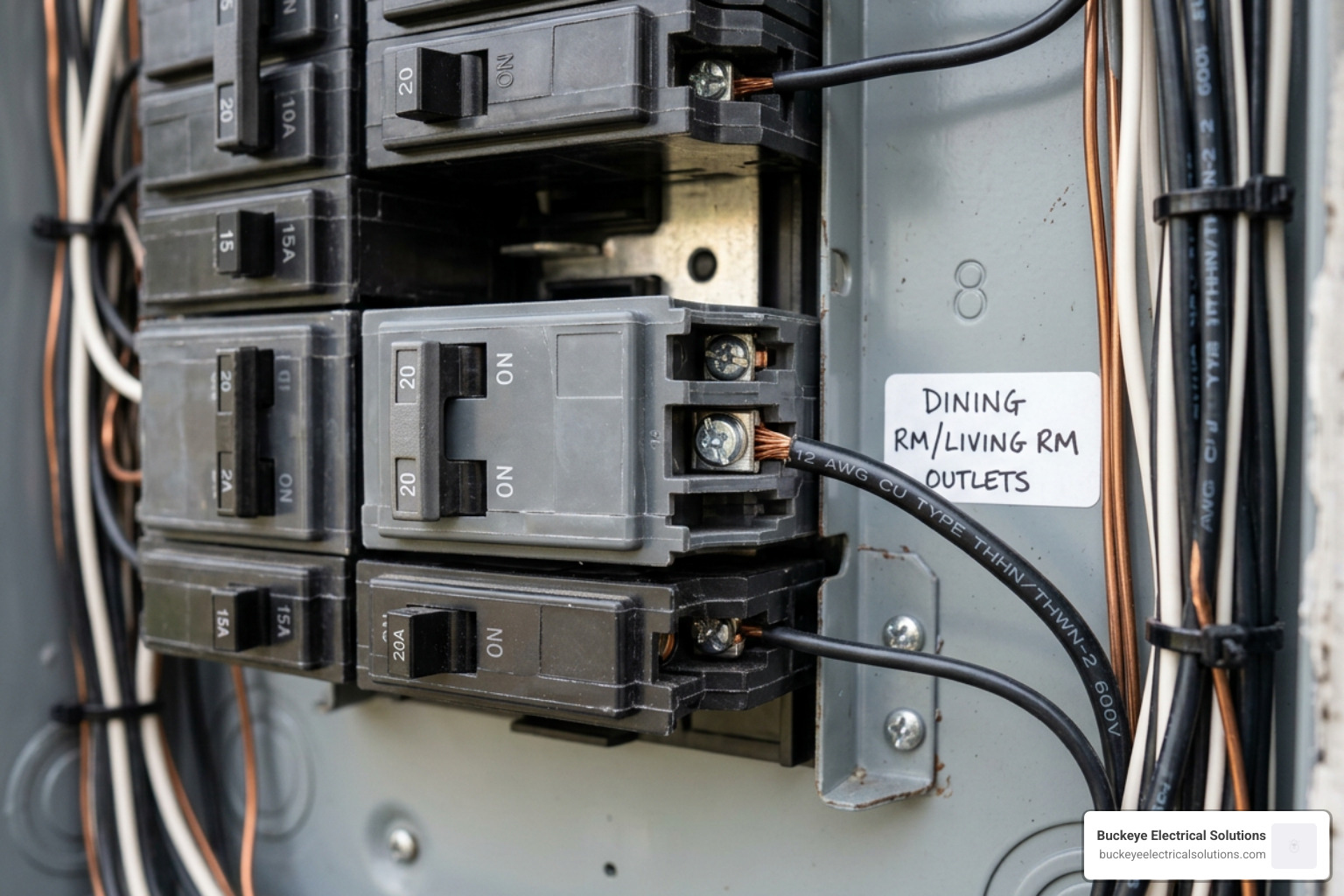
When we talk about electrical work in Northeast Ohio, the conversation always starts and ends with the National Electrical Code (NEC). Specifically, NEC 210.11(C)(3) is the “golden rule” for bathrooms. It states that at least one 20-ampere branch circuit must be provided to supply bathroom receptacle outlets. Crucially, these circuits should have no other outlets—meaning they shouldn’t power your bedroom lights or the hallway vacuum plug.
The 20-Ampere Standard
Why 20 amps? Think about your morning routine. A typical hair dryer pulls between 1,200 and 1,500 watts. If you are also running a high-end bidet or a space heater on the same circuit, a standard 15-amp circuit (common in older homes) will trip faster than you can finish brushing your teeth. By using a 20-amp circuit with 12-gauge wiring, we ensure the system can handle the heavy load of modern grooming appliances.
GFCI Protection and Ungrounded Wiring
Ground Fault Circuit Interrupter (GFCI) protection is non-negotiable. In a bathroom, water and electricity are constant neighbors. A GFCI outlet monitors the flow of electricity and cuts power instantly if it detects a leak (a ground fault), preventing a potentially lethal shock.
For those living in older Northeast Ohio homes with ungrounded (two-wire) systems, installing a GFCI is actually a code-approved way to add a degree of safety. While the GFCI won’t create a “true” ground, it will still trip if a fault occurs, protecting users from electrocution. However, these must be labeled “No Equipment Ground” to stay compliant. Learn more about shared knowledge for electrical standards to see how professionals navigate these complex legacy systems.
Load Calculations and Moisture
Before we add an outlet to bathroom walls, we perform a load calculation. We follow the 80% rule: a circuit should not be loaded to more than 80% of its capacity for continuous use. For a 20-amp circuit, that’s 16 amps. If your bidet draws 9.5A and your hair dryer draws 12.5A, running them simultaneously on one circuit is a recipe for a dark bathroom and a tripped breaker.
Safety Clearances to Add an Outlet to a Bathroom Near Water
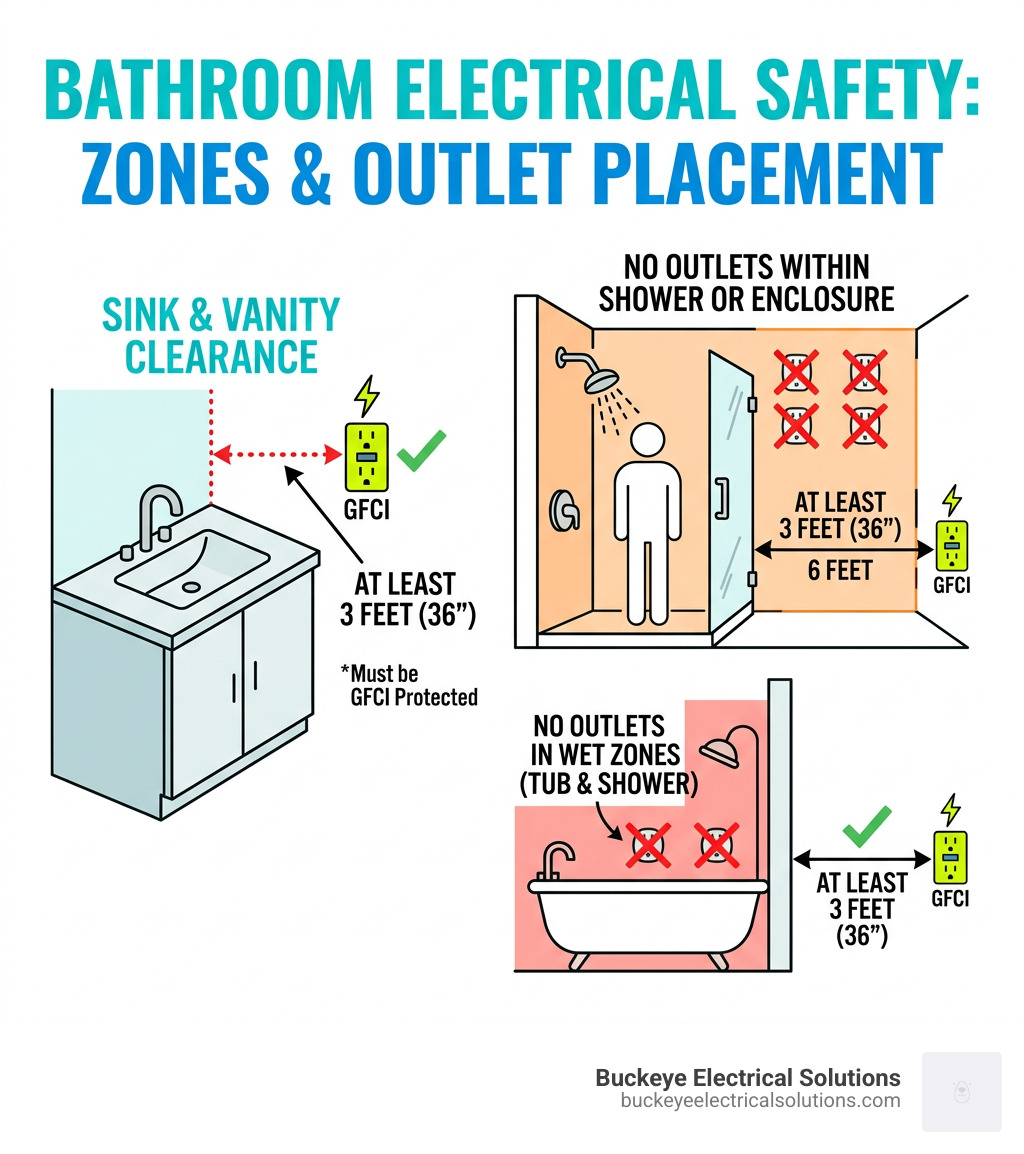
Placement isn’t just about convenience; it’s about physics. We follow strict clearance rules to keep you safe:
- The 6-Foot Rule: Generally, any receptacle within 6 feet of the outside edge of a sink must be GFCI protected.
- Zone Restrictions: Outlets should never be installed directly inside or over a bathtub or shower stall.
- Height and Reach: Receptacles must be installed on a wall or partition adjacent to the sink.
If you are planning a complex layout, our Residential Electrical Services can help ensure your new outlets are positioned perfectly within legal safety zones.
Vanity Upgrades to Add an Outlet to Bathroom Drawers
One of the most popular requests we see today is the “hidden” outlet. These are installed inside vanity drawers so you can keep hair dryers, curling irons, and electric toothbrushes plugged in and tucked away.
To do this safely, we use ETL-listed devices specifically designed for drawers. These units often feature temperature interlocks—a smart safety feature that cuts power if the temperature inside the drawer exceeds 120°F. This prevents a fire if a curling iron is accidentally left on while the drawer is closed. It’s the ultimate way to achieve styling tool organization without the countertop clutter.
Power Requirements for Bidets and High-Draw Appliances
The modern bidet is a marvel of hygiene, but it’s also a power-hungry appliance. Most high-end bidet seats feature heated water, heated seats, and warm-air dryers.
Understanding the Draw
A typical bidet can draw up to 1,140 watts, which is approximately 9.5 amps at 120V. When you combine that with a standard hair dryer (1,500 watts or 12.5 amps), you are looking at a total draw of 22 amps. This exceeds the capacity of even a 20-amp circuit.
This is why we often recommend a dedicated circuit if you are installing a high-performance bidet. If you “tap” into an existing lighting circuit (which is often only 15 amps), you are almost guaranteed to trip the breaker every time you use the bidet while the lights and exhaust fan are on.
Voltage Drop and Circuit Integrity
When running new wire from a distant electrical panel, we also have to consider voltage drop. If the wire run is exceptionally long, the voltage can dip, causing appliances to run inefficiently or motors to burn out prematurely. Using 12/2 NM-B copper wire is the standard for these 20-amp runs, providing the thickness needed to carry the current without significant loss.
Professional Considerations for New Circuit Installation
Running a new circuit involves following the structural and legal requirements of Northeast Ohio building departments.
Attic and Junction Box Standards
When pulling power from the attic, professional standards require all splices to be contained within accessible junction boxes. Code prohibits twisting wires together behind a wall and burying them. If there isn’t enough “slack” in an existing wire, multiple junction boxes are used to bridge the gap safely, ensuring the system remains accessible.
Permit Applications and Inspections
In cities like Cleveland, Akron, and Canton, adding a new electrical circuit requires a permit. This isn’t just red tape—it’s your protection. An electrical inspector will verify that the wire gauge is correct, the box is properly sized (to avoid “box fill” overheating), and the GFCI functions as intended. Unpermitted work can lead to major headaches during a home sale or, worse, denied insurance claims in the event of a fire.
For business owners looking to upgrade their facilities, our Commercial Electrical Services handle all the permitting and high-capacity mapping required for commercial-grade bathrooms.
Common Pitfalls in Bathroom Electrical Retrofitting
Even with the best intentions, improper installations can compromise safety. Here are the most common mistakes found in the field:
- Improper Grounding: Assuming a metal box is grounded when it isn’t.
- Tapping Lighting Circuits: As mentioned, bathroom lighting circuits are usually 15-amp and shared with other rooms. Using them to add outlets to bathroom walls is a violation of NEC 210.11(C)(3).
- Substandard Connections: Many installations rely on “push-in” connectors on the back of outlets. These are notorious for loosening over time, creating heat and potential fire hazards. Professional installations utilize more secure terminal connections to ensure long-term safety and reliability.
- Skipping the WR Rating: Bathroom outlets should ideally be Weather-Resistant (WR) rated, especially if they are near high-moisture areas like a shower, to prevent internal corrosion.
- Improper Box Volume: Cramming too many wires into a small plastic box can cause wires to pinch or overheat. Code dictates exactly how much “volume” each wire and device takes up.
Frequently Asked Questions about Bathroom Outlets
Can I add a bathroom outlet to an existing light switch circuit?
Connecting a bathroom outlet to a lighting circuit is not code-compliant. NEC requires bathroom receptacles to be on a dedicated 20-amp circuit. Lighting circuits are typically 15-amp and shared with other rooms. If a hair dryer is used on an outlet tapped off a lighting circuit, it will likely trip the breaker and leave the whole floor in the dark.
Does a bidet require a dedicated 20-amp circuit?
While some smaller bidets can share a 20-amp bathroom circuit, high-end models with integrated heaters draw nearly 10 amps on their own. To avoid nuisance tripping when using other appliances, a dedicated circuit is the best practice and often required by the manufacturer’s installation instructions.
Do I need a permit to install a new outlet in my bathroom?
Yes. In most jurisdictions across Northeast Ohio, any new wiring or addition of a circuit requires a permit and an inspection. This ensures the work meets the latest safety standards and protects your home’s resale value.
Conclusion
When you decide to add outlets to bathroom spaces, you are doing more than just adding convenience—you are modifying one of the most sensitive parts of your home’s infrastructure. Whether it’s for a high-tech bidet, a hidden vanity drawer for your styling tools, or simply to bring an old bathroom up to modern standards, safety must be the priority.
Proper GFCI protection, dedicated 20-amp circuits, and correct clearance from water sources are the hallmarks of a professional installation. While the DIY spirit is strong in Ohio, the complexities of the NEC and the risks of working in wet environments mean that some jobs are best left to the experts.
At Buckeye Electrical Solutions, we pride ourselves on providing Northeast Ohio homeowners with safe, code-compliant, and efficient electrical upgrades. From attic wire runs to complex panel upgrades, we ensure your home is powered for the future.
Ready to upgrade your bathroom? Explore Our Services or contact us today to schedule your professional outlet installation. Ensure your next “throne” upgrade is as safe as it is comfortable!