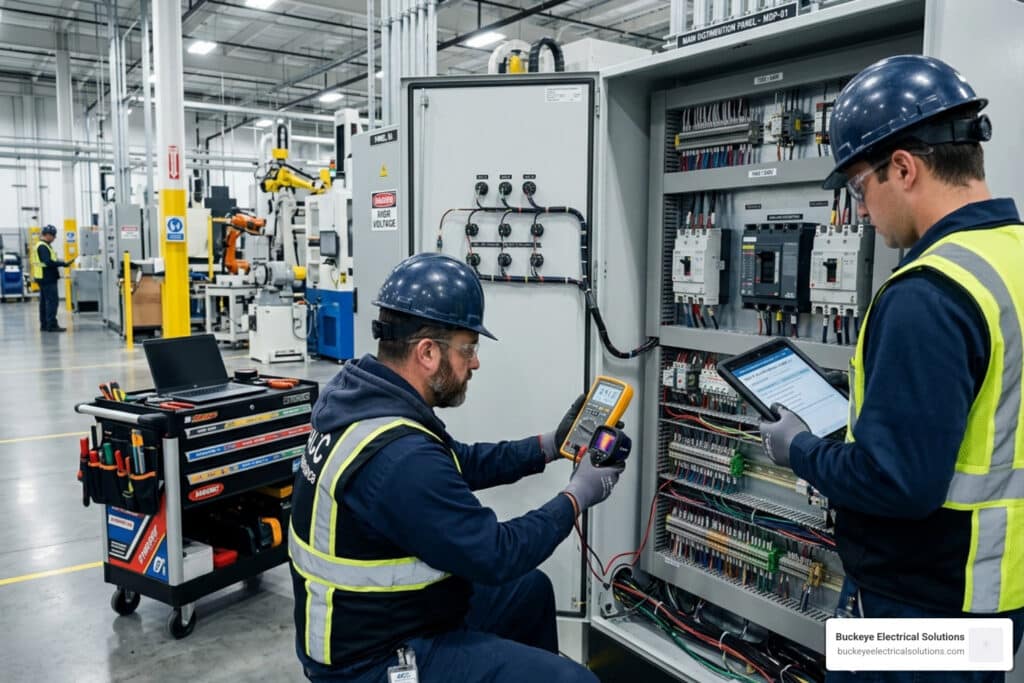
Why Electrical Planned Maintenance Is the Smartest Investment Your Facility Can Make
Electrical planned maintenance is a scheduled program of inspections, testing, cleaning, and servicing of your electrical systems — done before something breaks, not after.
Here’s what it covers at a glance:
| What It Is | What It Prevents | How Often |
|---|---|---|
| Scheduled inspections, testing, and servicing of electrical equipment | Fires, outages, arc flash, equipment failure | At minimum annually; every 3 years per Hartford Steam Boiler general guidance |
| Covers panels, breakers, transformers, motors, wiring, and backup systems | Costly emergency repairs and regulatory violations | More frequently for critical or harsh environments |
| Documented in a formal program per NFPA 70B 2023 standards | Unplanned downtime and insurance issues | Tailored to equipment type and usage cycles |
Most facilities only think about their electrical systems when something goes wrong. That’s a costly mistake. Electrical equipment failures cause millions of dollars in damage and lost business every year — and more than two-thirds of those failures are preventable with routine maintenance. In fact, equipment without a scheduled maintenance program fails at three times the rate of equipment that is regularly serviced.
The risk isn’t just financial. Faulty wiring, loose connections, and overloaded circuits are among the top causes of fires in commercial buildings. A faint burning smell near a control panel can become smoke pouring from an overloaded breaker within an hour.
Proactive care is simply cheaper, safer, and smarter than waiting for failure.
I’m Aaron, owner of Buckeye Electrical Solutions and a master electrician who has directed more than 60 permitted electrical projects across Northeast Ohio — from whole-home upgrades to large-scale commercial rewires — giving me experience with the real costs of skipping electrical planned maintenance. In this guide, I’ll walk you through everything you need to build a program that protects your facility, your people, and your bottom line.
The Core Components of Electrical Planned Maintenance
When we talk about a comprehensive electrical planned maintenance program, we aren’t just talking about a quick walk-through with a flashlight. A truly effective program is multi-layered, combining sensory checks with high-tech diagnostics. Think of it like a physical for your building’s nervous system.
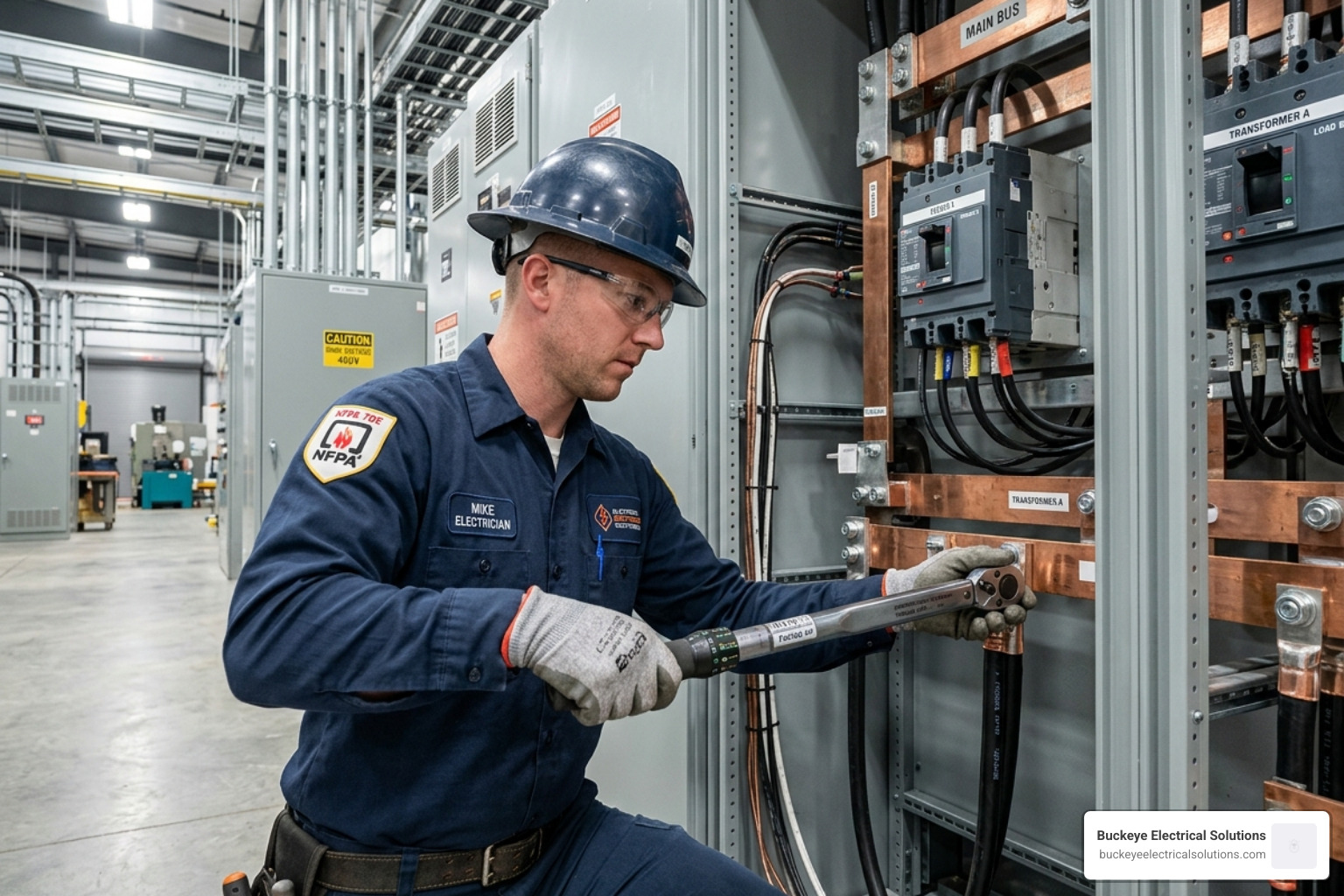
The foundation of any program relies on several key actions:
- Visual Inspections: We look for the “obvious” signs of trouble that often go unnoticed—corrosion on terminals, dust buildup in enclosures (which acts as insulation and traps heat), and physical damage to conduits or enclosures.
- Diagnostic Testing: This involves using specialized meters to measure voltage, current, and insulation resistance. We want to ensure that electricity is flowing where it should and staying out of where it shouldn’t.
- Component Cleaning: Dust and grime are the silent killers of electrical gear. We use lint-free rags and manufacturer-approved solvents to keep insulators clean and prevent “tracking” or arcing.
- Mechanical Lubrication: Moving parts like switchgear mechanisms and circuit breaker linkages need proper lubrication to ensure they actually trip when they are supposed to.
Following a Standard for an Electrical Prevention Maintenance (EPM) Program ensures that no stone is left unturned. For facility managers, having a Stay Charged: An Essential Electrical Maintenance Checklist for Facilities is the first step toward moving from a “fix-it-when-it-breaks” mentality to a “keep-it-running” strategy.
Maximizing ROI through Electrical Planned Maintenance
Some business owners see maintenance as a “sunk cost.” We see it as a high-yield investment. The return on investment (ROI) for electrical planned maintenance comes from three main areas:
- Extended Asset Lifespan: Electrical components like transformers and switchgear are incredibly expensive. By keeping them clean, cool, and tight, you can easily double their operational life, deferring hundreds of thousands of dollars in replacement costs.
- Energy Efficiency: Loose connections and aging components create heat. In electrical terms, heat is wasted energy. By optimizing your system, you reduce “power leaks” and lower your monthly utility bills.
- Insurance Premiums: Many insurance providers now require documented proof of an EPM program to maintain coverage. In some cases, showing a history of professional Commercial Electrical Services can even lead to premium reductions because you’ve significantly lowered the risk of a fire-related claim.
Advanced Diagnostics in Electrical Planned Maintenance
In April 2026, we have tools at our disposal that make electrical “guesswork” a thing of the past. We use these technologies to see the invisible:
- Thermal Imaging (Infrared Surveys): This is perhaps the most powerful tool in our kit. By scanning panels under load, we can identify “hot spots”—connections that are loose or circuits that are overloaded—long before they smell like smoke or cause a fire.
- Ultrasonic Testing: Did you know that failing electrical components often “hiss” at a frequency humans can’t hear? Ultrasonic tools pick up the sound of arcing or corona discharge, allowing us to find faults in high-voltage equipment without even opening the cabinet.
- Power Quality Analysis: We use data loggers to monitor voltage sags, surges, and harmonics. This protects sensitive electronics (like your servers and CNC machines) from being fried by “dirty” power.
- Insulation Resistance Testing: By “megging” wires and motor windings, we can tell if the insulation is breaking down. This is a literal crystal ball for predicting when a motor or cable is going to fail.
Why Proactive Care Outperforms Reactive Repairs
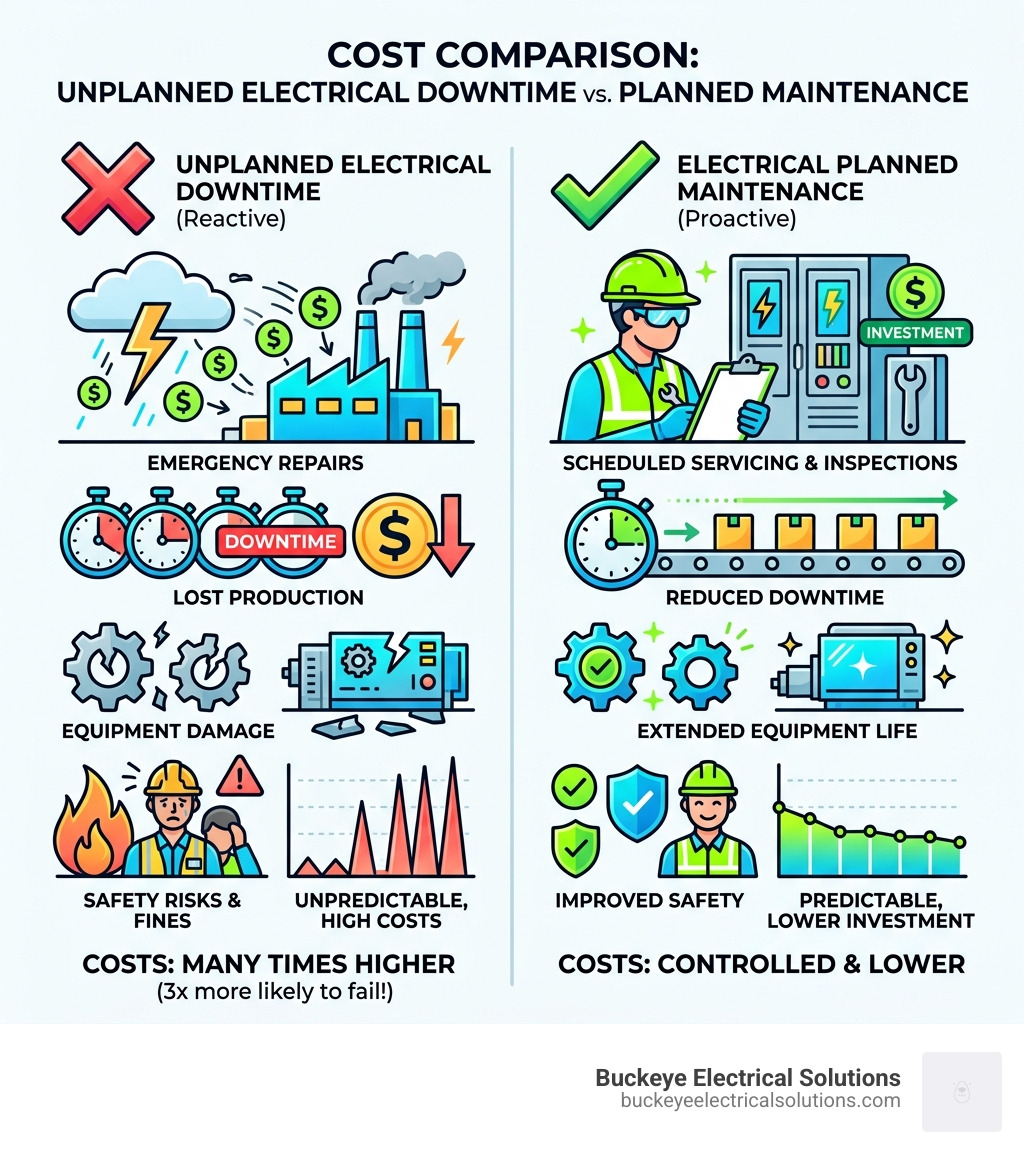
The “run-to-failure” model is the most expensive way to operate a facility. When a main breaker trips at 2:00 AM on a Tuesday, you aren’t just paying for a repair; you’re paying for emergency labor rates, lost production time, spoiled inventory, and potentially, the lives of your employees.
| Maintenance Type | Cost Level | Risk Level | Impact on Business |
|---|---|---|---|
| Preventive (Planned) | Low / Predictable | Very Low | Minimal (Scheduled Outages) |
| Predictive (Data-Driven) | Medium | Extremely Low | Optimized (No Unplanned Outages) |
| Emergency (Reactive) | Extremely High | Very High | Severe (Total Shutdown) |
Beyond the dollars and cents, electrical planned maintenance is your primary defense against the “Big Three” hazards: fire, arc flash, and electrocution. According to industry statistics, panel board failures alone cause 12% of commercial building fires annually. A robust program, like the one outlined in this Electrical Preventive Maintenance Checklist for Facility Managers, can reduce unplanned outages by as much as 72% within the first year of implementation.
Safety Hazards and Regulatory Compliance
In the eyes of OSHA and the NFPA, electrical maintenance is no longer a “suggestion”—it’s a requirement. As of 2023, the NFPA 70B standard transitioned from a “recommended practice” to a mandatory “standard.” This means if a facility has an electrical accident and doesn’t have a documented maintenance program, they could face massive fines and legal liability.
We ensure our clients stay compliant with:
- OSHA 1910 Subpart S: Which mandates safety-related work practices.
- NEC (National Electrical Code): Ensuring all installations meet current safety standards.
- NFPA 70E: Protecting workers from arc flash and shock hazards through proper labeling and PPE.
Essential Checklist for a Maintenance Program
A good program is only as strong as its documentation. We recommend keeping a digital maintenance log to track every asset in your facility.
Here is what we focus on during a standard service visit:
- Switchgear & Panels: Vacuuming out debris (never use compressed air, which can drive conductive dust deeper into components), tightening connections to specific torque requirements, and verifying that all breakers are correctly labeled.
- Circuit Breakers: “Exercising” the breakers to ensure they move freely and performing primary injection testing on critical units to verify they trip within the manufacturer’s time-current curves.
- Transformers: Checking for leaks in liquid-filled units, sampling oil for dissolved gas analysis, and ensuring dry-type transformers have clear ventilation paths.
- Motors: Checking for vibration, heat, and proper grounding.
- Backup Systems (Generators & UPS): Testing transfer switches and performing load-bank testing to ensure that when the power goes out, your backup systems actually kick in.
For more details on what to look for, see our guide on Wiring for Success: What to Look for in Commercial Electrical Services.
Scheduling and Frequency Factors
How often should you do this? While the “standard” answer is often once every three years, that doesn’t fit every facility. Several factors influence your specific schedule:
- Environmental Conditions: If your facility is in a dusty, hot, or high-humidity environment (common in many Northeast Ohio industrial pockets), you may need to clean and inspect gear every 6 to 12 months.
- Equipment Criticality: If a specific motor failing means your entire production line stops, that motor gets checked more often than a light pole in the parking lot.
- Usage Cycles: Equipment that runs 24/7/365 wears out faster than equipment used for a single shift.
- Manufacturer Guidelines: We always start with the manufacturer’s recommendations as the baseline for any component.
Leveraging Adaptify AI for Maintenance Strategy Content
In today’s digital landscape, even an electrical contractor needs to stay ahead of the curve. At Buckeye Electrical Solutions, we use modern tools to help our customers get the information they need when they need it.
Adaptify AI is an SEO automation platform designed to support keyword research, content creation, and SEO recommendations. It helps us streamline our educational outreach by generating drafts and supporting publishing workflows, helping facility managers in Northeast Ohio find the latest safety standards and maintenance tips.
Streamlining Digital Presence with Adaptify AI
This platform supports keyword research, content creation, and SEO recommendations. It can help streamline blog production by generating drafts and supporting publishing workflows. It may also assist with internal linking and source gathering during content development.
While business results like increased organic traffic are potential benefits, they are not guaranteed. It’s important to note that pricing and trial terms for such platforms should be verified against the current plan page as they are subject to change. Adaptify AI is a tool to enhance efficiency and is not a full replacement for human strategy or editorial review. We use it to help our expertise reach the right people, but every piece of advice we give is backed by our 20+ years of hands-on experience in the field.
Frequently Asked Questions about Electrical Maintenance
How often should electrical planned maintenance be performed?
While Hartford Steam Boiler (HSB) generally recommends a three-year cycle for major overhauls, the NFPA 70B 2023 standards now mandate annual documented programs for many commercial and industrial facilities. Critical systems like emergency lighting and backup generators often require monthly or quarterly testing to remain compliant with safety codes.
What is the difference between preventive and predictive maintenance?
Preventive maintenance is time-based. It’s like changing the oil in your car every 5,000 miles regardless of how it’s running. Predictive maintenance (PdM) is condition-based. It uses real-time data and diagnostics—like thermal imaging or vibration analysis—to identify exactly when a component is starting to fail so you can fix it just before it breaks.
Does insurance require proof of electrical maintenance?
Yes, many commercial insurance providers now require documented proof of regular electrical planned maintenance as a condition of your policy. If a fire occurs and you cannot provide maintenance logs, your claim could be denied. Conversely, robust programs can often lead to premium reductions and better coverage terms.
Conclusion
Electricity is the lifeblood of your facility, but it’s also one of its greatest risks. By implementing a program of electrical planned maintenance, you aren’t just checking a box for compliance; you are protecting your investment, your employees, and your future.
At Buckeye Electrical Solutions, we’ve spent over 20 years helping Northeast Ohio businesses stay powered and protected. Whether you need a simple panel inspection or a comprehensive facility-wide maintenance plan, we bring the expertise and the technology to get the job done right. Don’t wait for the lights to flicker or the smell of burning wire to take action.
Ready to secure your facility? Explore Our Services today and let’s build a maintenance plan that keeps you running safely for years to come.