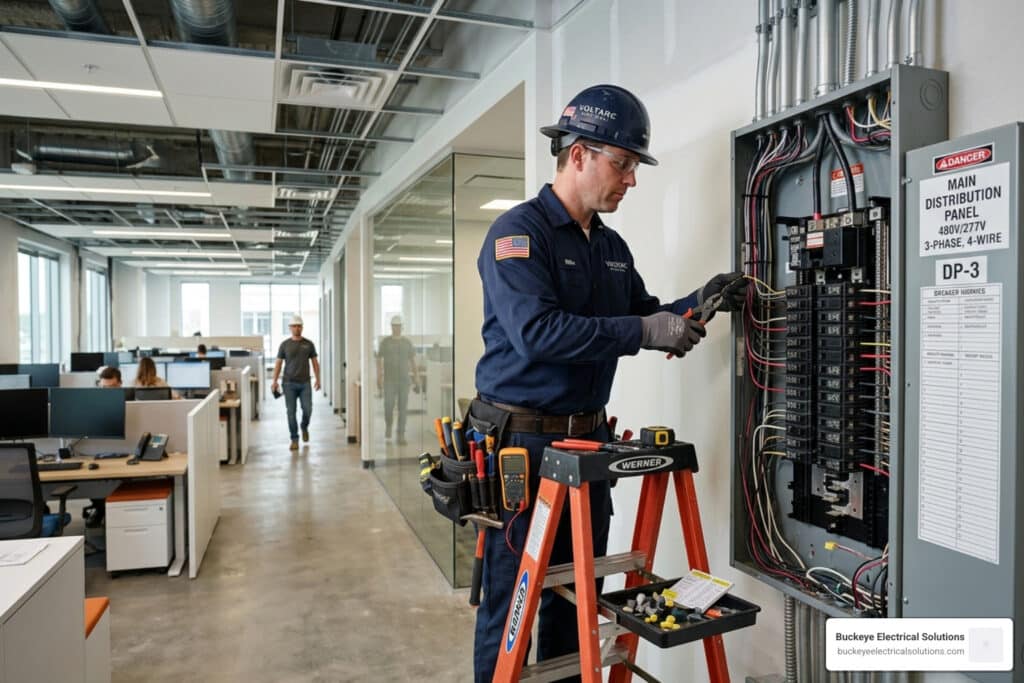
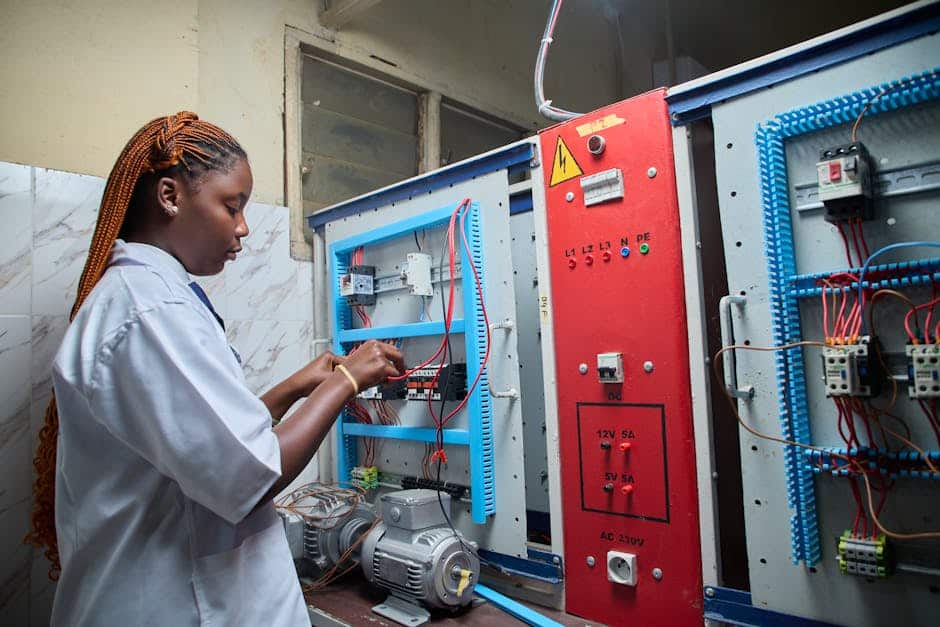
The Career That Keeps Industry Running: What You Need to Know
An industrial electrical technician is a skilled trades professional who installs, maintains, and repairs high-voltage electrical systems inside manufacturing plants, power stations, and large industrial facilities.
Here’s a quick snapshot of what this career looks like:
| Factor | Details |
|---|---|
| What they do | Install, troubleshoot, and maintain industrial electrical systems |
| Key equipment | PLCs, VFDs, motors, control panels, robotics |
| Education needed | Vocational training, apprenticeship, or associate degree |
| Avg. base salary | $65,000 – $85,000/year (can exceed $100,000 with overtime) |
| Job growth | 11% projected through 2033 |
| Work settings | Factories, processing plants, power stations, mines |
Manufacturing facilities across the U.S. are racing to automate and modernize. That’s created enormous demand for people who can work with complex electrical systems at scale. One experienced technician described a typical shift as anything but routine: troubleshooting conveyor faults, programming a PLC, and calibrating instruments — sometimes all before lunch.
This guide walks you through everything — from what the job actually involves, to how to get trained, to what you can expect to earn.
I’m Aaron, owner of Buckeye Electrical Solutions and a licensed master electrician with hands-on experience across dozens of permitted electrical projects in Northeast Ohio. While my company specializes in residential and commercial work, understanding the full landscape of electrical careers — including the industrial electrical technician path — is something I’m deeply familiar with as a professional in this trade.
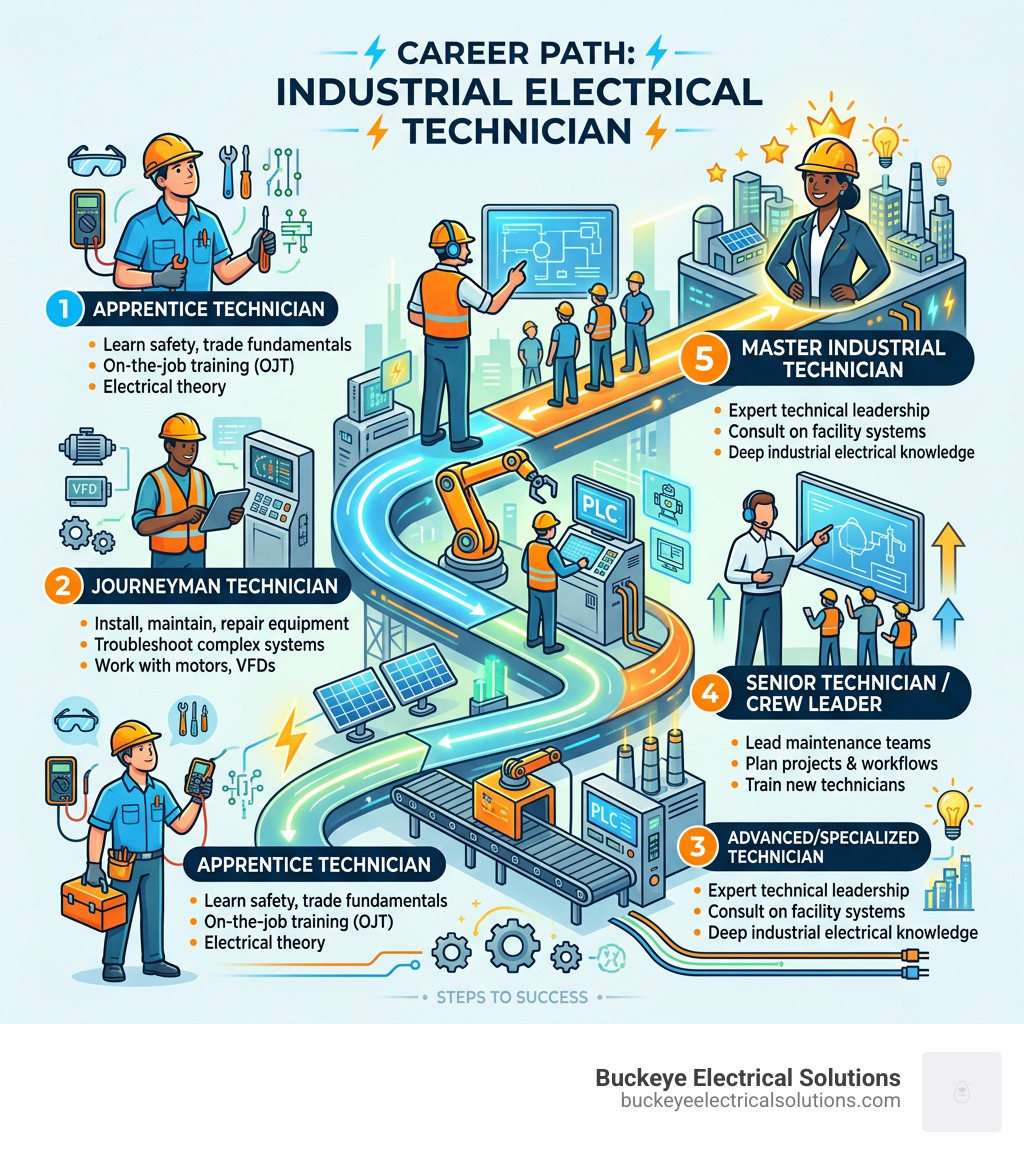
What is an Industrial Electrical Technician?

When most people think of an electrician, they picture someone fixing a light switch in a kitchen or wiring a new office building. While those are vital roles, the industrial electrical technician operates on a completely different scale. These professionals are the backbone of American production, ensuring that the massive machines that make our food, cars, and electricity never stop moving.
In the industrial world, the stakes are incredibly high. A single electrical fault in a manufacturing plant can cost a company tens of thousands of dollars per minute in lost production. Because of this, the role is heavily focused on specialized troubleshooting and preventive maintenance.
While we at Buckeye Electrical Solutions take pride in our Residential Electrical Services and Commercial Electrical Services, the industrial side of the trade requires a unique set of skills tailored to high-voltage environments and automated machinery.
| Feature | Residential | Commercial | Industrial |
|---|---|---|---|
| Primary Voltage | 120V / 240V | 120V / 208V / 480V | 480V up to 13.8KV |
| Wiring Method | Romex / Plastic Box | EMT Conduit / Metal Box | Rigid Conduit / Cable Trays |
| Main Focus | Lighting & Appliances | Power Distribution & HVAC | Automation & Heavy Machinery |
| Complexity | Moderate | High | Very High (PLCs/Robotics) |
The Scale of Industrial Systems
Industrial environments utilize three-phase power, which is much more efficient for driving large motors than the single-phase power found in homes. Technicians frequently work with 480V systems, but in large plants or power stations, they may handle medium-voltage systems reaching up to 13.8KV.
The challenge is often compounded by early 20th century infrastructure. Many factories in regions like Ohio have electrical systems that have been pieced together over decades. An industrial electrical technician must be able to bridge the gap between vintage switchgear and modern digital controllers.
Core Responsibilities and Specialized Equipment
A day in the life of an industrial electrical technician is rarely predictable. You might start your morning performing a routine thermal scan of a transformer and end it deep inside the logic of a robotic welder.
The primary goal is uptime. To achieve this, technicians rely on:
- Preventive Maintenance (PM): Regularly checking Motor systems to ensure conveyors, pumps, and compressors are running efficiently.
- Reading Schematics: Technicians must be experts at interpreting wiring diagrams and technical manuals to trace faults through miles of wire.
- Instrumentation and Sensors: Calibrating the “eyes and ears” of the factory—thermocouples, flow meters, and pressure transducers that feed data back to the control system.
Automation and Control Systems
Modern industry is synonymous with automation. This is where the “technician” part of the title really shines. You aren’t just pulling wire; you are managing the brains of the operation.
- PLCs (Programmable Logic Controllers): These are the computers that control the machines. Technicians use “ladder logic” to troubleshoot why a machine isn’t completing its cycle.
- VFDs (Variable Frequency Drives): These devices control the speed of AC motors. Knowing how to program and repair them is a premium skill.
- Robotics: Maintaining the electrical components of robotic arms and automated guided vehicles (AGVs).
Safety is the absolute priority when working with these powerful systems. Technicians must strictly follow lockout/tagout procedures to ensure machinery cannot be energized while being serviced. All work must comply with the National Electrical Code (NEC) and NFPA 70E standards for arc flash safety.
The Roadmap: Training and Certification
Because the construction industry is booming and manufacturing is seeing a resurgence, there are multiple ways to enter this field. In Ohio, the path typically involves a mix of formal education and documented hands-on experience.
Educational Pathways for the Industrial Electrical Technician
- Trade Schools and Community Colleges: Many students opt for a two-year associate degree in Industrial Electrical Technology or Mechatronics. These programs often cost between $15,000 and $30,000, but federal Pell Grants can provide up to $7,395 annually to help cover expenses.
- Union Apprenticeships: This is the “earn-while-you-learn” model. A typical program involves 8,000+ hours of paid on-the-job training (OJT) and 800+ hours of classroom instruction over 4 to 5 years.
- Certifications: Beyond a state license, many technicians pursue ETA (Electronics Technicians Association) certifications or specialized PLC training to command higher wages.
With 7% job growth projected for electricians generally, and even higher for industrial specialists, the investment in training pays off quickly. Quality trade school programs boast job placement rates above 85%.
Essential Skills for an Industrial Electrical Technician
It takes more than just knowing how to use a multimeter. To succeed, you need:
- Critical Thinking: When a million-dollar line stops, you have to systematically isolate the problem under pressure.
- Math Skills: A solid grasp of algebra and trigonometry is essential for calculating electrical loads and understanding alternating current (AC) theory.
- Cybersecurity Awareness: As factories become more connected, cybersecurity continues to grow as a concern. Technicians now need to understand how electrical networks can be vulnerable to hacking.
- Physical Dexterity: You’ll need to work with small components, climb ladders, and often work in tight or hot spaces.
Career Outlook, Salary, and Future Trends
The financial rewards for an industrial electrical technician are significant. Because the work is more complex and dangerous than standard residential wiring, industrial electricians often earn 20% more than their commercial counterparts.
- Salary Range: Base salaries typically fall between $65,000 and $85,000. However, because industrial plants often run 24/7, overtime is abundant. It is very common for experienced technicians to earn over $100,000 annually.
- Job Outlook: The BLS projects 11% growth for industrial-specific roles through 2033. Manufacturing hubs, particularly in the Midwest and Ohio, offer significantly more opportunities than other regions.
- Specialization Premiums: Technicians who specialize in robotics, instrumentation, or high-voltage switchgear can see a 15-25% bump in their base pay.
Emerging Technologies in Industry 4.0
The role is evolving from “wrench-turner” to “systems analyst.” The growth of the power generation field is driving a need for technicians who can integrate solar and wind-powered systems into existing factory grids.
We are also seeing the rise of the Industrial Internet of Things (IIoT). Sensors now provide real-time data to a technician’s tablet, allowing for predictive maintenance—fixing a motor because the data shows it’s about to fail, rather than waiting for it to smoke.
Frequently Asked Questions about Industrial Electrical Technicians
What is the difference between an industrial and commercial electrician?
The main differences are the environment and the equipment. Commercial electricians work in offices, retail stores, and schools, focusing on lighting, power outlets, and standard HVAC. Industrial technicians work in factories and plants, dealing with high-voltage machinery, complex automation (PLCs), and environments that may involve hazardous chemicals or extreme temperatures.
How much does an industrial electrical technician earn?
In today’s market, the national average ranges from $39,550 to $95,940. In manufacturing-heavy areas like Northeast Ohio, the average base is often higher, around $66,624, with total compensation frequently exceeding $90,000 once overtime and bonuses are included. Lead or supervisor roles can reach $120,000.
What are the physical demands of the job?
It is a physically demanding career. You must be comfortable working at heights (on lifts or catwalks) and in confined spaces. You may need to lift up to 50 lbs regularly and stand for long periods. Color vision is also a requirement, as you must be able to distinguish between colored wires to prevent dangerous mistakes.
Conclusion
The path to becoming an industrial electrical technician is challenging, but it offers a level of job security and financial reward that few other trades can match. Whether you are troubleshooting a legacy motor from the mid-century or programming a cutting-edge robotic arm, you are doing the work that keeps our world moving.
At Buckeye Electrical Solutions, we are passionate about the electrical trade in all its forms. While we focus our expertise on providing the best residential and commercial Our Services in Northeast Ohio, we know that a strong industrial sector is what keeps our local economy thriving.
If you’re looking for an expert team to handle your commercial or residential electrical needs with the same precision and safety standards required in the industrial world, we are here to help. Our 20+ years of experience in the Ohio market ensures that every project we touch is completed promptly and to the highest code standards.