
Introduction: From Flickering to Fixed
Broken light switch repair is often simpler than homeowners expect—in most cases, you’ll turn off the power at your breaker, remove the old switch, connect a few wires to a new one, and restore power in under an hour. The process requires basic tools, careful attention to safety, and a willingness to work methodically through a few straightforward steps.
Quick Answer: How to Repair a Broken Light Switch
- Turn off power at the circuit breaker and verify with a voltage tester
- Remove the switch plate and unscrew the old switch from the electrical box
- Disconnect the wires from the old switch (note their positions first)
- Connect the wires to your new switch—black (hot) wires to brass screws, white (neutral) to silver, green/bare (ground) to green screw
- Secure the switch back into the box, attach the plate, and restore power
- Test your work by flipping the switch on and off
Many homeowners find their light switch needs replacing when they notice warning signs: flickering lights, unusual buzzing or crackling sounds, a warm switch plate, or visible discoloration. These symptoms can indicate loose wire connections, worn internal components, or even a potential fire hazard that demands immediate attention. According to research from multiple electrical safety sources, a switch making audible buzzing sounds or that is warm to the touch should be attended to immediately by shutting off the circuit breaker, as such a switch could pose a fire hazard.
The good news? Common light switches typically cost less than $10, making replacement far more practical than attempting repairs. Because switches endure thousands of on-off cycles over their lifetime, wear and tear is inevitable—but the fix is both affordable and achievable for most DIYers with basic electrical knowledge.
I’m Aaron, and I’ve led Buckeye Electrical Solutions through dozens of residential electrical projects across Northeast Ohio, including countless broken light switch repair jobs that range from simple replacements to complex three-way switch installations. Whether you’re tackling this repair yourself or deciding when to call a professional, understanding the process will help you make safe, informed choices about your home’s electrical system.
Is Your Light Switch Really Broken? Signs and Safety First
Before we grab our tools and dive into broken light switch repair, it’s crucial to correctly diagnose the problem. Sometimes, what seems like a broken light switch might be a simpler issue with the bulb or fixture. But often, the switch itself is indeed the culprit, and it will give us some clear signals.
So, what are the common signs that a light switch is broken or malfunctioning?
- Flickering Lights: If your lights flicker when you operate the switch, or even when they’re supposed to be steadily on, it’s a strong indicator of an internal issue with the switch or loose wiring.
- Buzzing or Crackling Sounds: A switch making unusual noises such as crackling or buzzing is a serious red flag. These sounds can be symptomatic of loose wire connections or potential defects in the wiring that require immediate attention. Our research shows that a switch making audible buzzing signs should be attended to immediately by shutting off the circuit breaker.
- Warm Switch Plate or Discoloration: If your switch feels warm to the touch, or you notice discoloration or scorching on the switch plate, it may be a sign of overheating. This condition could point to a circuit that is carrying too much load or connections within the wire that have become loose. Overheating switches pose a significant fire hazard and must be addressed promptly.
- Temperamental Operation: Does the light only turn on or off if you jiggle the switch, or does it require multiple attempts? This “temperamental” behavior suggests the internal mechanism is failing.
- Sparking: While a tiny, momentary spark when flipping a switch on or off might be normal, consistent or large sparks are a sign of a serious problem, potentially arcing within the switch or a short circuit. This is a fire and shock hazard.
- Circuit Breakers Constantly Tripping: If the circuit breaker controlling the light switch frequently trips, it could indicate an overload, a short circuit, or a faulty switch drawing too much power.
- No Response: The most obvious sign – the switch does nothing at all. The light simply won’t turn on or off, even after trying a new bulb.
Before assuming the switch is bad, we always recommend checking the light bulb first. A loose or burnt-out bulb is a common, easy fix. If that doesn’t work, ensure the light fixture itself isn’t faulty by testing it with a known working bulb. Only after these basic checks should we proceed with inspecting the switch.
Essential Safety for Broken Light Switch Repair
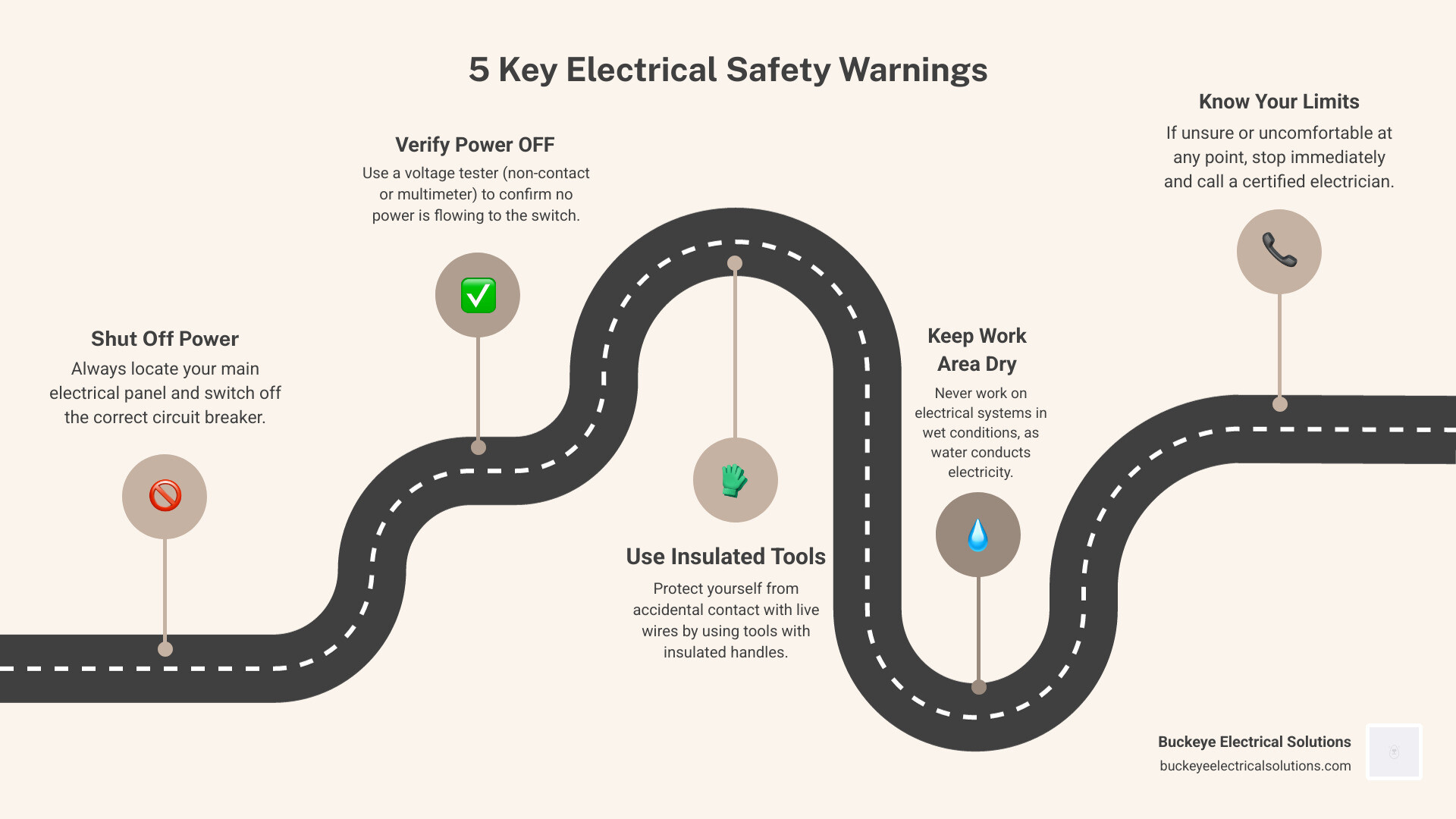
When dealing with electricity, safety is paramount. We cannot stress this enough: never work on an energized circuit. The safety precautions we must take before attempting to repair or replace a light switch are non-negotiable.
Here’s how we ensure safety:
- Turn Off Power at the Circuit Breaker Panel: This is the first and most critical step. Locate your home’s main electrical panel, typically found in a basement, garage, utility closet, or outside. Inside, you’ll see a row of circuit breakers.
- Identify the Correct Breaker: We need to pinpoint the specific breaker that controls the light switch you’re working on. Often, panels are labeled, but if not, you might need to flip breakers one by one until the light goes out. A good tip is to have a helper observe the light while you flip breakers. For more details on understanding your panel, you can learn how to find the right breaker in your panel.
- Flip the Breaker to the “OFF” Position: Once identified, firmly switch the breaker to the off position.
- Mark the Breaker: It’s a good idea to mark the breaker switch with tape or a note to ensure no one else accidentally turns it back on while you’re working. We often tell our clients to put a piece of electrical tape over the breaker switch.
- Verify Power is OFF with a Voltage Tester: Even after flipping the breaker, we must never assume the power is off. Use a non-contact voltage tester (or a multimeter) to confirm there is no power at the switch. Touch the tester to the switch terminals and any exposed wires. If the tester doesn’t light up or beep, you’re good to go. If it does, stop immediately and re-evaluate your breaker choice.
Failing to follow these steps puts us at risk of electrical shock, which can cause severe injury or even be fatal. It’s simply not worth the risk.
Potential Hazards of a Faulty Switch
Beyond the inconvenience of a non-functioning light, a faulty light switch poses several significant hazards to our homes and families in Northeast Ohio. These dangers are why prompt broken light switch repair is so important:
- Fire Risk: Overheating switches, often due to loose connections or an overloaded circuit, can generate enough heat to ignite surrounding insulation or framing materials. Arcing (electrical discharge between connections) is another common cause of electrical fires. Signs like warmth, scorching, or buzzing are direct warnings of this risk.
- Electrical Shock: Exposed wires, damaged insulation, or a failing switch mechanism can lead to live components being accessible, increasing the risk of accidental electrical shock to anyone touching the switch or its cover plate.
- Damage to Electrical System: A faulty switch can cause short circuits or overloads, which, while hopefully tripped by a breaker, can still put undue stress on our home’s wiring and other electrical components over time. This can lead to premature failure of other devices or even more widespread wiring problems.
- Inoperative Safety Devices: In some cases, a faulty switch might be indicative of a larger wiring issue that could impact other safety devices like ground fault circuit interrupters (GFCIs) or arc fault circuit interrupters (AFCIs).
Mitigating these hazards begins with vigilance. If we notice any of the warning signs discussed earlier, we act immediately by shutting off power to the circuit and either addressing the issue safely or calling in a professional.
Gather Your Tools and the Right Replacement Switch
Before we begin our broken light switch repair, having the right tools and materials ready will make the job much smoother and safer.
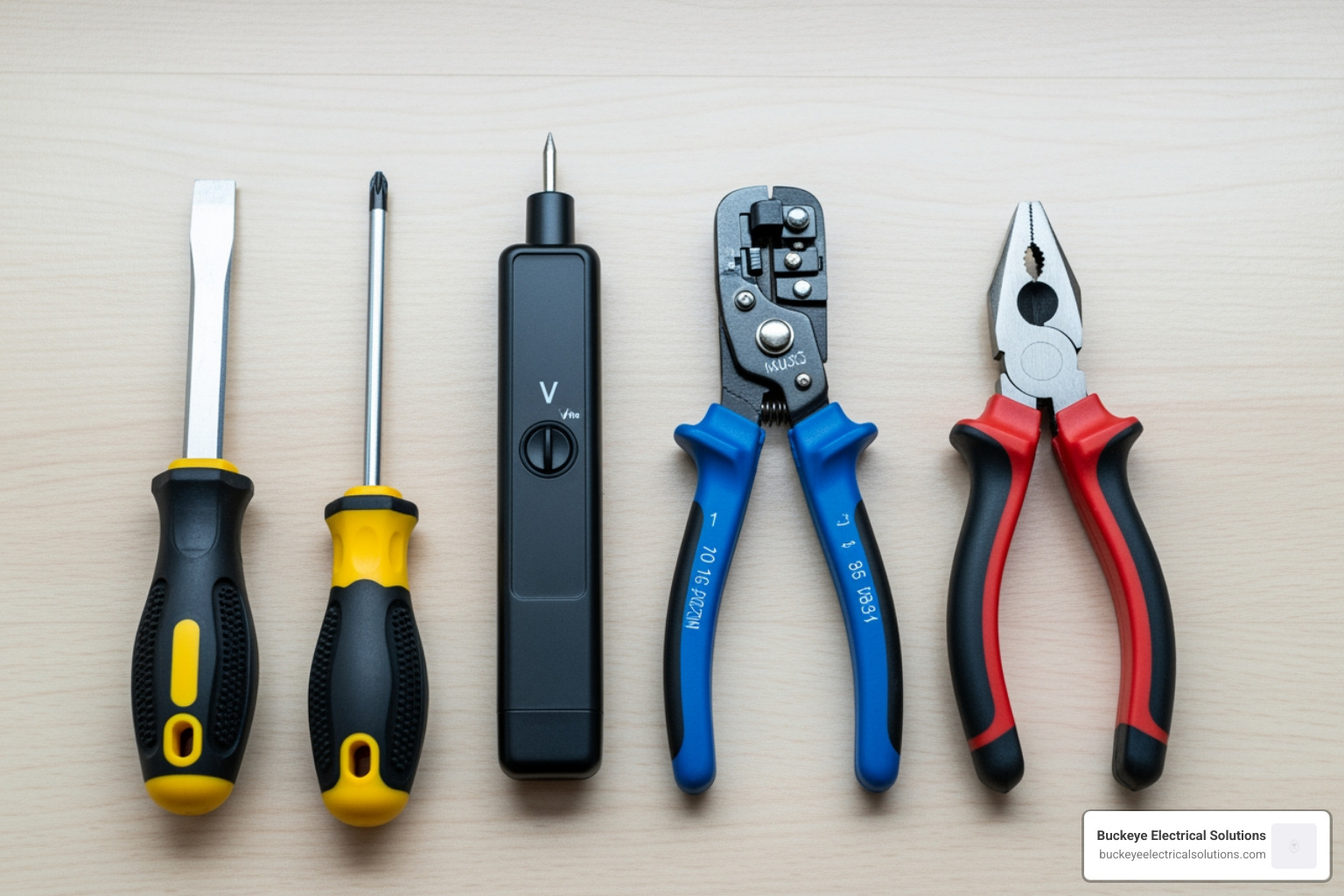
Here’s what we’ll typically need:
- Flat-head and Phillips-head screwdrivers: For removing the switch plate and mounting screws, and for connecting wires to screw terminals.
- Non-contact voltage tester (or multimeter): Absolutely essential for verifying the power is off.
- Wire strippers/cutters: For stripping insulation from wires and trimming frayed ends.
- Needle-nose pliers: Useful for bending wires into loops to connect to screw terminals.
- Electrical tape: For marking wires (especially in three-way/four-way switches) and insulating connections if needed.
- Utility knife or razor blade: Helpful if the switch plate has been painted over.
- New light switch: The correct type and style for your needs.
- New wall plate: If the old one is damaged or you want a fresh look.
Identifying Your Switch Type
One of the most critical steps in broken light switch repair is identifying the type of switch you need to replace. Swapping a single-pole switch with a three-way switch, for example, won’t work!
Here’s how to identify them by looking at the old switch’s terminals (after the power is safely off, of course):
| Switch Type | Description |
|---|---|
| Single-pole | The most common type of light switch, used to control a light from one single location. It has two brass-colored terminals (or two light-colored terminals and one green/bare terminal). |
| Three-way | Used to control a single light from two separate locations (e Example: Top and bottom of a stairway). Has three brass-colored terminals (or three light-colored terminals and one green/bare terminal). One terminal will be marked as “common” (often darker or on its own). |
| Four-way | Used in conjunction with two three-way switches to control a single light from three or more locations. Has four brass-colored terminals (or four light-colored terminals and one green/bare terminal). |
| Dimmer | Replaces a standard switch to allow adjustment of light intensity. Can be single-pole or three-way. Often has wire leads instead of screw terminals. |
| Smart Switch | Replaces a standard switch to allow remote control via Wi-Fi, voice commands, or scheduling. Can be single-pole, three-way, or dimmer. |
The easiest way to replace an old light switch is to choose a new one of the same model and type. Before purchasing, make sure it will fit in the same switch box as the old one.
Choosing Your Materials
For a standard broken light switch repair, we’ll primarily need:
- Replacement switch: Ensure it’s the correct type (single-pole, three-way, etc.) and that its amp and voltage ratings match or exceed those of the old switch. For example, most dimmer switches can handle 600 watts of power. If you have aluminum wiring in an older Northeast Ohio home, be sure to get a replacement switch marked ‘CO/ALR’ to prevent fire hazards.
- Wire connectors (wire nuts): If your new switch uses wire leads instead of screw terminals (common with dimmers), or if you need to re-splice any connections.
- Electrical tape: For insulation and marking.
- New wall plate: Optional, but a fresh plate can give a nice finish.
The Step-by-Step Guide to Your Broken Light Switch Repair
Now that we understand the signs, safety, and necessary materials, let’s get to the heart of broken light switch repair. We’ll walk through the process step-by-step.
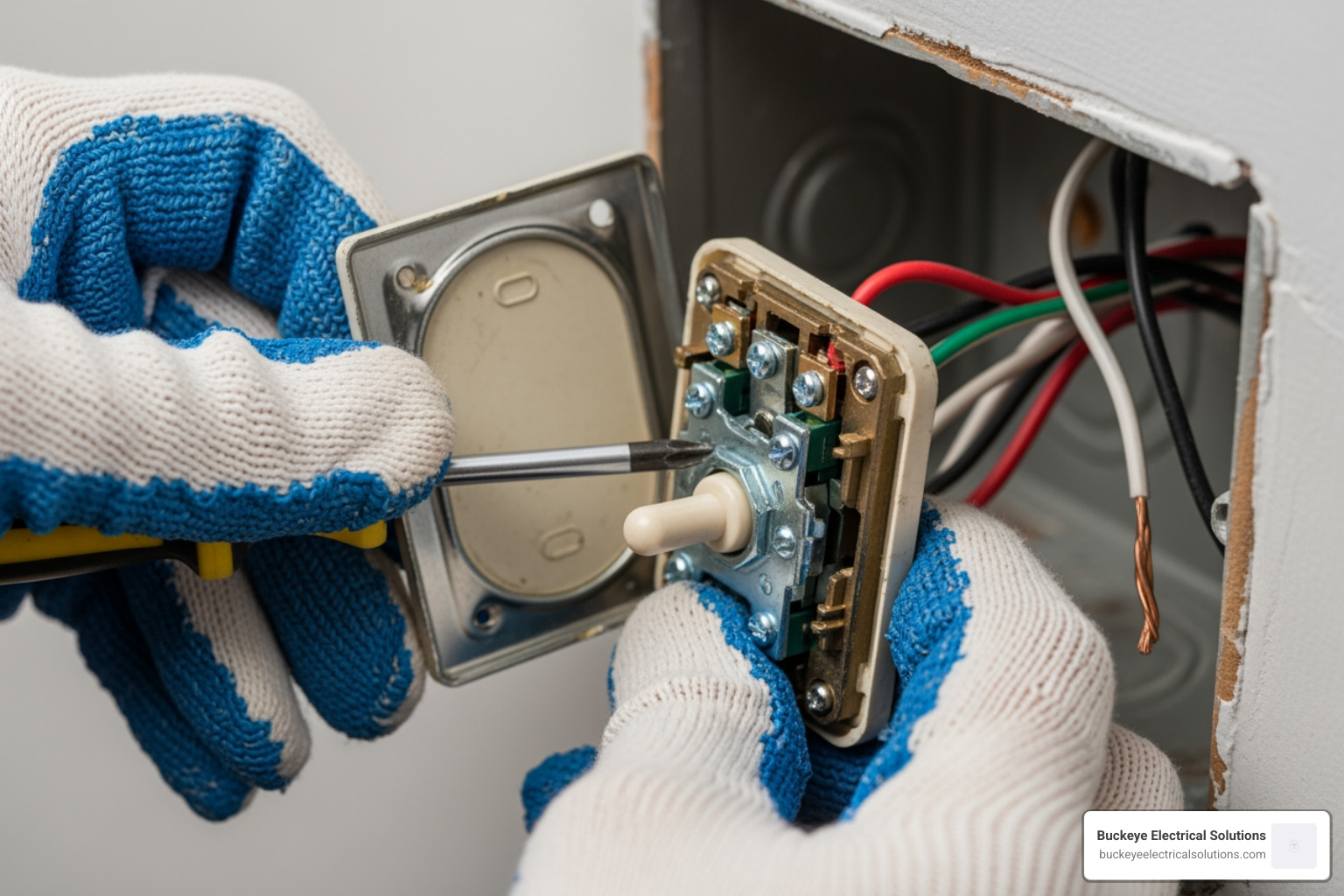
Step 1: Shut Down Power and Verify
This is the most critical step, and we’re reiterating it for a reason!
- Locate Your Breaker Box: Find your home’s electrical panel.
- Identify and Flip the Correct Breaker: As discussed, carefully find the breaker that controls the light switch circuit and flip it to the “OFF” position. Mark it with tape.
- Verify Power is OFF: Go back to the light switch. Try flipping it on and off – the light should not come on. Next, use your non-contact voltage tester on the switch and any exposed wires to confirm there is absolutely no power. If you’re not familiar with using an electrical tester, you can refer to our DIY Basics video, How Do I Use a Multimeter? for help.
Step 2: Remove the Old Switch Plate and Switch
With the power confirmed off, we can now safely access the switch.
- Remove the Switch Plate: Unscrew the two small screws holding the wall plate in place. If the wall plate has been painted over, use a utility knife to carefully score around the edges to prevent chipping paint or wallpaper.
- Unscrew the Switch: The switch itself is held in the electrical box by two longer screws at the top and bottom. Unscrew these.
- Gently Pull the Switch from the Box: Carefully pull the old switch out from the electrical box. It will still be connected by wires.
- Inspect the Wires: While the switch is out, take a moment to inspect the existing wires. Are they brittle, frayed, or discolored? If you find brittle insulation or fraying wires, that part of the circuit should be professionally rewired, and you should stop and call us immediately.
Step 3: Disconnect Wires and Install the New Switch
This is where the actual replacement happens.
- Take a Photo! Before you disconnect any wires, take a clear photo of how the old switch is wired. This is your best guide for connecting the new one, especially for three-way or four-way switches.
- Disconnect Wires from the Old Switch:
- Screw Terminals: Most switches have screw terminals. Use your screwdriver to loosen the screws and unhook the wires.
- Push-in Connectors (Back-wired): Some older or cheaper switches have wires pushed into small holes in the back. These are often called “backstabbers” by electricians and are less reliable. To release them, insert a small flat-bladed screwdriver into the slot next to the wire and push in while pulling the wire loose.
- Prepare Wires (if necessary): If the ends of your wires are frayed, bent, or discolored, use wire strippers to clip off about 1/2 to 3/4 inch of the insulation, exposing fresh copper.
- Connect the Ground Wire: The bare copper or green-insulated wire is the ground wire. It should connect to the green screw terminal on the new switch. Loop the wire clockwise around the screw and tighten it securely.
- Connect the Hot Wires (and Neutrals if present):
- Single-Pole Switches: You’ll typically have two black (hot) wires connected to the two brass-colored screws. It usually doesn’t matter which black wire goes to which brass screw on a single-pole switch.
- Three-Way Switches: This is where your photo is crucial. You’ll have a “common” wire (often black, connected to a darker or differently colored screw) and two “traveler” wires (often red, connected to the other two brass screws). Match these connections exactly to the new three-way switch. Use electrical tape to mark them if your photo isn’t clear enough.
- Four-Way Switches: Even more complex, with four traveler wires. Again, rely heavily on your photo and mark wires carefully.
- White Wires: White wires are typically neutral and are not usually connected to a standard switch unless they have black tape on them, indicating they’re being used as a hot wire (common in switch loops). If a white wire is connected to your old switch, connect it to the corresponding terminal on the new switch.
- Secure Connections: Loop each wire clockwise around its designated screw terminal. Ensure all bare wire is safely under the screw head and tighten the screws firmly. Tug gently on each wire to confirm it’s secure. For connecting wires, you can also watch our video on How Do I Connect Two Wires?.
- Orient the Switch: Ensure the new light switch is oriented correctly. For a toggle switch, the “ON” and “OFF” indicators should be upright, and the switch should be downward in the “OFF” position.
Final Steps in Your Broken Light Switch Repair: Testing and Finishing
We’re almost done!
- Gently Push Wires into the Box: Carefully fold the wires and push the new switch back into the electrical box. Make sure the wires are neatly tucked away and not pinched.
- Secure the New Switch: Use the mounting screws to fasten the switch to the electrical box. Adjust them until the switch is perfectly straight and flush with the wall.
- Attach the New Wall Plate: Screw on the new wall plate. Don’t overtighten, as this can crack the plate.
- Restore Power: Go back to your breaker panel, remove the tape, and flip the circuit breaker back to the “ON” position.
- Test the Switch: Return to the light switch and test its functionality. Flip it on and off multiple times. If it works, congratulations! You’ve successfully completed your broken light switch repair.
When DIY Isn’t the Answer: Calling a Professional
While many broken light switch repair jobs are manageable for homeowners, there are definitely times when it’s necessary to call a professional electrician. Knowing when to step back can save you time, money, and potentially prevent serious hazards.
You should always call a professional electrician if:
- You Encounter Aluminum Wiring: If you find aluminum wiring (silver-colored, not copper) in your electrical box, it requires special attention and often specific ‘CO/ALR’ rated switches. Working with aluminum wiring can be complex and is best left to us, the professionals.
- Signs of Wider Electrical Problems: If you find brittle, frayed, or severely discolored wiring, or if there’s evidence of arcing, burning, or smoke inside the electrical box, this indicates a larger issue than just a faulty switch. We need to assess the integrity of the entire circuit.
- Complex Wiring Situations: While we’ve outlined single-pole, three-way, and four-way switches, troubleshooting complex multi-gang boxes, or situations where the wiring doesn’t match standard configurations, can be tricky. If you’re unsure about the wiring, it’s always safer to call.
- Sparks or Smoke: If your switch sparks, produces smoke, or smells like burning, even after you’ve attempted a repair, shut off the power immediately and contact us. These are clear signs of a dangerous electrical fault.
- Persistent Issues: If the light still doesn’t work after your repair, or if the breaker continues to trip, there’s an underlying problem that needs expert diagnosis.
- Lack of Confidence: If at any point you feel uncomfortable, unsure, or out of your depth, that’s your cue to call a licensed electrician. Your safety and the safety of your home are always our top priority.
- Local Building Codes: In some areas of Northeast Ohio, certain electrical work may require permits or inspections, or must be performed by a licensed electrician. It’s always good to check local regulations.
For any complex electrical issues or if you simply prefer professional assurance, Buckeye Electrical Solutions provides comprehensive Residential Electrical Services throughout Northeast Ohio. We have over 20 years of experience ensuring homes are safe and efficiently powered.
Upgrading Your Switch: Dimmers and Smart Options
Replacing a broken light switch isn’t just about restoring functionality; it’s also an opportunity to upgrade your lighting control!
- Dimmer Switches: Can a dimmer switch be used as a replacement for a standard light switch? Absolutely! Dimmer switches allow you to adjust the brightness of your lights, creating different moods and saving energy.
- Considerations:
- Wattage Rating: Most dimmer switches can handle up to 600 watts of incandescent lighting. Ensure your total bulb wattage doesn’t exceed the dimmer’s rating.
- Bulb Compatibility: Not all dimmer switches work with all types of bulbs. Make sure your dimmer is compatible with incandescent, CFL, or LED bulbs as needed. Low-voltage lighting often requires a special type of dimmer.
- Wiring: Dimmer switches often come with wire leads instead of screw terminals, which means you’ll use wire nuts for connections. They can also be physically larger than standard switches, so you might need to carefully tuck wires into the electrical box.
- Type: Dimmers are available in single-pole and three-way versions, so ensure you choose the correct type for your circuit.
- Considerations:
- Smart Switches: For the tech-savvy homeowner, smart switches offer unparalleled convenience.
- Features: These switches connect to your home’s Wi-Fi network, allowing you to control your lights remotely via a smartphone app, set schedules, or even integrate with voice assistants like Alexa or Google Home.
- Considerations: Installation is similar to a standard switch, but they often require a neutral wire in the electrical box, which older homes in Northeast Ohio might lack. Setup involves pairing the switch with your home’s network.
Whether you’re looking for subtle ambiance or cutting-edge control, a broken light switch repair can be the perfect excuse to improve your home’s lighting experience.
Conclusion: Enjoy Your Newly Repaired Light
Successfully completing a broken light switch repair is a rewarding DIY project that empowers you as a homeowner. We’ve seen how a few basic tools, careful attention to safety, and a step-by-step approach can transform a flickering, buzzing nuisance into a perfectly functioning light. This not only restores convenience but also addresses potential safety hazards.
The most important takeaway is electrical safety. Always verify the power is off before touching any wires, and don’t hesitate to call for professional help if you encounter anything complex or beyond your comfort level.
For complex electrical issues, extensive wiring projects, or any electrical concern where you prefer the peace of mind that comes with expert service, Buckeye Electrical Solutions is here to help. As a trusted electrical contractor in Northeast Ohio, we provide quality residential electrical repair, installation, and maintenance, known for exceptional service and prompt project completion. Don’t let electrical problems dim your day; Contact Us for expert help with all your home’s electrical needs.