
Your Guide to a Cooler, More Comfortable Home
A ceiling fan installation is a great way to improve your home’s comfort and reduce energy costs. This guide will help you decide between a DIY project and hiring a professional, walking you through every step from selection to final testing.
Quick Overview: What You Need to Know
- Safety First: Turn off power at the circuit breaker and verify with a voltage tester.
- Proper Support: Ensure a fan-rated electrical box is installed.
- Tools & Materials: Gather a ladder, screwdrivers, pliers, wire strippers, and a voltage tester.
- Wiring: Follow the standard color-coded connections (black to black, white to white, ground to ground).
- Secure Mounting: Attach the bracket, hang the motor, and install the blades before testing.
- Timeframe: A typical installation with existing wiring takes 2-4 hours.
Ceiling fans can cool a room by 4°F in summer and circulate warm air in winter, cutting down on heating and AC use. Energy Star models are even more efficient. Most fans have reversible motors: counterclockwise for a summer breeze and clockwise to push warm air down in winter.
While a manageable DIY project for those with electrical experience, safety is paramount. Improper wiring can cause fires or electrocution. If you’re unsure about working with electricity, have complex wiring, or high ceilings, hiring a licensed electrician is the safest choice. A professional installation typically costs $100-$300 (plus the fan) and takes 1-4 hours.
At Buckeye Electrical Solutions, we’ve handled countless ceiling fan installation projects across Northeast Ohio. This guide shares our expertise to help you get the job done right.
Before You Begin: Preparation and Safety First
This section covers the essential groundwork for a successful and safe installation, from selecting the right fan to gathering your tools and understanding the electrical safety measures.
Choosing the Right Ceiling Fan for Your Space
Selecting the right fan involves more than just style. Consider your room’s size, ceiling height, and the fan’s intended use for optimal performance and safety.
Room Size Guide: Match the fan’s blade span to your room’s size for effective air circulation.
- Small Rooms (up to 75 sq. ft.): Under 36 inches.
- Medium Rooms (76-144 sq. ft.): 36-42 inches.
- Large Rooms (145-400 sq. ft.): 50-54 inches.
- Extra-Large Rooms (over 400 sq. ft.): 60+ inches or multiple fans.
Ceiling Height and Clearance:
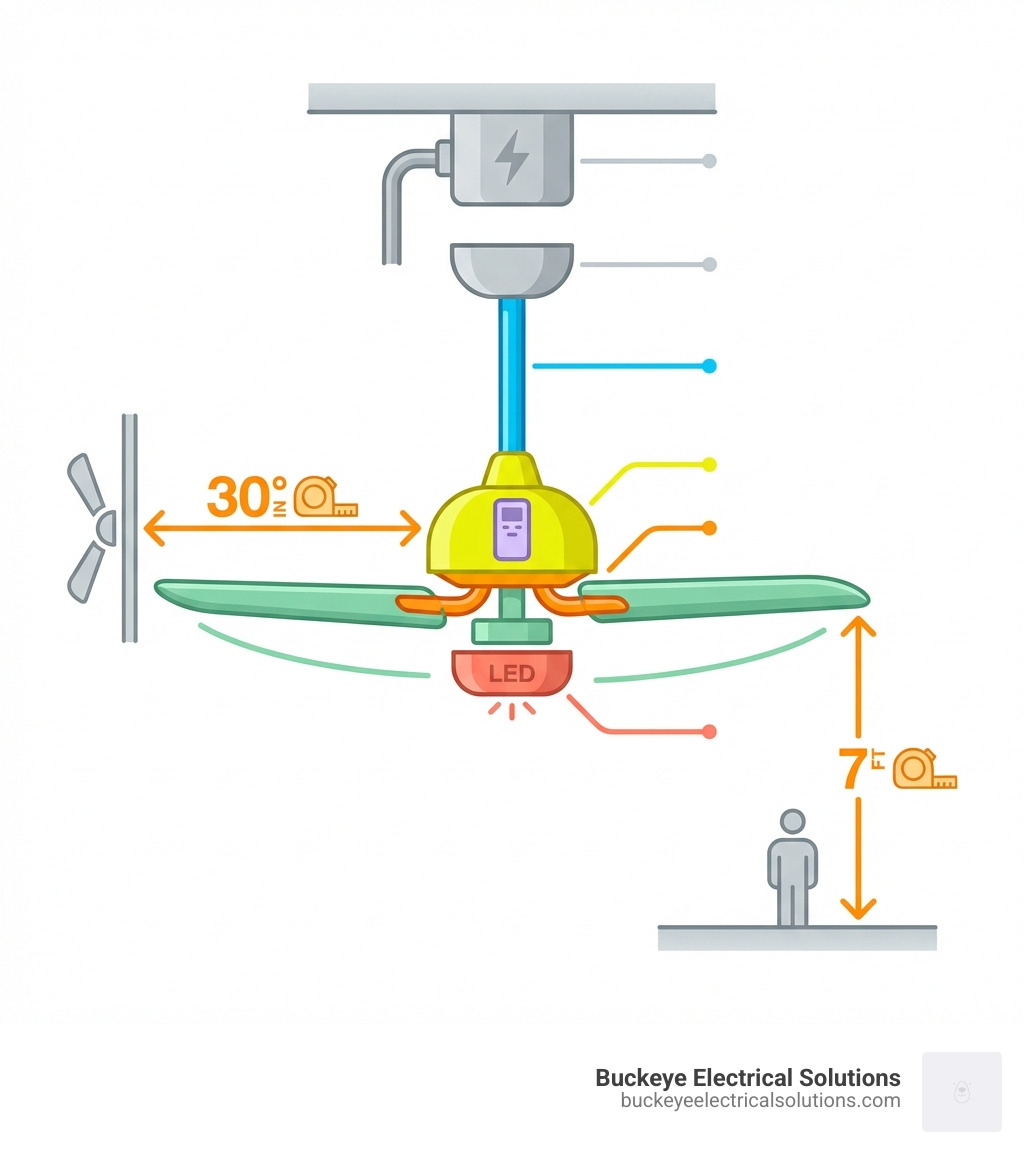
- Minimum Floor Clearance: Blades must be at least 7 feet from the floor.
- Wall Clearance: Blade tips need at least 30 inches of clearance from walls or obstructions.
- Downrod Length: Most fans include a 6-inch downrod for standard 8-9 foot ceilings. Taller ceilings require longer downrods (12+ inches) to lower the fan to an effective height. Angled ceilings may need a special adapter kit.
Special Fan Types:
- Low-Profile “Hugger” Fans: For ceilings under 8 feet, these fans mount flush to maximize headroom.
- Outdoor Damp/Wet Ratings: For porches or patios, use a damp-rated fan in covered areas or a wet-rated fan for locations exposed to rain.
Essential Tools and Materials for Installation
Having these items ready will make your ceiling fan installation smoother and safer.
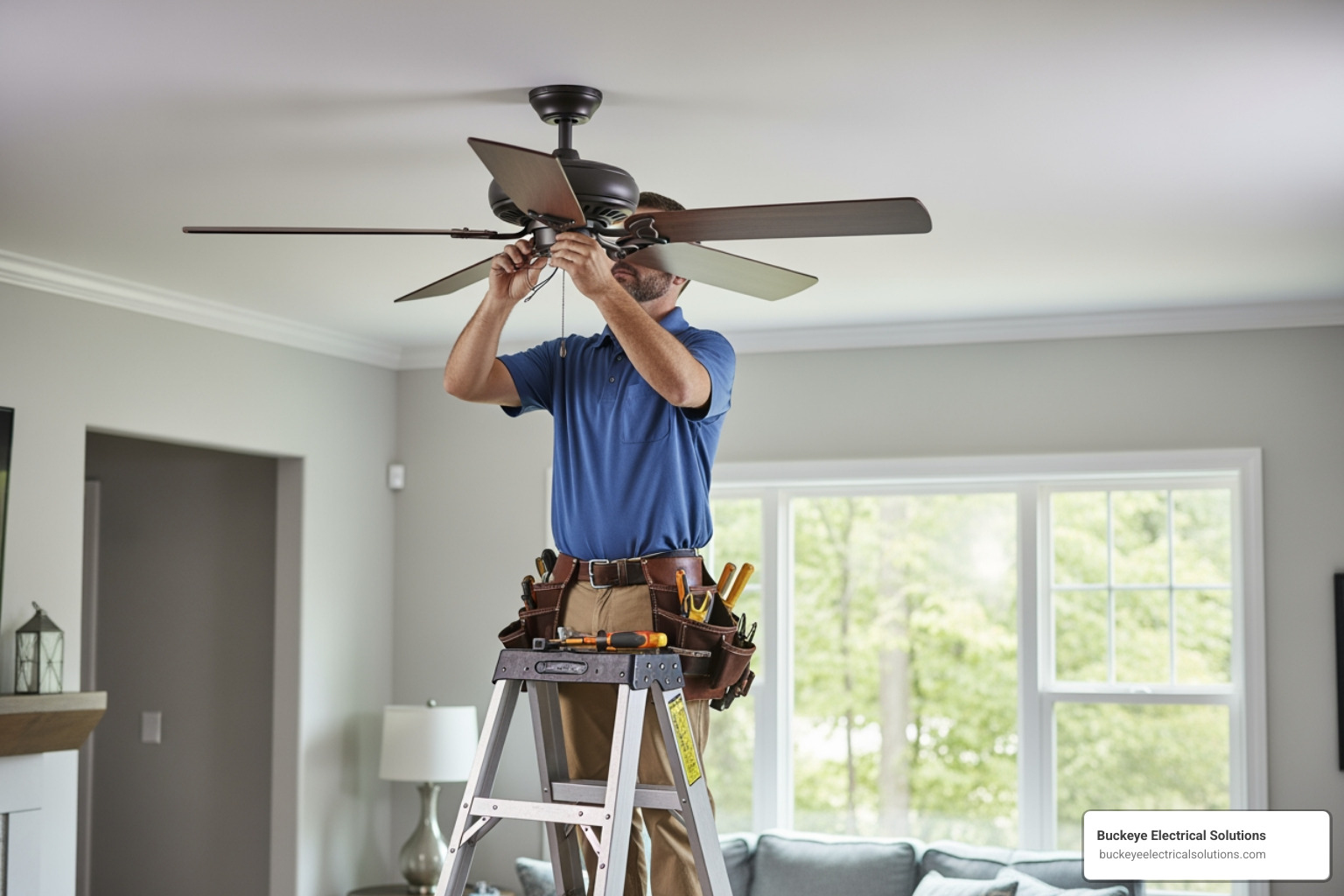
Essential Tools:
- Ladder: To safely reach the ceiling.
- Voltage Tester: To confirm the power is off before touching wires.
- Screwdrivers: Phillips-head and flat-head.
- Pliers: For gripping and cutting wires.
- Wire Strippers: For removing wire insulation.
- Adjustable Wrench or Socket Set: For tightening nuts.
- Blade Balancing Kit: Often included with the fan to fix wobbles.
Necessary Materials:
- Fan-Rated Electrical Box: This is non-negotiable. A standard light fixture box cannot support a fan’s weight and motion. The box should be stamped “Acceptable for Fan Support” and be securely mounted to a ceiling joist or brace.
- Wire Connectors (Wire Nuts): For joining wires.
- Electrical Tape: To secure wire connections.
- New Ceiling Fan: With all its parts and instructions.
Critical Safety Precautions
Your safety is the top priority. Follow these steps carefully.
Turning Off Power:
- Locate Breaker Box: Usually in a basement, garage, or utility closet.
- Identify Breaker: Find the breaker controlling the room’s power. If unlabeled, you may have to test them one by one.
- Flip to “OFF”: Place tape over the breaker to prevent it from being turned back on accidentally.
Verifying Power is Off:
- Use a Voltage Tester: Before touching any wires, use a non-contact voltage tester or multimeter.
- Test Wires: Touch the tester to each wire in the ceiling box. If it beeps or lights up, power is still on. Find the correct breaker.
- Learn More: For help identifying breakers, check out this guide: What’s in My Breaker Box?
Ladder Safety:
- Use a ladder tall enough to avoid overreaching.
- Place the ladder on a flat, stable surface.
- Maintain three points of contact (two feet and one hand, or one foot and two hands).
- Move the ladder instead of leaning too far to one side.
- A helper can improve safety, especially when handling heavy fixtures.
If you are ever unsure, call a professional. At Buckeye Electrical Solutions, we’re here to help homeowners in Northeast Ohio.
The Step-by-Step Ceiling Fan Installation Process
Follow these detailed steps to remove your old fixture and install your new ceiling fan. We’ll guide you through mounting, wiring, and final assembly.
Step 1: Prepare the Installation Site
Proper preparation is key to a smooth ceiling fan installation. This involves safely removing the old fixture and ensuring the electrical box is ready.
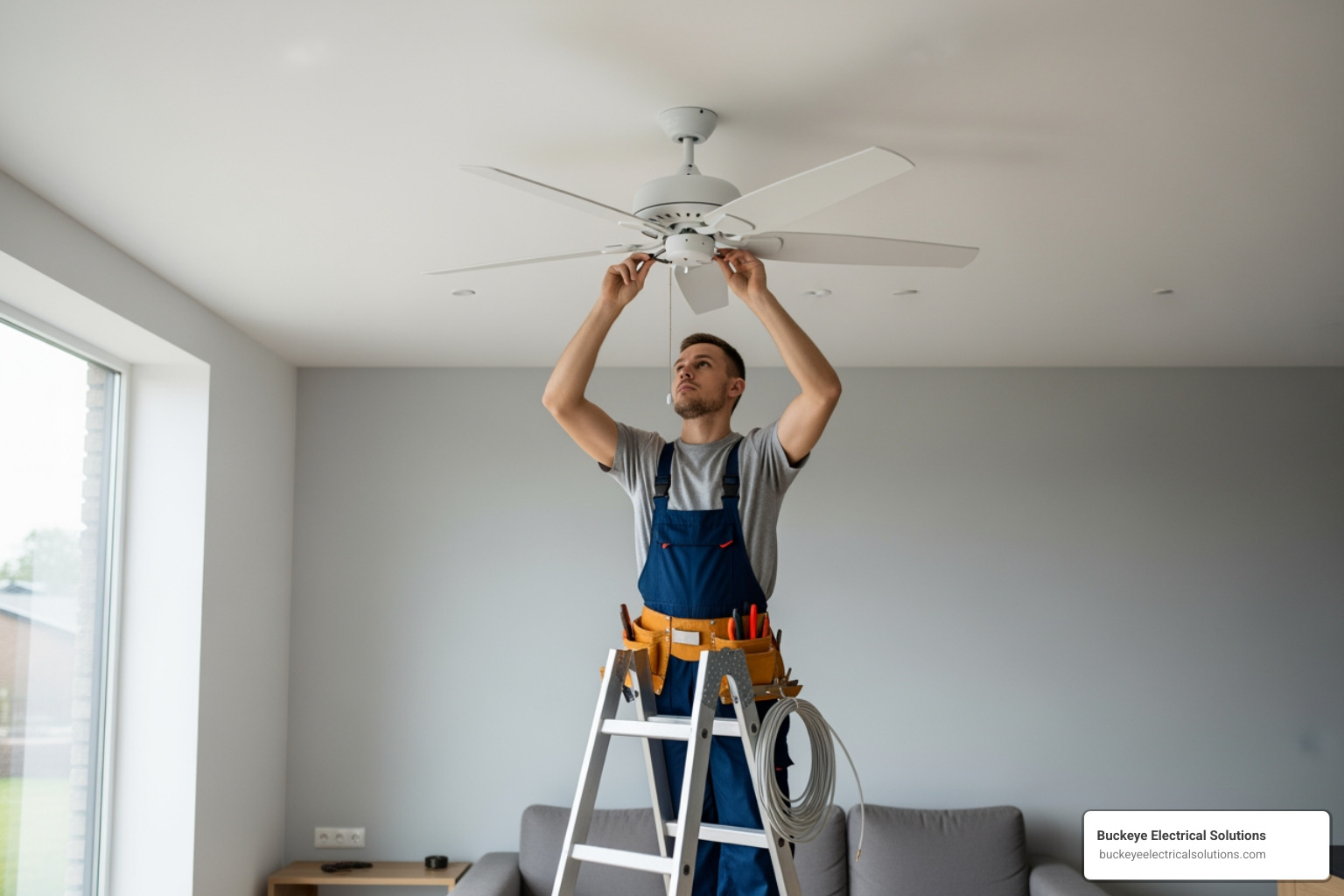
Removing the Old Fixture:
- Confirm Power is Off: Use your voltage tester again.
- Remove Cover: Unscrew the decorative canopy to expose the wiring.
- Disconnect Wires: Note the connections (usually black-to-black, white-to-white) before disconnecting.
- Remove Fixture: Unscrew the old fixture and its mounting bracket. Have a helper for heavy fixtures.
Assess the Electrical Box:
This is a critical safety check. The box must be fan-rated, meaning it’s stamped “Acceptable for Fan Support” and securely attached to a ceiling joist or a brace. A standard light fixture box is not strong enough and must be replaced. An improperly supported fan can fall, causing serious injury. If you’re replacing a light fixture, you will almost certainly need to install a new fan-rated box and brace.
Step 2: Mount the Bracket and Assemble the Fan
With the site prepared, it’s time to mount the new fan.
Install a Fan-Rated Box/Brace (if needed):
If the old box wasn’t fan-rated, install a new one. This typically involves securing an expandable metal hanger bar or a wood brace between ceiling joists and attaching the new fan-rated box to it.
Secure the Mounting Bracket:
- Pull the ceiling wires through the center of the new fan’s mounting bracket.
- Align the bracket with the holes on the electrical box and secure it firmly with the provided screws. It should not wiggle.
Assemble and Hang the Fan:
- Assemble Downrod: Feed the fan’s wires from the motor through the downrod and secure the downrod to the motor housing per the manufacturer’s instructions. Slide the canopy onto the downrod.
- Hang Fan: Lift the motor assembly and seat the hanger ball at the top of the downrod into the mounting bracket. This design lets the fan hang securely while you connect the wires. For a visual, you can reference your fan’s manual or a guide like this: Hanging The Fan – Hunter Regalia II Installation Manual [Page 6].
Step 3: Wiring Your Ceiling Fan Correctly
Take your time with these connections for safe operation.
Wire Identification:
- House Wires: Black (hot), White (neutral), Bare/Green (ground).
- Fan Wires: Black (fan motor), Blue (light kit), White (neutral), Green (ground).
Wiring Steps (Power OFF):
- Ground First: Connect the ground wires from the ceiling, bracket, and fan together with a wire nut.
- Neutrals: Connect the white neutral wire from the ceiling to the white wire(s) from the fan.
- Hot Wires: This depends on your wall switch setup.
- Single Switch: Connect the black hot wire from the ceiling to both the black fan wire and the blue light wire. The fan’s pull chains or remote will control the fan and light separately.
- Dual Switches: This requires two hot wires from the ceiling (e.g., black and red). Connect the black ceiling wire to the black fan wire. Connect the red ceiling wire to the blue light wire.
- Secure Connections: Twist the wire ends together and screw on a wire nut until tight. Gently tug each wire to ensure it’s secure. Wrap with electrical tape for extra security. For a visual guide, see: How Do I Connect Two Wires?
- Tuck Wires: Carefully push all wires into the electrical box.
Step 4: Final Assembly and Testing
Now for the finishing touches.
Attach the Canopy and Blades:
- Slide the canopy up to the ceiling, covering the wiring, and screw it into the mounting bracket.
- Attach the fan blades to the blade irons, then attach the blade assemblies to the fan motor. Tighten all screws securely.
Install the Light Kit (if applicable):
- Connect the light kit’s wiring, often using a simple quick-connect plug.
- Screw the light kit assembly to the fan motor housing.
- Install any glass shades or globes, being careful not to overtighten.
- Screw in the correct wattage light bulbs as specified by the manufacturer.
Test Operation:
- Restore Power: Turn the circuit breaker back ON.
- Pair Remote (if applicable): Follow the manufacturer’s instructions, which usually involve pressing a button on the remote shortly after restoring power.
- Test Everything: Cycle through all fan speeds and test the light. Watch for any excessive wobble. A slight movement is normal, but significant wobbling needs to be addressed.
Congratulations! Your ceiling fan installation is complete.
Troubleshooting Common Installation Problems
Even with a careful installation, you might encounter a few issues. This section helps you diagnose and fix the most common problems.
How to Fix a Wobbly Ceiling Fan
A wobbling fan is often a sign of a loose part and can be unsafe. Here’s how to fix it:
- Tighten All Screws: Systematically check and tighten every screw: blades to blade irons, blade irons to the motor, the downrod assembly, and the mounting bracket to the fan-rated electrical box.
- Check Blade Height: Measure the distance from the ceiling to the tip of each blade. If any blade is more than 1/8 inch off from the others, it can cause a wobble.
- Use the Balancing Kit: Most fans include a balancing kit. Attach the clip to one blade and see if the wobble improves. Test each blade to find the culprit, then move the clip along that blade to find the sweet spot. Replace the clip with a permanent adhesive weight.
- Swap Blades: As a last resort, try swapping two adjacent blades to see if it redistributes the weight more evenly.
Eliminating Noise, Humming, and Grinding
Unwanted noise can often be fixed with a few simple checks.
- Allow a Break-In Period: New fans may have a slight hum that disappears after 24 hours of continuous use.
- Check for Loose Parts: Noise is often caused by loose screws, a loose canopy cover vibrating against the ceiling, or a loose light kit. Re-tighten everything.
- Check Light Bulbs: Ensure light bulbs aren’t touching the glass shades or any other part of the fan.
- Avoid Incompatible Dimmers: Do not use a standard dimmer switch to control fan speed unless the fan is specifically designed for it, as this can cause motor hum. Use the provided controls (pull chain, remote, or compatible wall control).
What to Do if the Fan or Light Won’t Work
If nothing happens when you flip the switch, follow these steps.
- Check the Breaker: Ensure the circuit breaker is in the “ON” position. If it tripped, reset it. If it trips again, there’s a short circuit; turn it off and call an electrician.
- Verify Wire Connections: Turn the power off again. Lower the canopy and double-check that all wire nuts are tight and no wires have come loose. Ensure the quick-connect plugs for the light kit are fully seated.
- Check Remote and Pull Chains: If you have a remote, try fresh batteries and re-pair it with the receiver. If you have pull chains, pull them a few times to ensure they aren’t stuck between settings.
When to Call a Professional for Your Ceiling Fan Installation
While ceiling fan installation can be a rewarding DIY project, some situations require a licensed professional for safety and code compliance.
Signs You Need an Expert for Your Ceiling Fan Installation
Step back and call a pro if you encounter any of the following:
- No Existing Wiring: Installing a fan in a new location requires running new electrical lines, which is a job for a licensed electrician.
- High or Vaulted Ceilings: Working on tall ladders is dangerous. Professionals have the right equipment and experience to work safely at height.
- Old or Complex Wiring: If you find aluminum wiring, knob-and-tube, or wiring that looks deteriorated or confusing, stop and call an expert to avoid fire hazards.
- Discomfort with Electricity: If you feel uncertain at any point, it’s always safer to hire a professional. Your safety is not worth the risk.
At Buckeye Electrical Solutions, we handle all types of residential electrical services, including complex ceiling fan installation projects. See Our Services for how we can help.
Understanding Professional Installation Costs and Benefits
Hiring a pro offers safety, efficiency, and peace of mind.
Typical Cost and Time:
- Cost: Professional installation typically ranges from $100-$300, plus the cost of the fan. The price varies with job complexity.
- Time: A standard replacement takes about 1-2 hours. A new installation requiring wiring can take 3-4 hours.
Benefits of Hiring a Pro:
- Safety and Code Compliance: Electricians ensure your fan is installed according to the latest safety codes, minimizing fire and shock risks.
- Expertise: They can quickly troubleshoot unexpected issues, like inadequate wiring or an unsuitable electrical box.
- Efficiency: A pro will complete the job much faster and more cleanly than a typical DIYer.
- Guaranteed Work: Reputable companies like Buckeye Electrical Solutions stand behind their work, giving you peace of mind.
- No Risk of Injury or Damage: Professionals eliminate the risk of the fan falling, electrical shock, or damage to your home.
For homeowners in Northeast Ohio, our team at Buckeye Electrical Solutions brings over 20 years of experience to every ceiling fan installation. Learn more about our Residential Electrical Services.
Frequently Asked Questions about Ceiling Fan Installation
Can I install a ceiling fan where a light fixture was?
Yes, but it’s critical that you replace the existing electrical box with a fan-rated box. A standard light fixture box is not strong enough to support the weight and motion of a ceiling fan and will fail. The new box must be securely mounted to a ceiling joist or a fan brace.
How do I choose the right size ceiling fan for my room?
Match the fan’s blade span to your room’s square footage for optimal airflow:
- Up to 75 sq. ft.: Under 36 inches
- 76-144 sq. ft.: 36-42 inches
- 145-400 sq. ft.: 50-54 inches
- Over 400 sq. ft.: 60+ inches or multiple fans
Also, ensure blades are at least 7 feet from the floor and 30 inches from any wall.
How long does a typical DIY ceiling fan installation take?
A homeowner with basic electrical skills can typically replace an existing fixture with a fan in 2-4 hours. This assumes you have the right tools and the electrical box is already fan-rated or easily accessible for replacement. Installing a fan in a new location where wiring needs to be run will take significantly longer and is a job best left to a professional.
Conclusion: Enjoy Your Newfound Comfort and Style
A properly installed ceiling fan is a smart investment in your home’s comfort and energy efficiency. By following this guide and prioritizing safety, you can enjoy cooler summers, warmer winters, and lower energy bills.
Electrical work can be dangerous. If you encounter high ceilings, complex wiring, or simply prefer the assurance of a professional, don’t hesitate to call for help. For homeowners across Northeast Ohio, the team at Buckeye Electrical Solutions is ready to ensure your ceiling fan installation is safe, secure, and done right. With over 20 years of experience, we provide residential electrical services you can trust. Contact us today for your residential electrical needs.